Investment Thesis
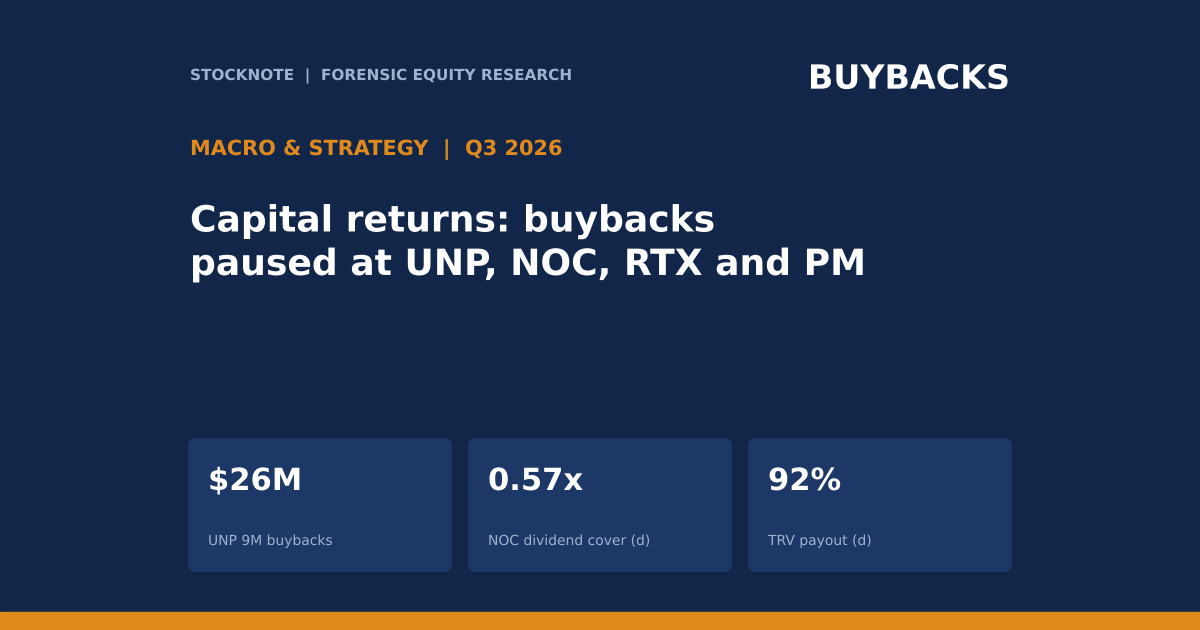
Buybacks are the flexible part of a company's capital return; dividends are the commitment. In the Q3 2026 releases from eight companies, buybacks have been cut sharply or stopped at Union Pacific, Northrop Grumman, RTX and Philip Morris, and halved at Mondelez, while Travelers, Chubb and Schwab continue to return large shares of earnings. This article uses the reported figures to test which payouts the cash flow supports, and what the dividend coverage implies for the next set of decisions.
- Union Pacific. Nine-month buybacks $26M (from $2,679M); operating cash flow minus capex $5,468M (d) covers dividends of $2,484M 2.2x (d).
- Northrop Grumman. Buybacks $68M (from $1,168M); operating cash flow minus capex $594M (d) covers dividends of $1,035M only 0.57x (d).
- Mondelez. Buybacks $845M (from $1,893M); free cash flow $1,659M covers dividends of $1,927M 0.86x (d).
- RTX and Philip Morris. RTX repurchased no shares in the first nine months of 2026; PM guides to no repurchases in 2026.
- Travelers, Chubb, Schwab. Q3 capital returned equals about 92%, 55% and 17% (d) of Q3 net income on the bases described below.
- This article contains no rating, price target or investment advice. Derived figures are marked (d).
Bottom line. The buyback pauses are not uniform signals. At Union Pacific the dividend is well covered and the pause coincides with a pending acquisition; at Northrop and Mondelez, dividends were not covered by nine-month free cash flow, and the buyback was the item that gave way.
Sources: Union Pacific | Northrop Grumman | Mondelez | RTX | Philip Morris | Travelers | Chubb | Schwab.
Q3 2026 At A Glance
| Company | Buybacks 2026 | Buybacks 2025 | Dividends | Period |
|---|---|---|---|---|
| Union Pacific | $26M | $2,679M | $2,484M | 9 months |
| Northrop Grumman | $68M | $1,168M | $1,035M | 9 months |
| Mondelez | $845M | $1,893M | $1,927M | 9 months |
| RTX | $0 | $50M | n/a | 9 months |
| Philip Morris | No repurchases planned | n/a | n/a | 2026 guidance |
| Travelers | $1.508B | n/a | $0.261B (d) | Q3 |
| Chubb | $1.18B | n/a | $393M | Q3 |
| Schwab | $0.5B | n/a | n/a | Q3 |
Sources: company releases. Travelers dividends derived as total capital returned $1.769B less repurchases $1.508B (d).
What The Market Believes vs. What The Data Actually Shows
| Belief | What the data show |
|---|---|
| Strong earnings mean larger buybacks | RTX adjusted EPS rose 33% and Union Pacific's operating cash flow rose 18% (d); both repurchased little or nothing. |
| A dividend is safe if the company is profitable | Northrop's nine-month cash flow covered its dividend 0.57x (d) and Mondelez's 0.86x (d). |
| A buyback pause signals weakness | Union Pacific's pause coincides with a pending acquisition; the extract does not state the link. |
| Insurers over-distribute | Travelers returned about 92% (d) of net income and Chubb about 55% (d), but insurers' earnings are not free cash flow in the industrial sense. |
| The full-year free cash flow guide is safe | Northrop and Mondelez need fourth-quarter free cash flow well above their nine-month run rate. |
Forensic #1: The Buyback Collapse
Share repurchases adjust to cash flow and to other uses of capital such as acquisitions and debt reduction. A buyback that drops by more than 90% against the prior year is a change in policy, not drift.
| Nine months, $ millions | 2025 | 2026 | Change (d) |
|---|---|---|---|
| Union Pacific | 2,679 | 26 | -99% |
| Northrop Grumman | 1,168 | 68 | -94% |
| Mondelez | 1,893 | 845 | -55% |
| RTX | 50 | 0 | -100% |
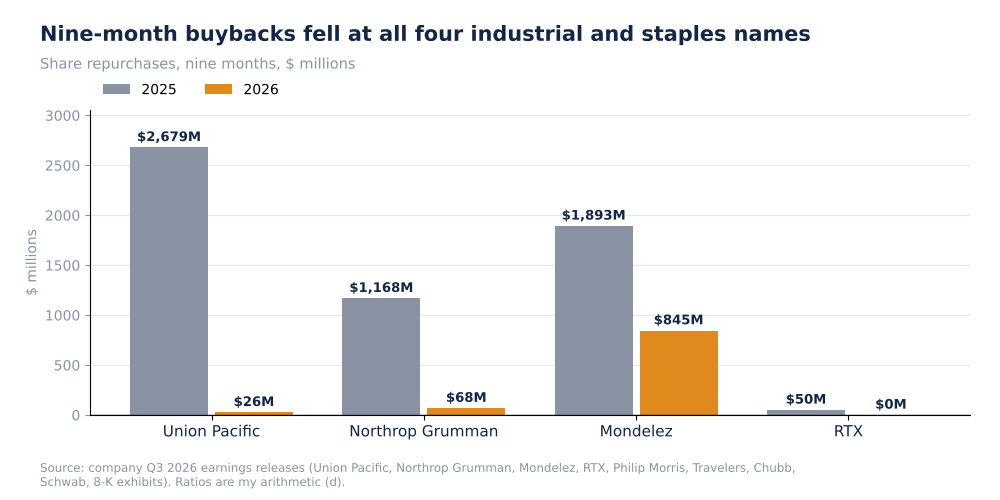
Share repurchases, nine months 2025 vs 2026
The combined drop across Union Pacific, Northrop and Mondelez is $4,801M (d) over nine months. Each company has a different explanation available but only one is stated in the extracts: Union Pacific reports acquisition-related expense for its Norfolk Southern transaction. For the others, the release extracts do not state a reason.
Why it matters. A buyback reduction is a source of cash that can fund the dividend, debt or an acquisition; it is also a headwind to EPS growth that investors had assumed would continue.
Source: company Q3 2026 earnings releases (Union Pacific, Northrop Grumman, Mondelez, RTX, Philip Morris, Travelers, Chubb, Schwab, 8-K exhibits). Ratios are my arithmetic (d).
Forensic #2: Dividend Coverage By Free Cash Flow
| Nine months 2026, $ millions | Free cash flow (d) | Dividends | Coverage (d) | Dividends + buybacks / FCF (d) |
|---|---|---|---|---|
| Union Pacific | 5,468 | 2,484 | 2.20x | 46% |
| Northrop | 594 | 1,035 | 0.57x | 186% |
| Mondelez | 1,659 | 1,927 | 0.86x | 167% |
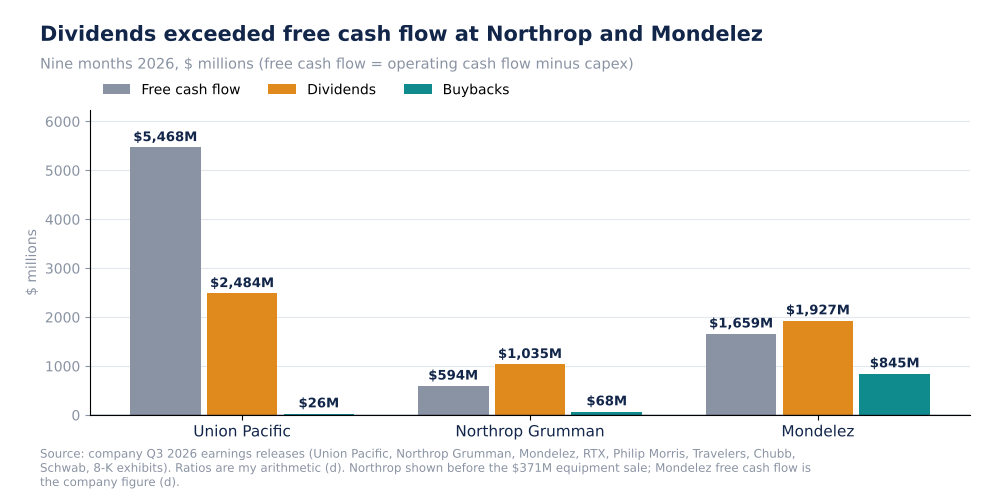
Free cash flow vs dividends and buybacks, nine months 2026
Dividend coverage is free cash flow divided by dividends. Below 1.0x the dividend is funded partly from cash on hand or borrowing, which is sustainable only while the cash flow pattern is temporary. Union Pacific covers its dividend 2.2x (d). Northrop covers only 0.57x (d) on operating cash flow minus capex, and 0.93x (d) using its adjusted figure that includes a $371M equipment sale. Mondelez covers 0.86x (d). Both depend on a large fourth quarter: Northrop's guide implies $2,135M to $2,535M (d) of adjusted free cash flow in Q4, and Mondelez's roughly $3B full-year guide implies about $1,341M (d).
Why it matters. A dividend funded by next quarter's cash flow is a bet on timing; companies with long-cycle contracts or seasonal cash patterns can be below 1.0x at nine months and above it for the year.
Source: company Q3 2026 earnings releases (Union Pacific, Northrop Grumman, Mondelez, RTX, Philip Morris, Travelers, Chubb, Schwab, 8-K exhibits). Ratios are my arithmetic (d).
Forensic #3: Insurers And Brokers Distribute Earnings, Not Free Cash Flow
| Company | Q3 returned | Q3 net income | Share (d) | Basis |
|---|---|---|---|---|
| Travelers | $1,769M | $1,917M | 92% | Buybacks plus dividends |
| Chubb | $1,573M (d) | $2,844M | 55% | Buybacks $1.18B plus dividends $393M |
| Schwab | $500M | $2,906M | 17% | Buybacks only; dividends not in extract |
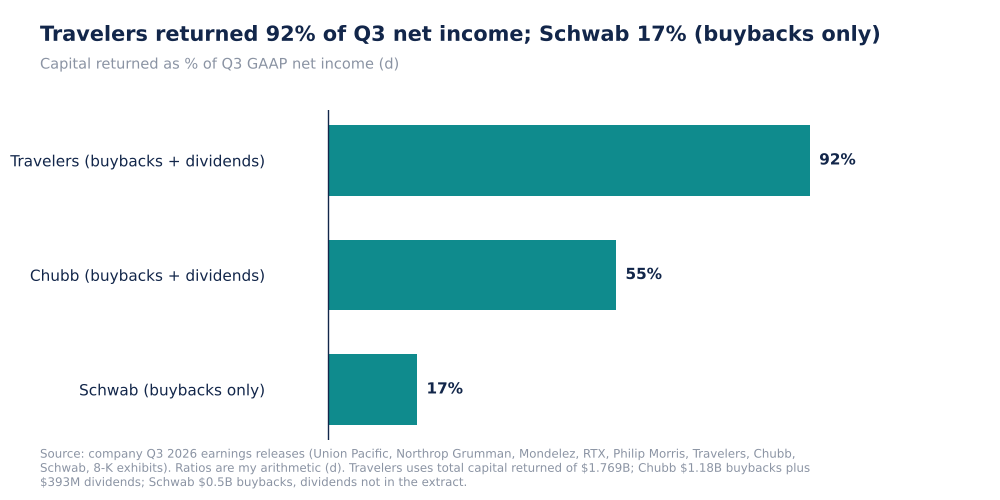
Capital returned as a percentage of Q3 GAAP net income
For financial firms, the limiting factor is regulatory and rating-agency capital, not free cash flow, so payout as a share of earnings is the relevant ratio. Travelers' payout of about 92% (d) of net income is consistent with book value per share being flat year over year ($141.48 vs $141.72) while earnings are high: the company is distributing what it earns. Chubb's lower payout and book value up 5.1% show retention. Schwab's buybacks of $0.5B are small against $2.9B of net income, but its adjusted Tier 1 leverage ratio of 7.0% at the holding company is the limiting measure, not earnings.
Why it matters. A high payout reduces the capital cushion if reserves or investment losses rise; the combination of a high payout and widening gaps between adjusted and reported book value, as at Travelers, is one to monitor.
Source: company Q3 2026 earnings releases (Union Pacific, Northrop Grumman, Mondelez, RTX, Philip Morris, Travelers, Chubb, Schwab, 8-K exhibits). Ratios are my arithmetic (d).
Forensic #4: What Policy Is Not Visible In The Numbers
| Company | Fact stated in release | Fact not stated in extract |
|---|---|---|
| Union Pacific | Acquisition-related expense of $93M year to date | Whether buybacks resume after the deal |
| Northrop Grumman | Backlog up 15%; buybacks $68M | Whether buybacks resume |
| Mondelez | Capital returned $2.8B in nine months; acquisition announced | Price of the acquisition |
| RTX | No repurchases in 2026 | Policy on future repurchases |
| Philip Morris | Guidance excludes share repurchases; net debt to EBITDA near 2.0x | Whether leverage target drives the pause |
The releases supply the outcomes (cash spent) and not the policy. Where a company is deleveraging (PM's net debt to EBITDA target) or acquiring (Union Pacific, Mondelez), a buyback pause is a choice about the best use of cash. Where neither is stated (Northrop, RTX), the extracts do not explain it.
Why it matters. The buyback decision is the leading indicator for cash priorities, and the conference-call commentary and 10-Q liquidity sections are the next place to look.
Source: company Q3 2026 earnings releases (Union Pacific, Northrop Grumman, Mondelez, RTX, Philip Morris, Travelers, Chubb, Schwab, 8-K exhibits). Ratios are my arithmetic (d).
Valuation Snapshot
These are cross-company measures, not security valuations. My sources have no share prices.
| Measure | Union Pacific | Northrop | Mondelez |
|---|---|---|---|
| Dividend coverage, nine months (d) | 2.20x | 0.57x | 0.86x |
| Buyback change vs 2025 | -99% | -94% | -55% |
| Dividends + buybacks / FCF (d) | 46% | 186% | 167% |
What has to be true. For Northrop and Mondelez to maintain their dividends without added debt, fourth-quarter cash flow must be well above the nine-month pace.
Risks: What Would Break The Thesis
- Different free cash flow definitions. I use operating cash flow minus capex for Union Pacific and Northrop, and the company figure for Mondelez.
- Timing. Nine-month cash flow is not the full year.
- Mixed periods. Q3 payout ratios and nine-month coverage ratios are not comparable.
- Unstated policy. Releases do not explain most buyback decisions.
- Data limits. No share prices, no 2025 dividend figures for Mondelez and no Schwab dividend figure in the extracts.
The reading would be wrong if fourth-quarter cash flow at Northrop and Mondelez meets the guidance, which would put full-year coverage near or above 1.0x.
What To Watch Next
- Northrop's fourth-quarter adjusted free cash flow against the implied $2.1B to $2.5B (d).
- Mondelez's fourth-quarter free cash flow against the implied $1.3B (d).
- Any statement from Union Pacific on repurchases after the Norfolk Southern transaction.
- RTX and Philip Morris on whether repurchases resume.
- Travelers' reported book value per share against $141.48.
- Schwab's adjusted Tier 1 leverage against 7.0% (holding company).

Sandeep Gupta
Independent equity research analyst publishing forensic theses on US-listed stocks. MBA, Politecnico di Milano School of Management (Milan, Italy).
Get new research in your inbox
Subscribe to receive forensic equity research the moment it's published. Free, no spam.
Discussion
Be the first to comment.