Investment Thesis
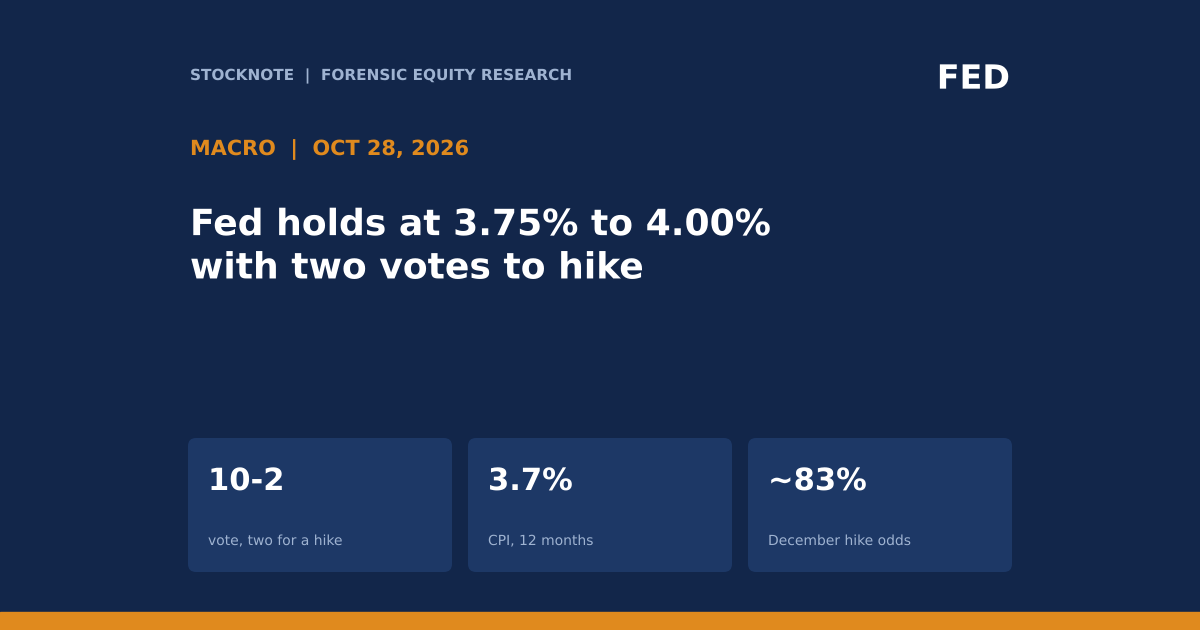
The Federal Reserve left the federal funds target range at 3.75% to 4.00% on October 28, 2026, by a 10-2 vote. Governor Lisa Cook and Cleveland Fed President Beth Hammack both wanted a quarter-point increase. The Fed had raised rates by 25 basis points in September, its first increase since July 2023. The statement upgraded its description of growth to "strong" and said inflation "remains elevated". The September CPI, released two weeks earlier, rose 0.6% on the month and 3.7% over twelve months, while core CPI was 2.6%. This article lays out what the data say about why two voters wanted a hike and what a December decision depends on.
- Decision. Target range held at 3.75% to 4.00%. Vote 10-2, with Cook and Hammack preferring a 25 basis point increase. Next meeting December 8 to 9.
- Statement. Economic activity is expanding at a strong pace (the prior wording was solid, per Kiplinger). Inflation remains elevated. Job gains have kept pace with the workforce and the unemployment rate has changed little.
- Headline CPI. +0.6% in September, +3.7% over twelve months. Energy +5.2% on the month and +20.4% over the year. Gasoline +9.1% on the month and +34.2% over the year.
- Core CPI. +0.3% in September, +2.6% over twelve months. Shelter +3.2%, services less energy services +3.1%, food +2.5%.
- Market pricing. About 83% to 85% probability of a December hike (CME FedWatch via Fox Business, 82.6%; Johnson Investment Counsel via Kiplinger, about 85%).
- Yields at the Oct 28 close. 2-year 4.706%, 10-year 5.024%, 30-year 5.351%. S&P 500 7,743.
- Oil. WTI about $99.99 and Brent about $109.46 on Oct 27, with WTI up roughly 50% since the U.S.-Iran conflict began, according to Kiplinger.
- This article contains no rating, price target or investment advice. Every figure comes from a named source, and anything I calculated is marked (d).
Bottom line. The gap between the 3.7% headline and 2.6% core rates is an energy story, and the Fed's two dissenters are betting that it will not stay an energy story. The September monthly core rate of 0.3% annualises to about 3.7% (d), which is above the 2.6% twelve-month figure, and consumers' twelve-month inflation expectations are 5.8%. The majority is betting that restrictive-enough policy, a weak September jobs report and the fall in quarterly PCE inflation are enough to wait. The market has already sided with the hawks: a December hike is priced at above 80%.
Sources: Federal Reserve press release, Oct 28, 2026; BLS CPI release, Oct 14, 2026; Kiplinger; Fox Business.
October 2026 At A Glance
| Indicator | Latest | Detail |
|---|---|---|
| Federal funds target range | 3.75% to 4.00% | held Oct 28; 25 bp hike in September |
| FOMC vote | 10-2 | Cook and Hammack for a 25 bp hike |
| CPI, all items (Sept) | +3.7% year over year | +0.6% month over month |
| Core CPI (Sept) | +2.6% year over year | +0.3% month over month |
| Energy CPI (Sept) | +20.4% year over year | +5.2% month over month |
| Q3 PCE price index (annualised) | 2.1% | Q2: 5.0% |
| Q3 core PCE (annualised) | 2.5% | Q2: 3.3% |
| 10-year Treasury yield (Oct 28) | 5.024% | 2-year 4.706%, 30-year 5.351% |
| December hike probability | about 83% to 85% | FedWatch 82.6% |
| Consumer 12-month inflation expectations | 5.8% | Conference Board, via Kiplinger |
Sources: Federal Reserve; BLS; BEA; Kiplinger; Fox Business.
What The Market Believes vs. What The Data Actually Shows
| Belief | What the data show |
|---|---|
| Inflation is mainly an energy problem | Core CPI is 2.6% over twelve months, but gasoline and airfares explain the headline gap. The monthly core rate is 0.3%, or about 3.7% annualised (d). |
| Policy is already restrictive | The funds range midpoint of 3.875% is only about 0.2 points above headline CPI (d). The chair said financial conditions have tightened but he is unwilling and unable to call them tight. |
| The Fed is near the end of hiking | Futures price a December hike at over 80%, and the market had at one point priced about four hikes, per Kiplinger. |
| Quarterly PCE shows inflation easing | Q3 PCE inflation was 2.1% annualised against 5.0% in Q2, but September CPI alone annualises to about 7.4% (d). |
| Weak jobs argue for waiting | September payrolls rose 29,000 and unemployment was 4.2%, but the Fed statement says job gains have kept pace with the workforce. |
The common summary is that the Fed is fighting an oil shock it cannot control. That is partly right, since energy explains the headline, but the committee is also reacting to six years of inflation above its goal, which the chair said ran "close to six years", and to a core monthly rate that is running above its annual rate.
Forensic #1: The Headline Is Energy, And The Core Is Calmer
| CPI, September 2026 | Monthly | 12-month |
|---|---|---|
| All items | +0.6% | +3.7% |
| Core (less food and energy) | +0.3% | +2.6% |
| Energy | +5.2% | +20.4% |
| Gasoline (all types) | +9.1% | +34.2% |
| Food | 0.0% | +2.5% |
| Shelter | +0.4% | +3.2% |
| Services less energy services | +0.4% | +3.1% |
| Airline fares | +1.2% | +22.4% |
| New vehicles | +0.2% | +0.6% |
| Used cars and trucks | +0.7% | -1.5% |
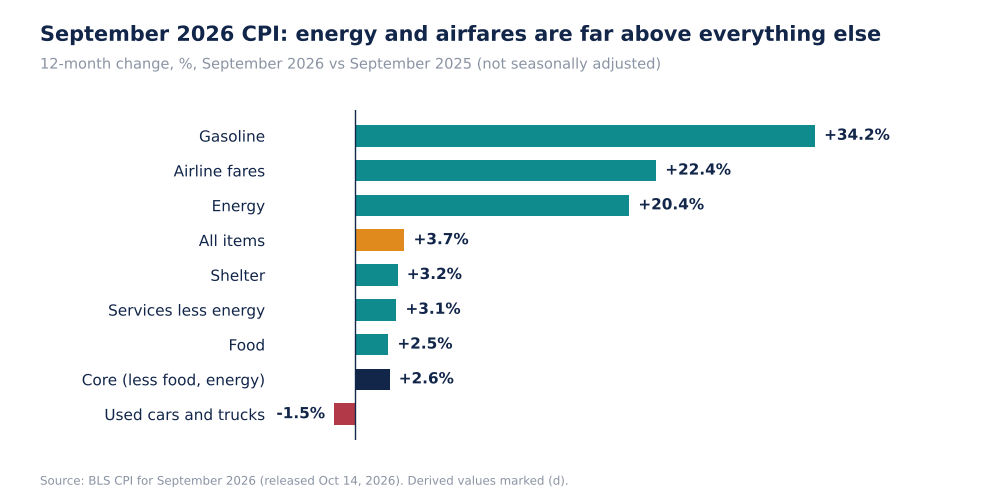
September 2026 CPI, 12-Month Change By Category, % (Self-Made)
The spread between headline and core is 1.1 points (d). Gasoline accounted for more than half of the September monthly increase, according to Kiplinger. Outside energy and airfares, the largest components are moderate: shelter at 3.2% and services at 3.1% are above the 2.6% core average, which means the rest of the core basket (goods) is running lower, with new vehicles at 0.6% and used vehicles at -1.5%. The core rate is therefore being held down by goods, while services are higher.
Why it matters. Services prices are less sensitive to oil and are the part of inflation that is slower to change. With shelter at 3.2% and services at 3.1%, services inflation is above the Fed's 2% target without any contribution from energy, and goods prices, which are below it, are the offsetting factor. Investors should watch whether energy costs spread into goods and transport prices, since airfares at +22.4% may already reflect a pass-through.
Source: BLS CPI release for September 2026. The spread is derived.
Forensic #2: The Monthly Pace Is Faster Than The Annual Rate
| Measure | Monthly | Annualised (d) | 12-month |
|---|---|---|---|
| All items CPI | +0.6% | about 7.4% | +3.7% |
| Core CPI | +0.3% | about 3.7% | +2.6% |
| Q3 PCE price index (quarterly, annualised) | n/a | 2.1% | n/a |
| Q3 core PCE (quarterly, annualised) | n/a | 2.5% | n/a |
| Q2 PCE price index | n/a | 5.0% | n/a |
| Q2 core PCE | n/a | 3.3% | n/a |
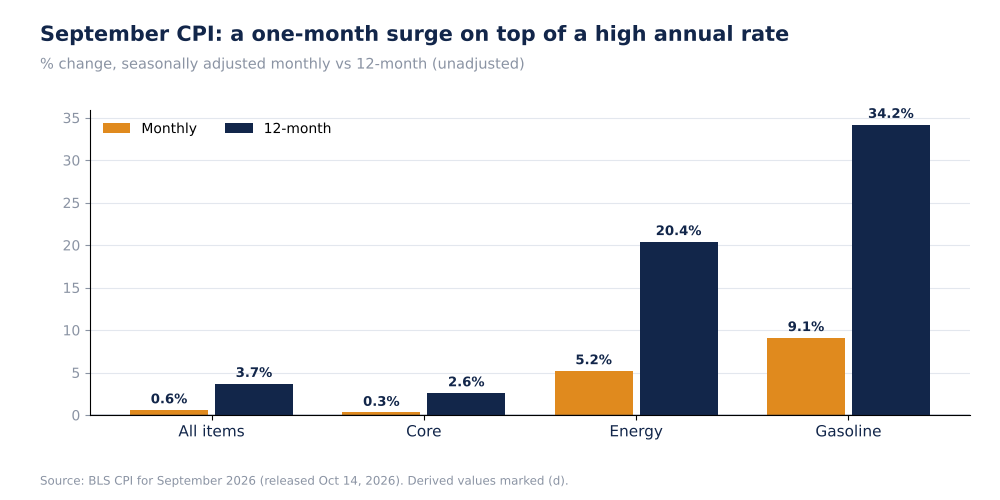
September 2026 CPI, Monthly vs 12-Month Change, % (Self-Made)
A single month annualised is noisy, and September's 0.6% was driven by gasoline, so I treat the 7.4% as an illustration of the energy shock, not a forecast. The core figure matters more: a 0.3% monthly rate, if repeated, would carry core CPI above its 2.6% twelve-month level. The quarterly PCE figures tell a calmer story, with headline PCE falling to 2.1% from 5.0% and core PCE to 2.5% from 3.3%, but PCE is the Fed's target measure and core PCE at 2.5% is still 0.5 points above the 2% goal (d). The chair said the target is 2% as measured by PCE.
Why it matters. The dissenters can point to the September monthly data, while the majority can point to the quarter. October CPI, due November 10, is the next test of which is the better guide. In my reading, a second 0.3% core print would favour the hawks, while a 0.2% or lower print would support waiting.
Sources: BLS; BEA advance Q3 GDP release. Annualised figures are compounded monthly changes (d).
Forensic #3: A Split Committee, A Hawkish Chair And Rates Near Neutral In Real Terms
| Item | Detail |
|---|---|
| Target range | 3.75% to 4.00% |
| September 2026 | 25 bp hike, first since July 2023 |
| October 28 vote | 10-2; Cook and Hammack preferred a 25 bp hike |
| Real funds rate: midpoint less headline CPI (d) | about +0.2 points |
| Real funds rate: midpoint less core CPI (d) | about +1.3 points |
| Statement on growth | 'strong' (upgraded from 'solid') |
| Statement on inflation | 'remains elevated' |
| Chair on inflation | above the objective for 'close to six years'; target is 2% PCE |
| Chair on financial conditions | tightened, but 'unwilling and unable to call them tight' |
| From 2027 | one of eight meetings to focus on strategy, with no rate vote or statement |
The chair is Kevin Warsh. His remarks, as reported by Fox Business and Kiplinger, were that inflation control is a gradual process, that the Fed's "monetary medicine is starting to work some", that consumers' price worries are short-term and not a loss of confidence in the 2% goal, and that he does not aim to "throw people out of work" to cut inflation. He also said higher rates affect AI investment, "I don't believe they are somehow divorced from the rest of the economy". Real rates are close to zero against headline inflation (d) and about 1.3 points against core (d), which is why the dissenters' view that policy is not yet restrictive enough has an arithmetical basis.
Why it matters. A committee with two hawkish dissents one meeting after a hike is signalling the direction of risk, and the statement's upgrade of growth to strong reduces the argument for waiting. At the same time the chair's remarks on gradual progress and on employment suggest the majority is not in a hurry. The decision in December turns on the October CPI and the October jobs report.
Sources: Federal Reserve; Kiplinger; Fox Business. Real rates are my arithmetic (d).
Forensic #4: The Bond Market Is Ahead Of The Fed
| Item | Level |
|---|---|
| Federal funds range | 3.75% to 4.00% |
| 2-year Treasury yield (Oct 28 close) | 4.706% (-3.1 bp on the day) |
| 10-year Treasury yield | 5.024% (+3.3 bp) |
| 30-year Treasury yield | 5.351% (+4.6 bp) |
| 2-year yield less top of funds range (d) | about +71 bp |
| 10-year less 2-year (d) | about +32 bp |
| 30-year less 10-year (d) | about +33 bp |
| 10-year yield less 12-month CPI (d) | about +1.3 points |
| S&P 500 / Dow / Nasdaq Composite (Oct 28 close) | 7,743 / 52,475 / 26,549 |
| WTI / Brent (Oct 27) | about $99.99 / about $109.46 |
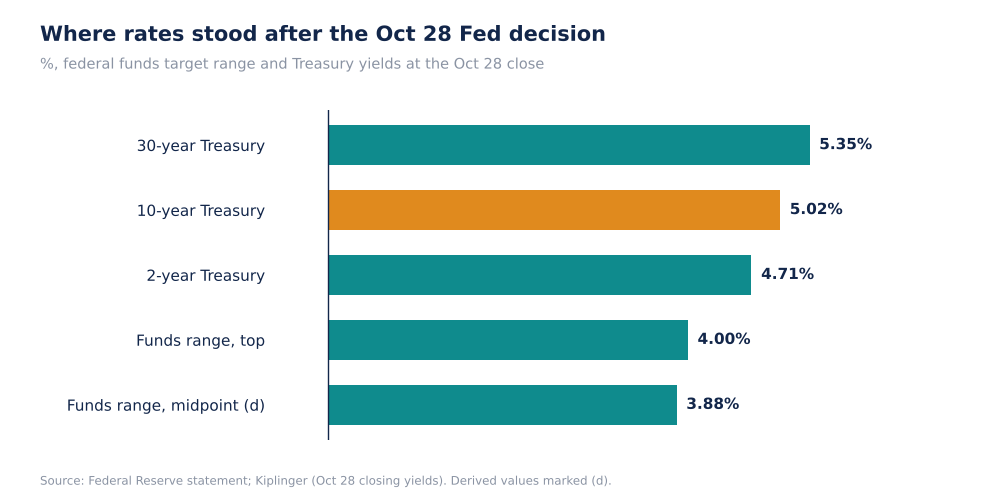
Rates After The Oct 28, 2026 Fed Decision, % (Self-Made)
The 2-year yield of 4.706% is about 71 basis points above the top of the funds range (d), which means the market expects the funds rate to rise materially from here, consistent with an 83% to 85% December probability and with the market having priced about four hikes, according to Kiplinger, against an expectation of one or two from some strategists. The 10-year yield sits at 5.024%, so long-term borrowing costs are already above 5% without a Fed hike in October. Stocks closed higher on the day, with the S&P 500 up 0.3%.
Why it matters. Long yields above 5% set the hurdle rate for every equity and real-asset valuation. In the company articles published with this one, GE Aerospace trades at about 37 times guided EPS, Intuitive Surgical at about 36 times annualised non-GAAP EPS and Texas Instruments at about 29.5 times annualised EPS (all d), so the highest multiples are the most sensitive to a discount rate near 5%. If the Fed delivers less than the market expects, long yields could fall, and if oil climbs further, the reverse is possible.
Sources: Kiplinger, Oct 28 closing levels; Fox Business, CME FedWatch. Spreads are derived.
Valuation Snapshot
This is a macro article, so the snapshot is about the discount rate. The S&P 500 closed at 7,743 on Oct 28 with the 10-year Treasury at 5.024%, a risk-free rate that is a full 1.3 points above the 12-month CPI rate (d).
| Measure | Figure |
|---|---|
| 10-year Treasury yield | 5.024% |
| 10-year yield less 12-month CPI (d) | about +1.3 points |
| 10-year yield less 12-month core CPI (d) | about +2.4 points |
| Funds range midpoint less 12-month CPI (d) | about +0.2 points |
| December hike probability | about 83% to 85% |
| Consumer inflation expectations, 12 months | 5.8% |
I did not retrieve index earnings, so I do not calculate an equity risk premium. A reader can do so by dividing forward S&P 500 earnings by the index level and comparing the result with 5.024%.
What has to be true. For rates to stop rising, energy needs to stop adding to headline inflation and core monthly prints need to move back toward 0.2%. For the hawks to be wrong, the 2.6% core rate must be the better guide than the 3.7% annualised monthly pace. If oil stays near $100 a barrel, September's gasoline effect becomes a level shift and the debate moves to second-round effects.
Risks: What Would Break The Thesis
- Oil escalation. WTI is up about 50% since the conflict began, and gasoline rose 34.2% in a year.
- Core acceleration. A second 0.3% or higher monthly core print would raise the odds of more hikes than December.
- Expectations. Consumers' 12-month expectations are 5.8%, above realised inflation.
- Policy overshoot. Hiking into a weak jobs report (29,000 payrolls in September) risks slower growth.
- Rates and valuations. A 10-year yield of 5.024% and a 30-year of 5.351% pressure long-duration assets.
- Data limits. I did not retrieve the September PCE report, the Summary of Economic Projections or the full press conference.
The risks run both ways. The Fed could hike into a slowdown, or wait into entrenched inflation, and the data in this article support either reading, which is why the committee itself split.
What To Watch Next
- October CPI, due November 10: core month over month against 0.3% and energy against +5.2%.
- The October employment report, against 29,000 payrolls and 4.2% unemployment.
- The December 8 to 9 FOMC: the decision, the vote count and the dissenters.
- The 2-year yield against 4.706% and the 10-year against 5.024%.
- WTI and Brent against about $100 and $109 a barrel, and gasoline prices.
- Q3 GDP second estimate on November 25, with revised PCE prices.

Sandeep Gupta
Independent equity research analyst publishing forensic theses on US-listed stocks. MBA, Politecnico di Milano School of Management (Milan, Italy).
Get new research in your inbox
Subscribe to receive forensic equity research the moment it's published. Free, no spam.
Related Research
 SPX
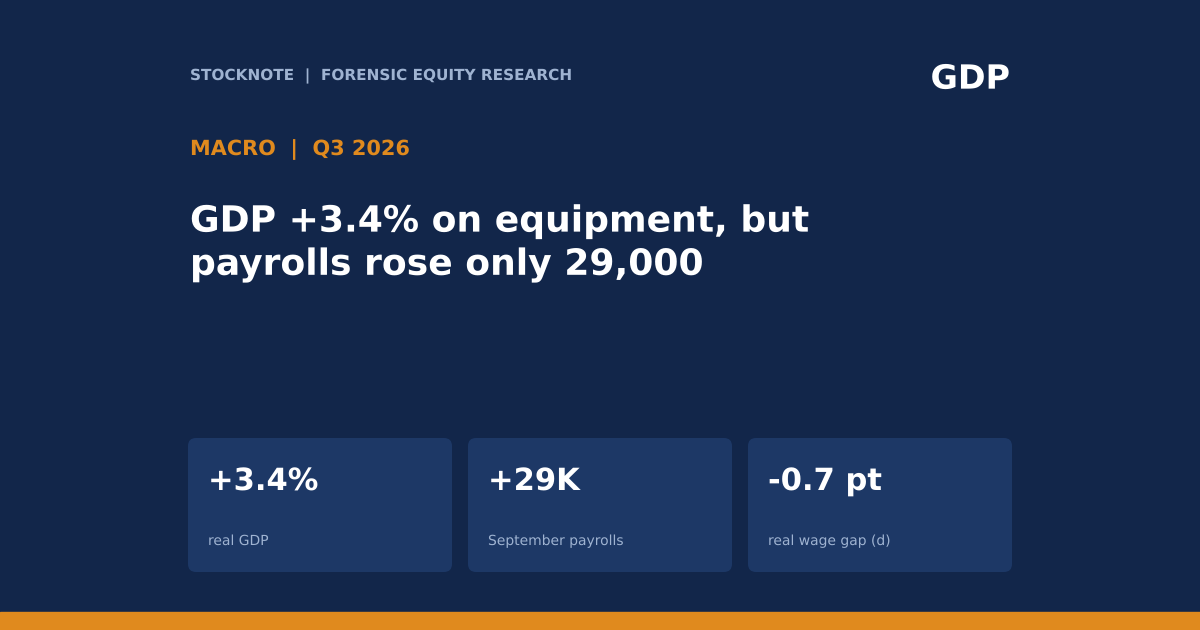
Real GDP Grew 3.4% On Equipment Spending, But Payrolls Rose Only 29,000 And Real Wages Are Falling
 CMCSA
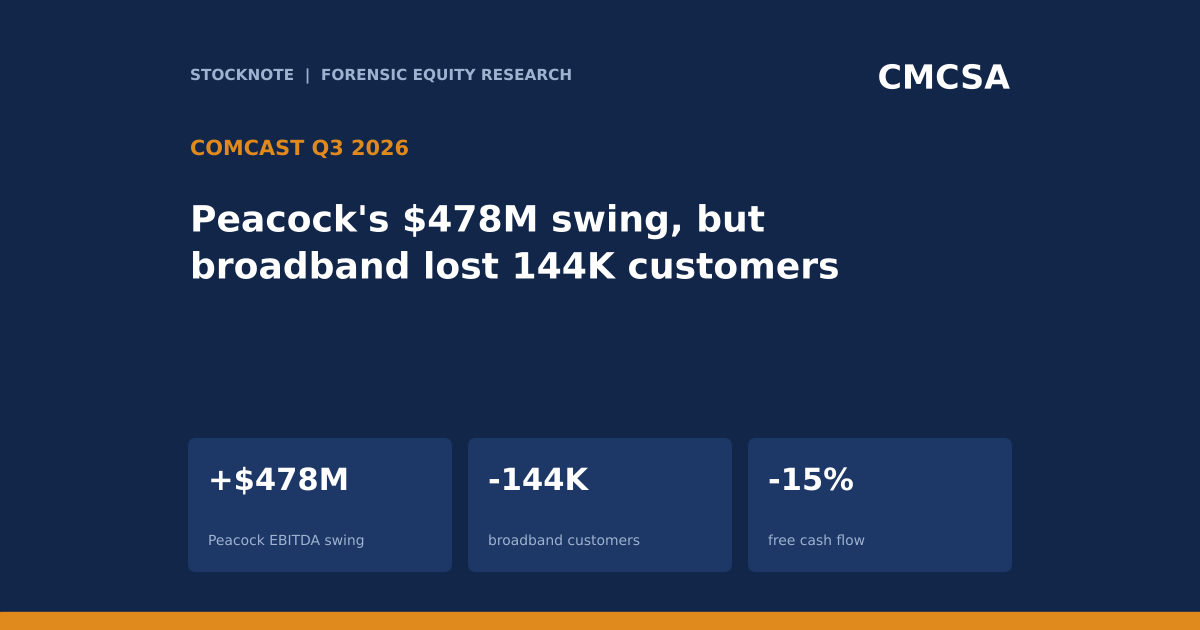
Comcast (CMCSA): Peacock's $478M Swing Drove Media Profit, While Broadband Lost 144K Customers And Free Cash Flow Fell 15%
 DHR
Discussion
Be the first to comment.