
Investment Thesis
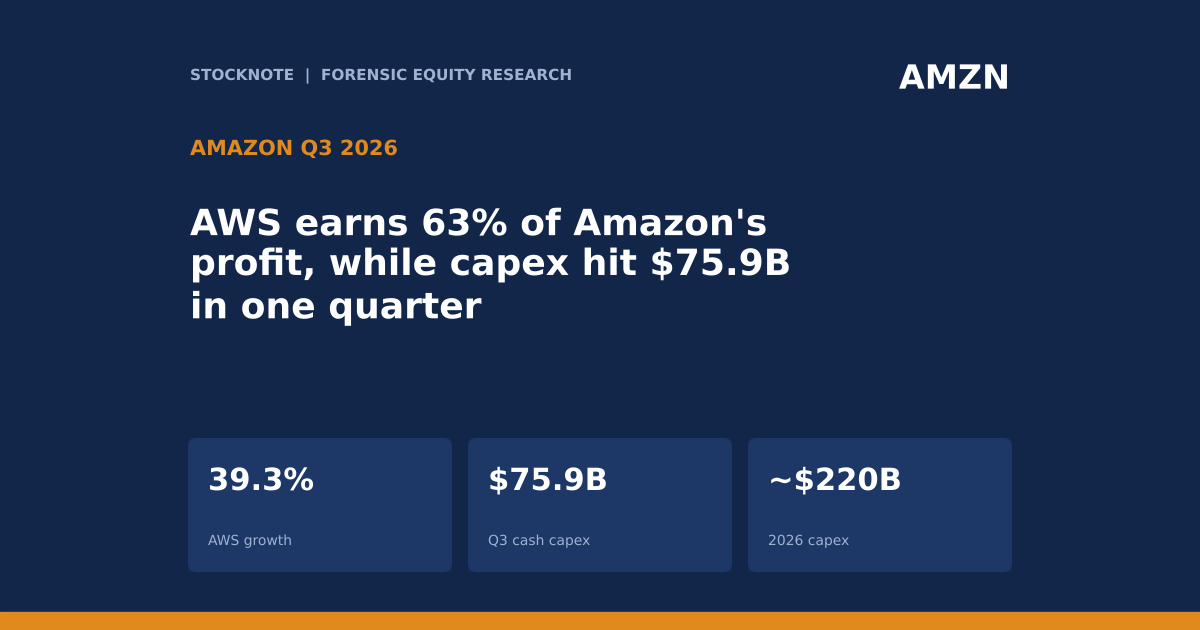
Amazon's third-quarter revenue rose 12% to $201.9B and operating income rose 61% to $28.1B, with AWS growing 39.3% on a $578B backlog. The profit is concentrated and the spending is very large: AWS earned about 63% of operating income on about 23% of sales, quarterly cash capex was $75.9B, and the fourth-quarter guide implies a lower operating margin than the third quarter.
- Results. Revenue was $201.9B (+12%, +13% excluding FX). Operating income was $28.1B, a 13.9% margin, up 61%, which implies about $17.5B a year ago (d).
- AWS. Revenue was $46.0B (+39.3%), operating income $17.8B, a 38.7% margin. AWS added $3.8B of revenue over Q2. Backlog was $578B, growing at triple digits. AWS supplied about 60% of Amazon's revenue growth (d).
- Concentration. AWS was 22.8% of net sales and 63.3% of operating income. The rest of Amazon earned $10.3B on $156.0B of sales, a 6.6% margin (d).
- Retail margins. North America sales were $112.9B (+6%) with a 7.7% margin. International sales were $43.1B (+8% excluding FX) with a 3.7% margin.
- Capex. Q3 cash capex was $75.9B, equal to 1.65 times AWS revenue and 2.7 times total operating income (d). The CEO guided 2026 cash capex to about $220B.
- Q4 guide. Net sales of $240B to $247B and operating income of $28.5B to $33.5B, which implies a margin of about 11.5% to 14.0%, midpoint 12.7% (d), against 13.9% in Q3.
- Advertising. Ad revenue was $19.6B, up 12%, with management expecting a return to high-teens growth in Q4.
- This article contains no price target or rating. Every figure comes from the executives' spoken remarks on the Q3 call or a named source, and anything I calculated is marked (d).
Bottom line. Amazon's profit growth is real and large, but it is concentrated in AWS and funded against an unusually heavy capex programme. The debate is not whether AWS is growing, since at 39.3% it is, but what return the roughly $220B of 2026 capex earns, and whether retail margins of 7.7% and 3.7% can rise to share more of the load.
Source: Amazon Q3 2026 earnings call transcript, Motley Fool, Oct 30, 2026.
Q3 2026 At A Glance
| Metric (Q3 2026) | Result | Growth or margin |
|---|---|---|
| Net sales | $201.9B | +12% (+13% excluding FX) |
| Operating income | $28.1B | +61%; 13.9% margin |
| North America sales / operating income | $112.9B / $8.7B | +6%; 7.7% margin |
| International sales / operating income | $43.1B / $1.6B | +8% excluding FX; 3.7% margin |
| AWS sales / operating income | $46.0B / $17.8B | +39.3%; 38.7% margin |
| AWS backlog | $578B | triple-digit growth |
| Advertising revenue | $19.6B | +12% |
| Paid units | n/a | +12% |
| Q3 cash capex | $75.9B | n/a |
| Q4 net sales guide | $240B to $247B | FX about -60 bp |
| Q4 operating income guide | $28.5B to $33.5B | n/a |
Segment sales add to $202.0B (d), $0.1B above total net sales, which is rounding. Source: Amazon Q3 2026 call transcript.
What The Market Believes vs. What The Data Actually Shows
| Belief | What the call shows |
|---|---|
| Amazon is a retail company | About 63% of operating income came from AWS (d). North America and International together were 36.7% (d). |
| Margins are expanding everywhere | Total margin is 13.9%, but North America is 7.7% and International 3.7%. The Q4 guide implies 11.5% to 14.0%. |
| AI spend is funded by profits | Q3 capex of $75.9B is 2.7 times Q3 operating income (d). The call did not give free cash flow. |
| Growth is accelerating | AWS growth accelerated for a sixth straight quarter, but total net sales grew 12%. |
The call gave no consensus; prices are in the Valuation Snapshot.
Amazon is often valued as a retailer with a cloud business attached. The numbers invert that: AWS earns about 63% of operating income, so investors are valuing a cloud and AI infrastructure business with a very large retail operation attached.
Forensic #1: AWS Is 23% Of Sales And 63% Of Operating Income
| Segment | Net sales | Share of sales (d) | Operating income | Share of op. income (d) |
|---|---|---|---|---|
| North America | $112.9B | 55.9% | $8.7B | 31.0% |
| International | $43.1B | 21.3% | $1.6B | 5.7% |
| AWS | $46.0B | 22.8% | $17.8B | 63.3% |
| Total | $201.9B | 100% | $28.1B | 100% |
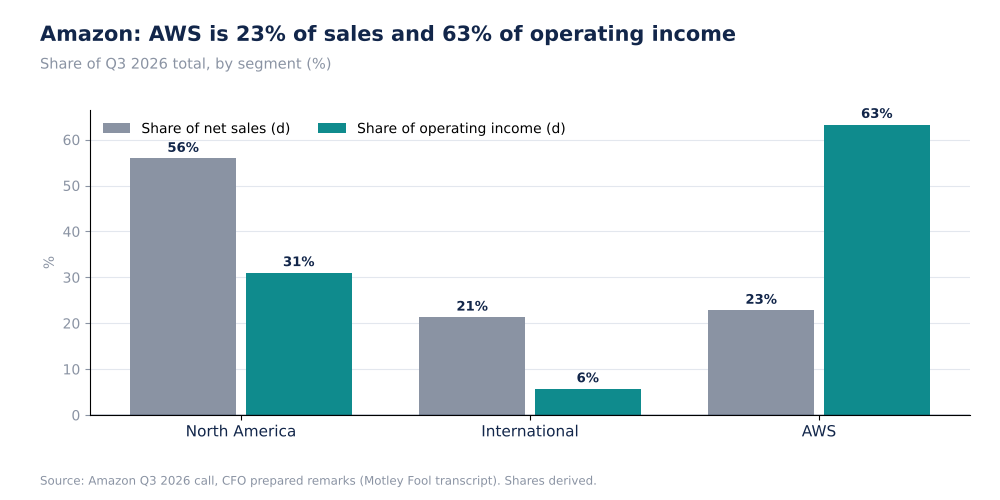
Amazon Q3 2026 Share Of Net Sales vs Share Of Operating Income By Segment (Self-Made)
AWS revenue grew from about $33.0B a year ago to $46.0B (d), a $13.0B increase that is about 60% of Amazon's total revenue increase of about $21.6B (d). The company's growth and profit both depend on one segment.
Why it matters. Concentration raises both upside and risk. A 10% change in AWS operating income is about $1.8B of quarterly profit (d), equal to about 17% of what the rest of the company earns ($10.3B). Any investor needs a view on AWS margins and growth, not only on retail.
Source: Amazon Q3 2026 call transcript.
Forensic #2: Retail Margins Are Thin Next To AWS
| Segment | Operating margin |
|---|---|
| AWS | 38.7% |
| Total company | 13.9% |
| North America | 7.7% |
| International | 3.7% |
| Everything except AWS (d) | 6.6% |
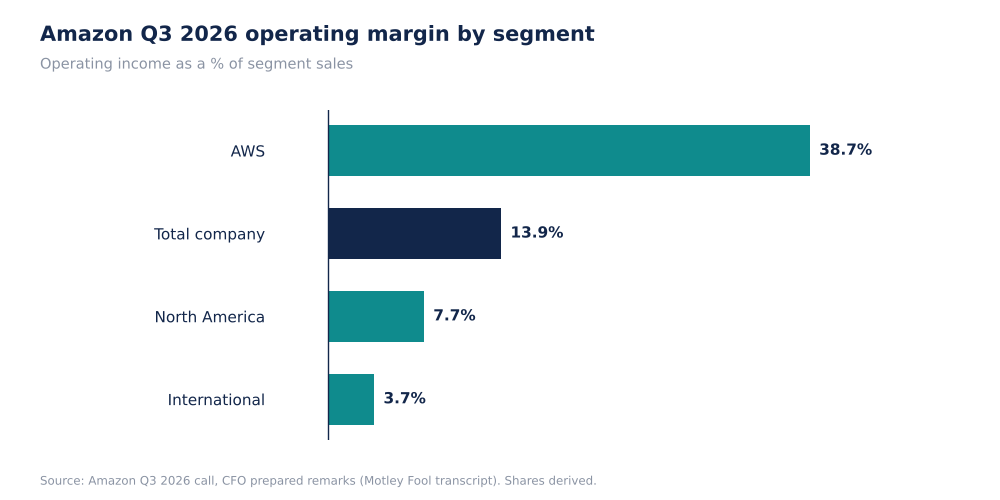
Amazon Q3 2026 Operating Margin By Segment (Self-Made)
Shipping costs rose 11% against paid-unit growth of 12%. Excluding fuel and line-haul inflation, shipping costs grew 8%, the CFO said. The call did not give a retail margin bridge, so I do not attribute the 61% rise in operating income to any one factor.
Why it matters. A 6.6% margin outside AWS is thin for a business of this scale: each one-point change in that margin is about $1.6B of quarterly operating income (d). That makes shipping cost discipline a direct driver of earnings, and shipping costs grew 11% against 12% unit growth.
Source: Amazon Q3 2026 call transcript.
Forensic #3: Capex Of $75.9B Against $28.1B Of Operating Income
| Measure | Figure |
|---|---|
| Q3 cash capex | $75.9B |
| Q3 operating income | $28.1B |
| Capex as multiple of operating income (d) | 2.7x |
| AWS Q3 revenue | $46.0B |
| Capex as multiple of AWS revenue (d) | 1.65x |
| 2026 cash capex (CEO) | about $220B |
| Average per quarter implied (d) | about $55B |
| AWS backlog | $578B |
| Backlog as multiple of Q3 AWS revenue (d) | 12.6x |
Capex covers the whole company, so the AWS ratio is a scale marker, not a return on investment. Operating cash flow and free cash flow were not in the spoken remarks, so I cannot say how the capex is funded.
Why it matters. Capex of $75.9B in a quarter is 2.7 times the quarter's operating income, and the 2026 total is near $220B. The backlog of $578B equals about 12.6 quarters of AWS revenue at the Q3 rate (d), which is the evidence that customers stand behind the spending. The open question is return, and the call did not give free cash flow, so investors should read the 10-Q.
Source: Amazon Q3 2026 call transcript.
Forensic #4: The Q4 Guide Implies A Lower Margin
| Case | Net sales | Operating income | Implied margin (d) |
|---|---|---|---|
| Q3 2026 actual | $201.9B | $28.1B | 13.9% |
| Q4 low op. income, high sales | $247B | $28.5B | 11.5% |
| Q4 midpoint | $243.5B | $31.0B | 12.7% |
| Q4 high op. income, low sales | $240B | $33.5B | 14.0% |
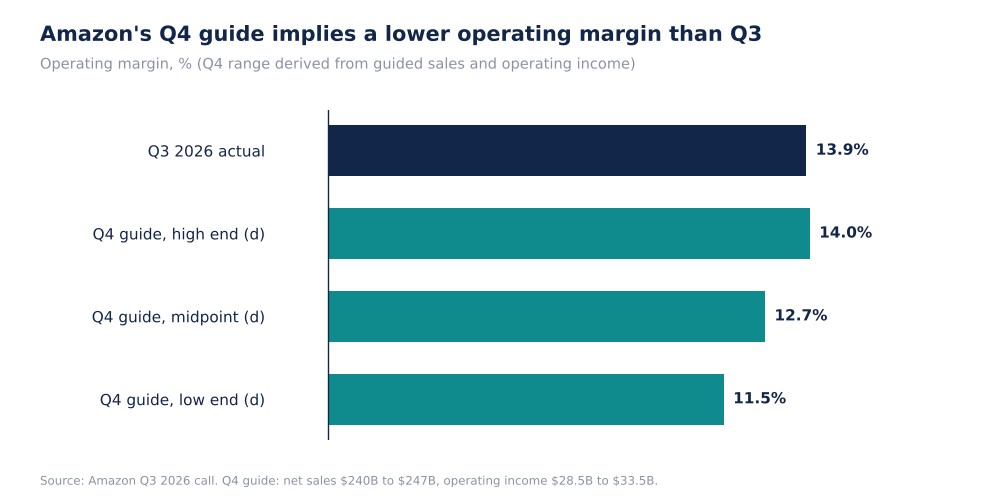
Amazon Operating Margin: Q3 2026 Actual vs Q4 Guide Range (Self-Made)
Only the very top of the Q4 range matches Q3's margin. Guidance for Q4 includes an FX headwind of about 60 basis points to sales growth. The call did not explain the lower implied margin, so I do not assign a cause.
Why it matters. The Q4 guide midpoint of $31B of operating income is about 10% above Q3 on sales about 21% higher (d), so the implied margin falls. Q4 is normally the largest retail quarter, a seasonal pattern the call did not discuss, so part of the lower margin may be mix. Investors should test the margin step-down against the Q4 results.
Source: Amazon Q3 2026 call transcript.
Valuation Snapshot
TradingView shows Amazon at $240.35 with a market cap of about $2.63T, about 16% below its Aug 3, 2026 high of $287.20. The page's day-change figures disagree with each other (-1.4% and -4.3%), so I give neither.
| Measure | Figure |
|---|---|
| Share price (TradingView) | $240.35 |
| Market cap (TradingView) | about $2.63T |
| P/E, trailing (TradingView) | 20.6 |
| Below the Aug 3 all-time high of $287.20 (d) | about 16% |
| Market cap / annualised Q3 operating income of $112.4B (d) | about 23.4x |
| Market cap / annualised Q4 operating income guide midpoint of $124B (d) | about 21.2x |
| Market cap / AWS annualised run rate of $184B (d) | about 14.3x |
| Annualised Q3 capex of $303.6B as % of market cap (d) | about 11.5% |
| 2026 capex of about $220B as % of market cap (d) | about 8.4% |
At about 21 to 23 times annualised operating income, the price depends on AWS, which earns about 63% of that profit, continuing to grow near 40% while the company spends the equivalent of 8% to 12% of its market cap on capex in a year.
What has to be true. At roughly 21 to 23 times annualised operating income, the price assumes AWS keeps growing near 40%, the CEO's stated view for 2027 and 2028, and that capex converts into profit. If AWS growth slowed sharply, the same multiple would require retail margins to do far more of the work.
Risks: What Would Break The Thesis
- AWS slows. With 63% of operating income in one segment, a slowdown from 39.3% hits the whole company.
- Capex outruns revenue. $75.9B in a quarter is 1.65 times AWS revenue.
- Retail margin. North America at 7.7% and International at 3.7% leave little cushion.
- Backlog conversion. $578B is 12.6 times Q3 AWS revenue.
- Data limits. I did not read the release or the 10-Q; free cash flow was not spoken.
The key risk is a timing mismatch between capex, which is paid now, and AWS revenue from the backlog, which is recognised over years. Retail margin risk is separate and smaller, but it affects the 37% of operating income that does not come from AWS.
What To Watch Next
- Q4 operating income against $28.5B to $33.5B.
- AWS growth against 39.3% and the CEO's 'north of 40%' view for 2027 and 2028.
- Quarterly capex against $75.9B and the $220B annual figure.
- Free cash flow in the 10-Q, which the call did not provide.
- International margin against 3.7%.

Sandeep Gupta
Independent equity research analyst publishing forensic theses on US-listed stocks. MBA, Politecnico di Milano School of Management (Milan, Italy).
Get new research in your inbox
Subscribe to receive forensic equity research the moment it's published. Free, no spam.
Discussion
Be the first to comment.