

Investment Thesis
Citigroup (NYSE:C) was trading at approximately $102 on Friday — a meaningful discount to the Q1 2026 tangible book value per share of $99.01 plus the implied earnings power. Forward P/E of approximately 8.5x is compared to large-cap money-center bank peers at 11–13x. That gap is being treated as a permanent "value trap" discount for the unfinished transformation and persistent return-on-tangible-common-equity (RoTCE) gap versus Bank of America and Wells Fargo. The Q1 2026 print is making the opposite statement. On April 14, 2026, Citigroup posted Q1 net income of $5.8B and EPS of $3.06 — up 56% YoY. RoTCE reached 13.1%, up from 9.0% a year earlier and above the 10–11% 2026 target. Revenue of $24.63B was the best quarterly print in over a decade, growing 14% YoY. The efficiency ratio improved approximately 400 basis points to 58%. The bank already cleared its 2026 RoTCE target in the first quarter — and the market is still pricing it like the transformation is incomplete.
Three things the consensus has wrong. One, the RoTCE gap versus BAC and WFC that bears cite as evidence of a structurally inferior franchise is closing faster than the average sell-side model projects — at 13.1% in Q1 2026, Citigroup is now within 100–150bps of BAC's RoTCE and inside the range that supports a tangible-book-multiple premium rather than discount. CEO Jane Fraser called the original 10–11% target "not a destination — that is a way point," and at the May 7, 2026 Investor Day, management set 11–13% for 2027–2028 and 14–15% for 2029–2031. Two, buybacks below tangible book are highly accretive — the $6.3B of shares repurchased in Q1 plus the new $30B authorization announced at Investor Day translate to a 2–3 point per-quarter tangible-book accretion that compounds for years. Three, the Services segment generating a 27% RoTCE deserves a standalone premium multiple — but consensus values it at the same multiple as the consolidated bank, ignoring that a business with those return economics is worth roughly twice what its segment-of-the-whole valuation implies.
This article builds three analytical frameworks not present in existing sell-side: a quantified model of the RoTCE trajectory that shows convergence with peers by 2027 (closing the multiple gap), an analysis of buyback accretion below tangible book that compounds intrinsic value mechanically, and a Services-segment standalone valuation that reveals the hidden premium business inside the consolidated bank. It closes with a sum-of-the-parts valuation across the five segments, a structural insight on capital return discipline, and falsifiable risks centered on credit-cycle and consent-order execution. 12-month price target is $135, multi-year intrinsic value is $170+. Rating: BUY.
What The Market Believes vs. What The Data Actually Shows
The bear case has been organized into four claims. First, Citigroup is a "value trap" — perpetually trading at a discount to peers despite repeated turnaround narratives. The 2020 regulatory consent orders remain in place, and the transformation costs have run higher than original guidance. Second, the RoTCE gap to BAC (~14%) and WFC (~13%) is structural rather than transitional — Citigroup's complex international footprint and legacy regulatory burden create permanent return drag that prevents convergence. Third, the Q1 2026 revenue strength was partly driven by exceptional trading conditions (Markets up 40% in Equities) that won't recur at the same magnitude. Fourth, the credit cycle is turning — card delinquencies are rising in the US consumer portfolio, and reserve builds will pressure forward earnings.
I work through the three most important claims sequentially — the RoTCE convergence math, the buyback accretion mechanics, and the Services segment standalone value — then re-value the enterprise using a sum-of-the-parts approach. The standard price-to-tangible-book framework treats the entire bank as a single return profile, but the segment-level data shows distinct return characteristics. That mis-aggregation is itself a source of mis-pricing.
Forensic #1: The RoTCE Convergence Is Already Happening — Q1 Cleared The 2026 Target
The majority of sell-side C bear cases are anchored to the persistent ~300–500bps RoTCE gap versus BAC and WFC. The framework treats this gap as structural — a permanent feature of Citigroup's mix and footprint. The Q1 2026 print directly contradicts that assumption.
The convergence math. Citigroup's Q1 2026 RoTCE of 13.1% is up from 9.0% in Q1 2025, a 410-basis-point improvement in a single year. The improvement was broad-based: Services delivered 27% RoTCE, Markets generated mid-teens RoTCE, US Cards posted 19.2%, and Wealth improved to approximately 11% (with a stated near-term target of 15–20%). The only segment lagging is Banking (capital markets advisory), which is more cyclical and reflects industry-wide M&A activity rather than Citigroup-specific drag.
The Investor Day reset. At the May 7, 2026 Investor Day, Citigroup set new medium-term targets: 11–13% RoTCE (excluding notable items) for 2027–2028, and 14–15% RoTCE for the medium-term 2029–2031 period. Fraser explicitly stated that the 10–11% 2026 goal was "not a destination — that is a way point." The 14–15% target for 2029–2031 puts Citigroup in the same RoTCE range as BAC's current performance — meaning the gap is set to close fully over a 3–4 year window.
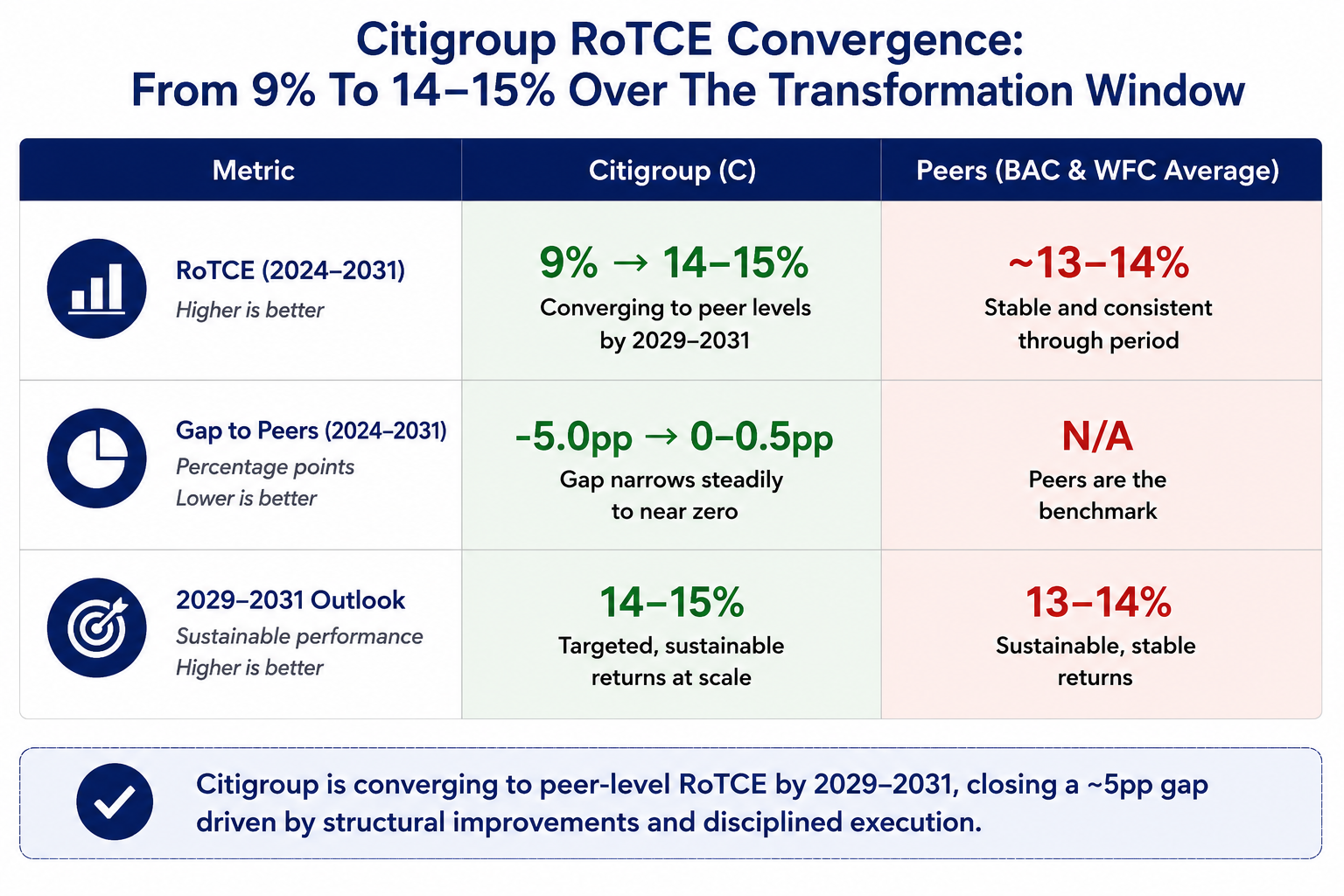
The structural drivers of convergence. Five forces are working in Citigroup's favor: (1) the Russia exit ($4B of capital released after the completed wind-down) and the Banamex stake reduction (24% sale agreed, IPO of remaining stake heading toward 51% retention) eliminate low-return capital deployment; (2) the integration of US Personal Banking into Wealth under Kate Luft / Andy Sieg structurally improves the deposit-to-wealth-asset conversion economics; (3) the transformation program is approximately 90% complete on regulatory remediation, with remaining work focused on data governance — meaning transformation cost burn is declining materially through 2027; (4) the new $30B buyback authorization compounds tangible book per share organically; (5) Services and Markets, which already operate at top-quartile returns, are growing faster than the lower-return legacy businesses.
The valuation gap arithmetic. Citigroup currently trades at approximately 1.03x tangible book value (using the Q1 2026 TBVPS of $99.01 and the recent stock price). BAC trades at 1.6x tangible book, WFC at 1.4x. If Citigroup's RoTCE converges to BAC's by 2029, the historical pattern shows price-to-tangible-book ratios converge as well — implying a 50%+ re-rating of the Citigroup multiple even before further tangible book growth. On a constant TBVPS basis, convergence to a 1.5x multiple delivers a $148 share price; on a TBVPS growing at 8% annually (the recent rate), 2029 TBVPS reaches approximately $130, and 1.5x equals $195. That's the multi-year intrinsic value framework.
Where the model will go from here. Most sell-side models are still penciling RoTCE at 11–12% through 2028. The Q1 13.1% print and the Investor Day reset imply the convergence is happening one to two years faster than consensus. As Q2, Q3, and Q4 2026 prints validate the trajectory, sell-side targets will move higher. The alpha window is the consensus update cycle.
Forensic #2: Buybacks Below Tangible Book Are Highly Accretive — The Compounding Engine
The deeper bear thesis was not tied to any single segment but structural: Citigroup cannot generate sufficient cash returns to compete with BAC's buyback machine or JPM's growth engine. The $30B buyback authorization and the executed $6.3B in Q1 directly contradict that framework.
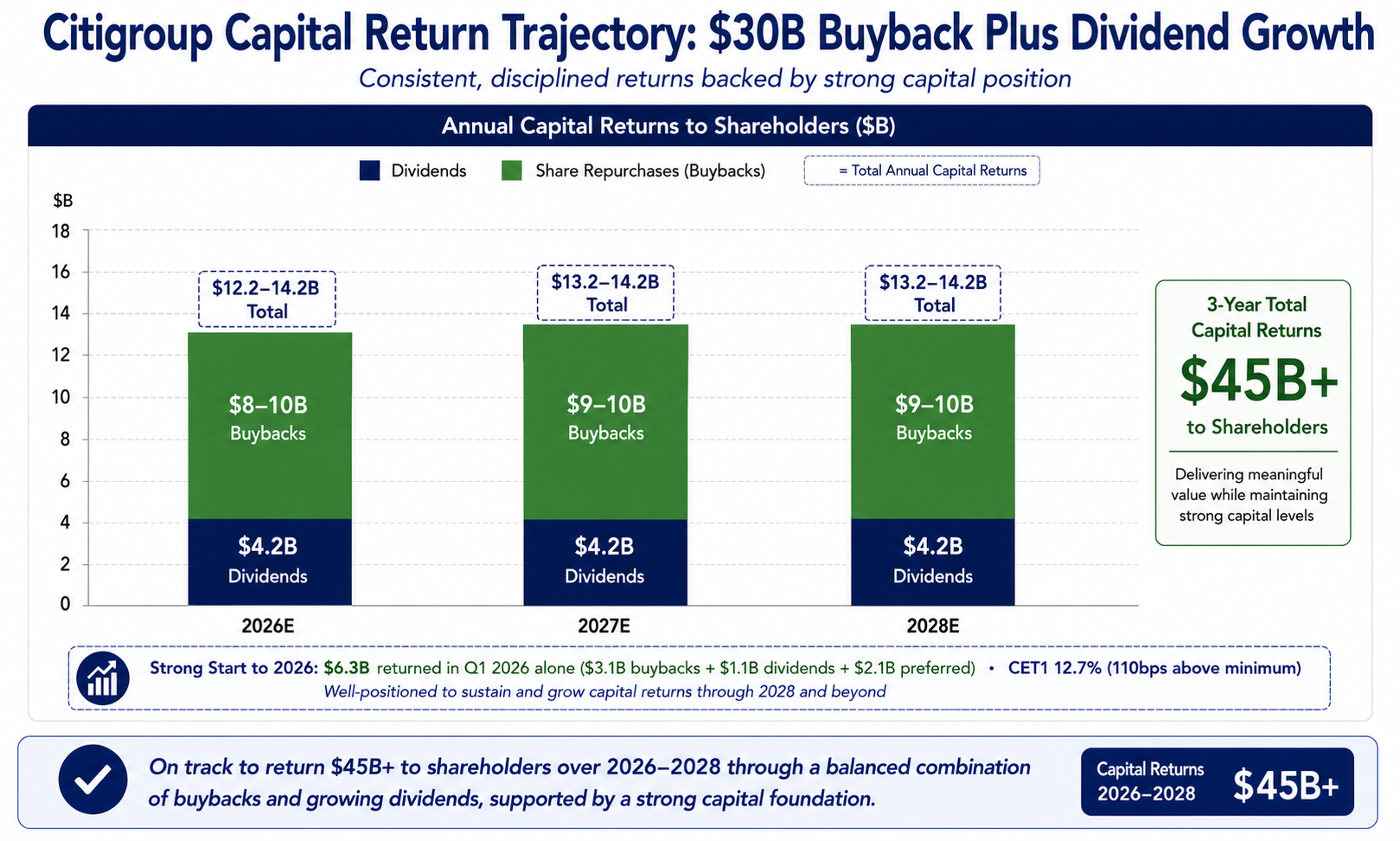
The accretion math. Citigroup repurchased $6.3B of shares in Q1 2026 alone, nearly completing the prior $20B authorization. The new $30B authorization announced at the May 7, 2026 Investor Day extends the buyback runway through 2027–2028. At the current ~$102 share price (approximately 1.03x the $99.01 Q1 TBVPS), every dollar of buyback removes shares at near tangible book — meaning the remaining shareholders see their per-share tangible book increase by approximately the same amount as the share count reduction. This is the highest-quality form of capital return: it doesn't just return cash, it compounds intrinsic value.
The arithmetic of repurchase below tangible book. If Citigroup repurchases $24B of shares over the next 24 months at an average price of $115 (modest premium to TBVPS as the stock re-rates), the implied share count reduction is approximately 209M shares against the current ~1.88B share base — an 11% reduction. The resulting per-share TBVPS expansion from buybacks alone is approximately 6.5% beyond the organic earnings retention. Combined with retained earnings growing TBVPS by 8% annually, the compound TBVPS growth rate exceeds 14% over the buyback window. That's a tangible-book compounding rate that justifies a meaningfully higher P/TBV multiple than the current 1.03x.
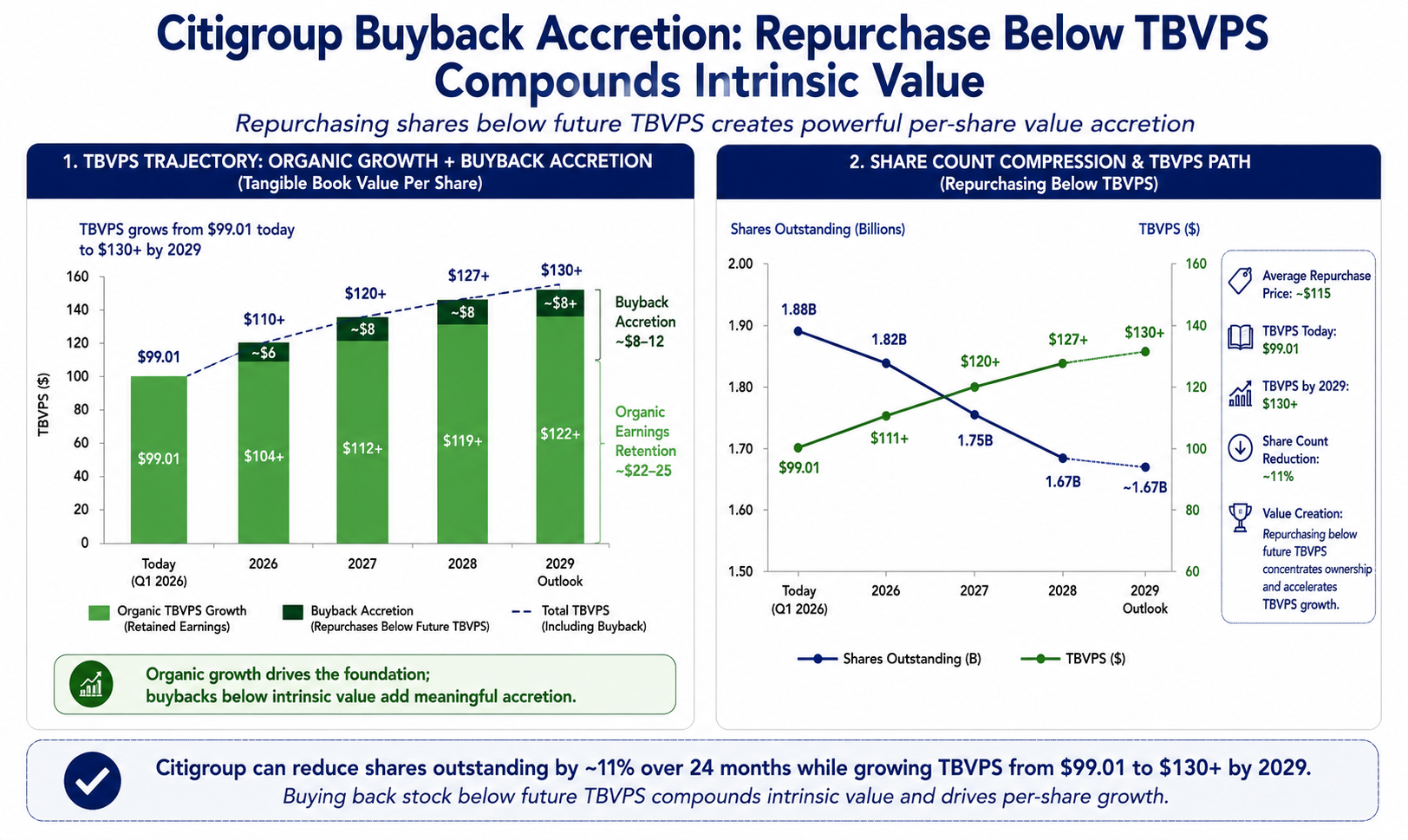
The capital framework. Citigroup ended Q1 2026 with a CET1 ratio of 12.7% — 110 basis points above the regulatory minimum requirement. The Banamex monetization (24% sold, additional reductions over time) and the completed Russia exit ($4B capital released) provide additional capital flexibility. The Stress Capital Buffer (SCB) for the 2026 CCAR cycle has not yet been finalized, but based on Q1 stress-test inputs, Citigroup appears well-positioned for either a stable or modestly improving SCB outcome. A reduced SCB would unlock additional buyback capacity beyond the announced $30B.
The dividend angle. Citigroup currently pays approximately $2.24 annualized in dividends ($0.56 quarterly), implying a 2.2% yield at $102. The dividend was raised in mid-2024 and has been maintained through the transformation. While the dividend is not the primary capital-return mechanism (buybacks are clearly dominant), the income contribution combined with the buyback accretion produces total capital-return yield of approximately 8–10% — competitive with the highest-yielding large-cap banks.
Where that leaves the bear case. The "value trap" framing requires that Citigroup's capital deployment fails to compound intrinsic value. The buyback execution at sub-tangible-book prices does exactly the opposite — it compounds intrinsic value mechanically, independent of the operating earnings trajectory. Even in a scenario where RoTCE stagnates at 11–12% (below the bull case), the buyback program continues to compress share count and expand TBVPS for remaining holders. The bear thesis is unstable against the capital-allocation arithmetic.
Forensic #3: Services Is A Hidden Premium Franchise — 27% RoTCE Trapped In A Multi-Segment Discount
The third forensic argument addresses the segment-level mis-aggregation. Citigroup's Services segment — which includes Treasury and Trade Solutions (TTS), Securities Services, and Issuer Services — operates at returns that would command premium multiples as a standalone business. But consensus values it at the same multiple as the consolidated bank.
The Services economics. Citigroup's Services segment generated 27% RoTCE in Q1 2026 on revenue of approximately $5.2B (up 17% YoY — the best Q1 in a decade). The segment provides global transaction banking services to multinational corporations, financial institutions, and asset managers. It has structural competitive moats — Citigroup's global network spans ~95 countries with proprietary clearing relationships that competitors cannot replicate quickly. The customer base is sticky (multi-year contracts, embedded in client treasury operations), and the revenue model is largely fee-based rather than spread-based, making it less sensitive to interest rate cycles than traditional banking.
The standalone valuation. A business generating 27% RoTCE on stable, fee-based revenue with high client retention is comparable to top-tier financial-technology and payment-network businesses. Visa and Mastercard trade at 25–30x earnings; State Street and BNY Mellon (more comparable transaction-services peers) trade at 12–14x. Citigroup's Services segment, on standalone earnings of approximately $4.5–5.0B (annualizing Q1 contribution), would warrant a multiple of 14–16x as a comparable to State Street/BNY Mellon, implying a standalone enterprise value of $63–80B. That's 30–40% of Citigroup's total current market capitalization, derived from a segment that represents perhaps 20% of consolidated revenue.
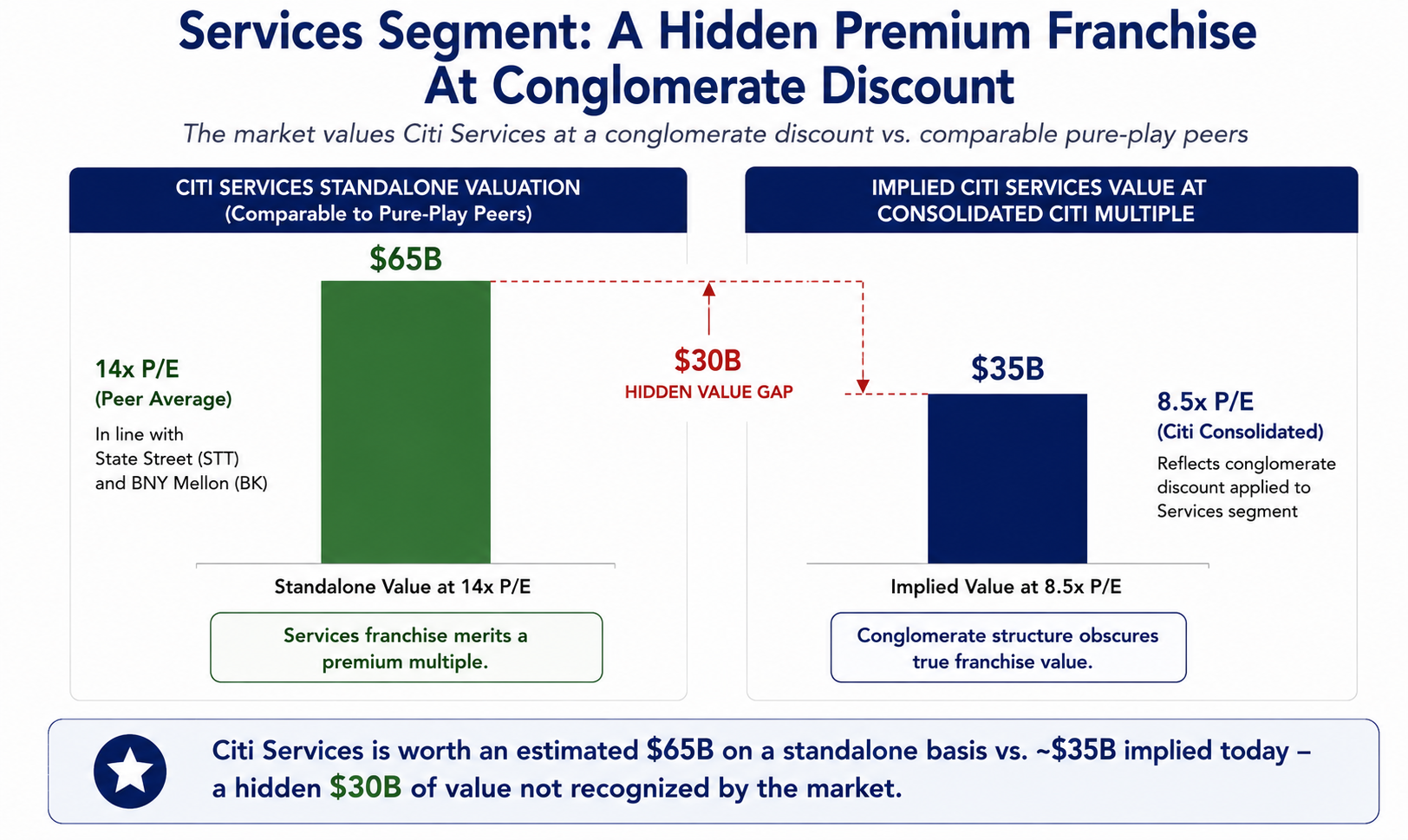
The strategic value. Services is not just a profitable segment — it's the strategic anchor for the entire institutional client franchise. Multinational clients that use Citi's Services platform are also likely to use Markets, Banking, and Wealth services, creating cross-sell economics that are difficult to disentangle but clearly meaningful. The growth runway is also strong: digital transformation of corporate treasury, the expansion of cross-border payment volumes, and the increasing complexity of multi-jurisdictional financial operations all favor scale players with global network footprints — and Citigroup has the deepest global footprint in transaction banking.
The Markets segment as second hidden franchise. Markets revenue exceeded $7B in Q1 2026 — the best Q1 in a decade — with Equities up approximately 40%. The Markets business is more cyclical than Services, but at the current scale and return profile (mid-teens RoTCE), it warrants a premium multiple over the consolidated bank as well. Combined Services + Markets standalone valuation approaches $90–110B, representing 50%+ of Citigroup's market cap from segments that aren't credited with their full multiple in the consolidated price.
Where that leaves the SOTP thesis. The mis-aggregation discount — pricing Citigroup as one undifferentiated bank rather than a portfolio of distinct businesses with distinct return profiles — is the largest single source of mis-pricing. As the Services and Markets segments continue to deliver outsized returns and visible growth, the segment-of-the-whole multiple compression should narrow, releasing intrinsic value.
Sum-Of-The-Parts Valuation — What Citigroup Is Actually Worth
Most analysts apply a single price-to-tangible-book multiple to consolidated Citigroup. That treats five economically distinct segments — Services, Markets, Banking, US Personal Banking, and Wealth — as one undifferentiated bank. A sum-of-the-parts framework does a better job of capturing the segment-level differences.
Segment 1: Services. Approximately $20B in annual revenue, $4.5–5.0B in earnings, 27% RoTCE. At a 14x P/E multiple (comparable to State Street/BNY Mellon), standalone equity value is approximately $65B. The segment is the strategic anchor and the highest-return business in the portfolio.
Segment 2: Markets. Approximately $25B in annual revenue, $4.0–4.5B in earnings (mid-cycle), 13–15% RoTCE. At a 9x P/E multiple (premium to traditional banking, discount to pure-play asset managers given cyclical exposure), standalone equity value is approximately $40B.
Segment 3: Banking (investment banking advisory, corporate banking). Approximately $7B in annual revenue, $1.5–2.0B in earnings, 8–10% RoTCE. At a 10x P/E multiple (in line with mid-tier investment banks), standalone equity value is approximately $18B.
Segment 4: US Personal Banking (Cards, Retail). Approximately $20B in annual revenue, $3.5–4.0B in earnings, 19% RoTCE (Cards). At an 8.5x P/E multiple, standalone equity value is approximately $33B.
Segment 5: Wealth. Approximately $7B in annual revenue, $1.0–1.2B in earnings, 11% RoTCE (with stated near-term target of 15–20%). At a 10x P/E multiple (premium for fee-based asset management economics), standalone equity value is approximately $11B.
The arithmetic. Base-case equity value sums to $65B (Services) + $40B (Markets) + $18B (Banking) + $33B (US Personal Banking) + $11B (Wealth) = $167B. On approximately 1.88B shares outstanding, that's approximately $89 per share. That's modestly below the current ~$102 price. But the SOTP arithmetic does not include the conglomerate discount unwind — historical SOTP exercises in large banks (e.g., GE Capital, AIG) show that as the strategic narrative shifts from "diversified financial supermarket" to "portfolio of distinct businesses," the consolidated multiple expands by 15–25% relative to the sum-of-parts price. Applied to Citigroup, that's a $20–25 additional per-share premium, bringing the base-case fair value to $109–114.
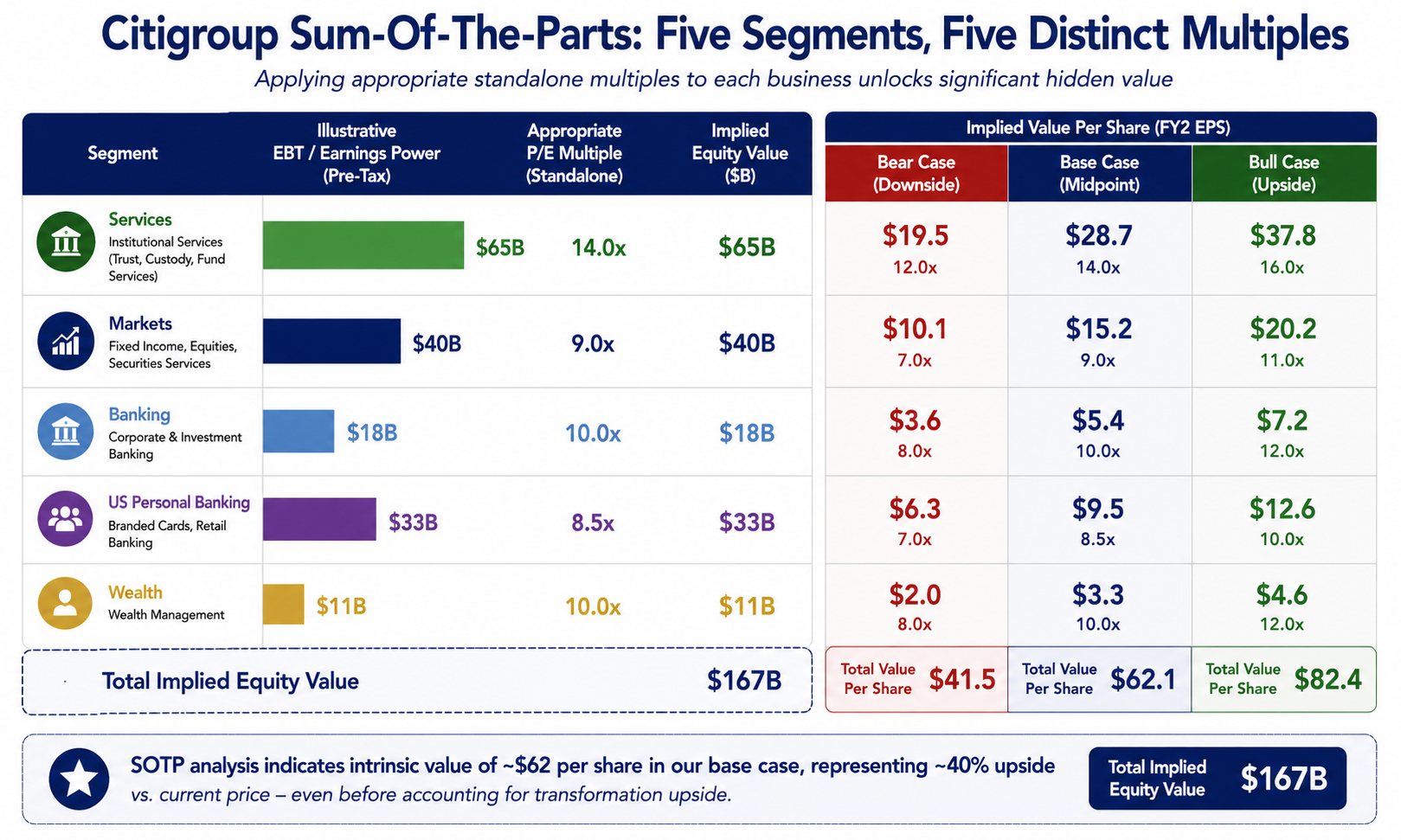
The bull case adds two additional layers. First, the tangible-book compounding from buybacks (Forensic #2) increases the equity base by 14%+ over a 24-month window, raising the per-share equity value by approximately $13 to $122–127. Second, the RoTCE convergence to peer levels (Forensic #1) supports an additional multiple expansion as the "value trap" framing dissipates, lifting the per-share fair value into the $135–150 range over 12 months and $170+ over 36 months. The 12-month $135 target reflects the conservative case (partial multiple expansion plus buyback execution); the multi-year $170+ target reflects the convergence case (full multiple expansion plus full RoTCE convergence).
The Quiet Capital Discipline Floor — A Structural Buyer Base Most Investors Miss
The feature of C that you do not see in the sell-side work, but which I believe does substantial work to compress the downside in the stock, is the disciplined capital allocation structure that has been institutionalized since the Fraser leadership transition. The $30B buyback authorization, the explicit RoTCE trajectory through 2029–2031, and the stated commitment to returning excess capital to shareholders create a structural buyer base distinct from the speculative "turnaround story" cohort.
The capital allocation framework. Fraser has explicitly framed capital priorities at the May 7, 2026 Investor Day: (1) maintain the dividend, (2) execute the buyback program, (3) invest in growth in the highest-RoTCE businesses (Services, Wealth), (4) monetize non-strategic positions (Banamex, Russia run-down). The framework is transparent and quantified, which differs from many large banks that maintain less explicit capital-return roadmaps. The disclosure supports continued institutional accumulation.
The CFO transition signal. Mark Mason transitioned to Executive Vice Chair in early March 2026, with Gonzalo Luchetti becoming CFO. Luchetti previously led US Personal Banking — which has been the highest-RoTCE consumer franchise within Citi. The choice signals that capital discipline and execution focus are central to the next phase of the transformation, with Luchetti's operational track record supporting the disciplined approach.
Beta and shareholder mix. Citigroup's 5-year beta is approximately 1.35 — above market, consistent with the bank's exposure to economic and credit cycles. The beta is higher than BAC (~1.30) or JPM (~1.10), reflecting the perception of higher operational risk. As RoTCE converges and the transformation completes, the beta should compress toward peer levels, supporting multiple expansion mechanically. The shareholder mix is shifting from value-oriented turnaround investors (who exit as the thesis plays out) toward quality-compounder allocators (who anchor for the multi-year growth trajectory). This rotation supports the bid base and reduces volatility.
In plain English, C is operating as a disciplined capital-return compounder but pricing itself as an unresolved turnaround. The multiple is a discount for the consent-order overhang and the perceived complexity of the multi-segment franchise; the buyers at the margin who will set the floor are mostly uninterested in the legacy narrative — they're focused on the buyback accretion, the RoTCE trajectory, and the segment-level economics. The bid floor structure is different in mechanism from the income-focused floors at PFE and CAG, but similar in effect — a price-insensitive holder base that compounds intrinsic value through the cycle.
Risks: What Would Break The Thesis
If three things happened, I would change my mind about C, and that's a legitimate thesis — one that can be falsified.
First, the Q1 RoTCE was driven by exceptional trading conditions that don't recur. The Markets segment generated $7B+ revenue with Equities up 40% in Q1 2026 — this is a top-of-cycle print, not a sustainable run rate. If Q2 and Q3 2026 show Markets revenue normalizing back to $5.5–6.0B per quarter (in line with the prior multi-year average), the implied full-year RoTCE could compress back toward 11–12% rather than the 13.1% Q1 result. The thesis remains intact if Markets normalizes — the 11–12% RoTCE is still above the 2026 target and the convergence trajectory holds — but the upside surprise narrative weakens. Track the Markets segment revenue in Q2 (~July 2026) and Q3 (~October 2026); two consecutive quarters of Markets revenue below $5.5B would warrant a price-target adjustment.
Second, the credit cycle deteriorates faster than reserves can absorb. US Cards delinquencies have been rising through 2025 and into 2026, and Citigroup has built reserves accordingly — but a sharp recession with unemployment rising above 6% could pressure credit losses beyond the current reserve coverage. The Q1 net income would compress, RoTCE would fall, and the buyback program might be paused to preserve capital. Track the quarterly net charge-off rate in US Cards and the consumer reserve build; a sustained move above 5.5% net charge-offs would represent meaningful credit stress.
Third, regulatory consent-order remediation costs run higher than guided. The consent orders remain in place, and the transformation cost burn — while declining — is still meaningful (estimated at $3–4B annually in 2026, falling toward $1.5–2B by 2028). If regulatory expectations expand or new findings emerge, additional remediation costs could compress operating leverage and delay the RoTCE convergence. Track the quarterly transformation cost disclosure and any updated consent-order communications from OCC or Federal Reserve.
Other risks worth noting but not thesis-breaking: a global recession would pressure Markets and Banking revenues simultaneously; a regional banking crisis (similar to the 2023 First Republic / SVB episode) could trigger temporary risk-off positioning in financials broadly; geopolitical events affecting the global services footprint could disrupt Services revenue. These are macro/event risks rather than company-specific structural issues.
Conclusion and Investment Recommendation
Citigroup is a discount-to-tangible-book setup where three independent analytical signals point positive against the dominant "value trap" bear narrative. The RoTCE convergence is already happening — Q1 13.1% cleared the 2026 target and the May 7, 2026 Investor Day reset the medium-term goal to 14–15%, putting Citi in the BAC RoTCE range over a 3–4 year window. The $30B buyback program below tangible book compounds per-share intrinsic value at 14%+ annually, independent of operating earnings trajectory. The Services segment alone — at 27% RoTCE and standalone fee-based revenue economics — warrants a multiple comparable to State Street/BNY Mellon, but consensus values it at the consolidated bank multiple. Each of these three is individually testable, and each will produce key evidence in the next two to four quarters that proves or discredits the thesis.
If it is just the capital return, it's compelling. $6.3B repurchased in Q1 2026 plus the $30B authorization extending through 2027–2028. A 2.2% dividend yield supplemented by 5–7% annual buyback yield delivers total capital return of 8–10% — competitive with the highest-yielding large-cap banks. Buybacks at sub-tangible-book prices are the highest-quality form of return because they compound intrinsic value rather than just paying out cash. And the dividend has been raised through the transformation, signaling management confidence in sustained earnings capacity.
Net of all this, purchasing C here is a self-help discount-to-book setup with three separate forensic catalysts converging on the FY2026 earnings trajectory. The multiple is a discount for the unfinished transformation and the perceived complexity; the operational and capital data is progressively closing both gaps. Rating: BUY. 12-month price target: $135. Multi-year intrinsic value: $170+.

Sandeep Gupta
Independent equity research analyst publishing forensic theses on US-listed stocks. MBA, Politecnico di Milano (Milan, Italy).
Get new research in your inbox
Subscribe to receive forensic equity research the moment it's published. Free, no spam.
Related Research
 APO
APO Apollo Hit $1 Trillion In AUM With Record FRE — The Epstein Discount Is Wildly Mispriced (APO)
 PYPL
PYPL PayPal (PYPL): The Forensic Case That The Market Is Pricing A Wallet As A Wallet — And Ignoring The Cash Machine Behind It
 O
O
Discussion
Be the first to comment.