

Investment Thesis
Stellantis (NYSE:STLA) was trading at approximately $12.50 on Thursday. The forward P/E is approximately 4x on the FY2026 guidance; the stock trades at approximately 0.23x price-to-book, deeply below the global auto peer average of 0.7–1.0x. Industrial net liquidity is approximately €35–40B — more than the current US market cap of approximately $38B. The stock yields approximately 6% on the reinstated dividend. On April 30, 2026, Stellantis reported Q1 2026 net revenues of €38.1B, up 6% year-over-year, with consolidated shipments of 1.4 million units, up 12% year-over-year. Adjusted operating income surged 194% to €960M, with an AOI margin expanding 160 basis points to 2.5%. Most importantly: net profit improved to €0.4B — the first positive net income since the first half of 2024. Full-year 2026 guidance of mid-single-digit percentage revenue growth, low-single-digit AOI margin, and year-over-year improvement in industrial free cash flow was confirmed.
Three things the consensus has wrong. One, the dominant bear narrative is that Stellantis has permanently lost US market share during the 2024–2025 operational crisis — but North America was identified as "the primary contributor" to Q1 revenue growth, and the Ram 1500 HEMI V8, Jeep Cherokee re-entry, and Dodge Charger SIXPACK launches represent a precisely the product wave that the channel had been waiting for. Two, the negative industrial FCF of -€1.9B in Q1 is being cited as evidence of continued cash burn — but this figure includes approximately €1.2B of provisions and restructuring charges from H2 2025 settlements, making the underlying operating cash conversion approximately -€0.7B, consistent with the seasonal Q1 pattern for the auto industry. By Q3–Q4 2026, the working capital cycle normalizes and FCF turns positive under the full-year guidance. Three, the stock is trading below its net industrial liquidity — at approximately $38B market cap against approximately €35B+ in industrial cash and equivalents, the market is assigning negative value to Stellantis' operating businesses plus all 14 brands, the 40 manufacturing facilities, and the $6B+ in annual R&D intellectual property. That is a mathematically extreme undervaluation that requires either an activist catalyst or a strategic transaction to resolve.
This article builds three analytical frameworks: a North America product wave analysis demonstrating the depth of the 2026 launch calendar, a net-cash floor analysis showing the equity is worth more dead than alive at current prices, and a sum-of-the-parts valuation that values the individual brand portfolio against comparable transactions. 12-month price target: $18. Multi-year intrinsic value: $26+. Rating: BUY.
What The Market Believes vs. What The Data Actually Shows
The bear case has four claims. First, the US market share loss under previous CEO Carlos Tavares was so severe that dealer relationships and consumer trust will take 3–5 years to rebuild — with the Ram, Jeep, and Dodge brands in free-fall, the 2026 product launches are too little, too late. Second, tariffs on Mexican-manufactured vehicles (the primary source of Ram and Jeep production) impose a structural cost disadvantage that makes North American profitability unlikely to recover above 4–5% operating margins. Third, the EV transition risk is asymmetric for Stellantis, which lacks the software and battery technology of Tesla, GM, and Ford at scale. Fourth, the balance sheet liquidity is declining rather than stable — industrial FCF was negative in 2025 and remains negative in Q1 2026.
The Q1 data directly contradicts the most important claim. North America was the primary driver of the 6% revenue growth and the return to positive net income. The 12% volume increase in consolidated shipments indicates that the product launches are generating real consumer demand, not just promotional volume. The new CEO Antonio Filosa — named in late 2025 after Tavares's abrupt departure — has restructured the organization, refocused the brand hierarchy, and committed to the 2026 product wave as the primary operational priority.
Forensic #1: The North America Product Wave Is Real — Ram HEMI, Cherokee, and Charger SIXPACK
Stellantis's 2026 North America product calendar is the most consequential brand repositioning in the company's history since the 2021 merger. Three launches are directly addressing the market share gaps that emerged under Tavares's cost-focused strategy.
Ram 1500 HEMI V8. The Ram 1500 — launched with a reintroduced 5.7-liter HEMI V8 in late 2025 — directly addresses the core grievance of Ram truck buyers who defected to Ford F-150 and Chevrolet Silverado during the 2023–2025 period when Stellantis was removing the V8 option to cut costs. The HEMI restart was CEO Filosa's first major product decision, announced within weeks of taking the role. Inventory builds for Ram 1500 in Q1 2026 are explicitly cited in the financial results as a driver of the higher inventory levels (1.34 million units, up 11% year-over-year) — a deliberate channel fill ahead of expected retail demand.
Jeep Cherokee mid-SUV re-entry. The Jeep Cherokee — discontinued in 2023 as part of the Tavares cost focus — is returning to the mid-size SUV segment with a 2026 model year launch. The mid-size SUV is the largest single segment of the US market by unit volume. Jeep's absence from this segment for three years created a gap that is directly measurable in the brand's US market share decline. The re-entry is being supported by a significant marketing investment confirmed in the Q4 2025 full-year results.
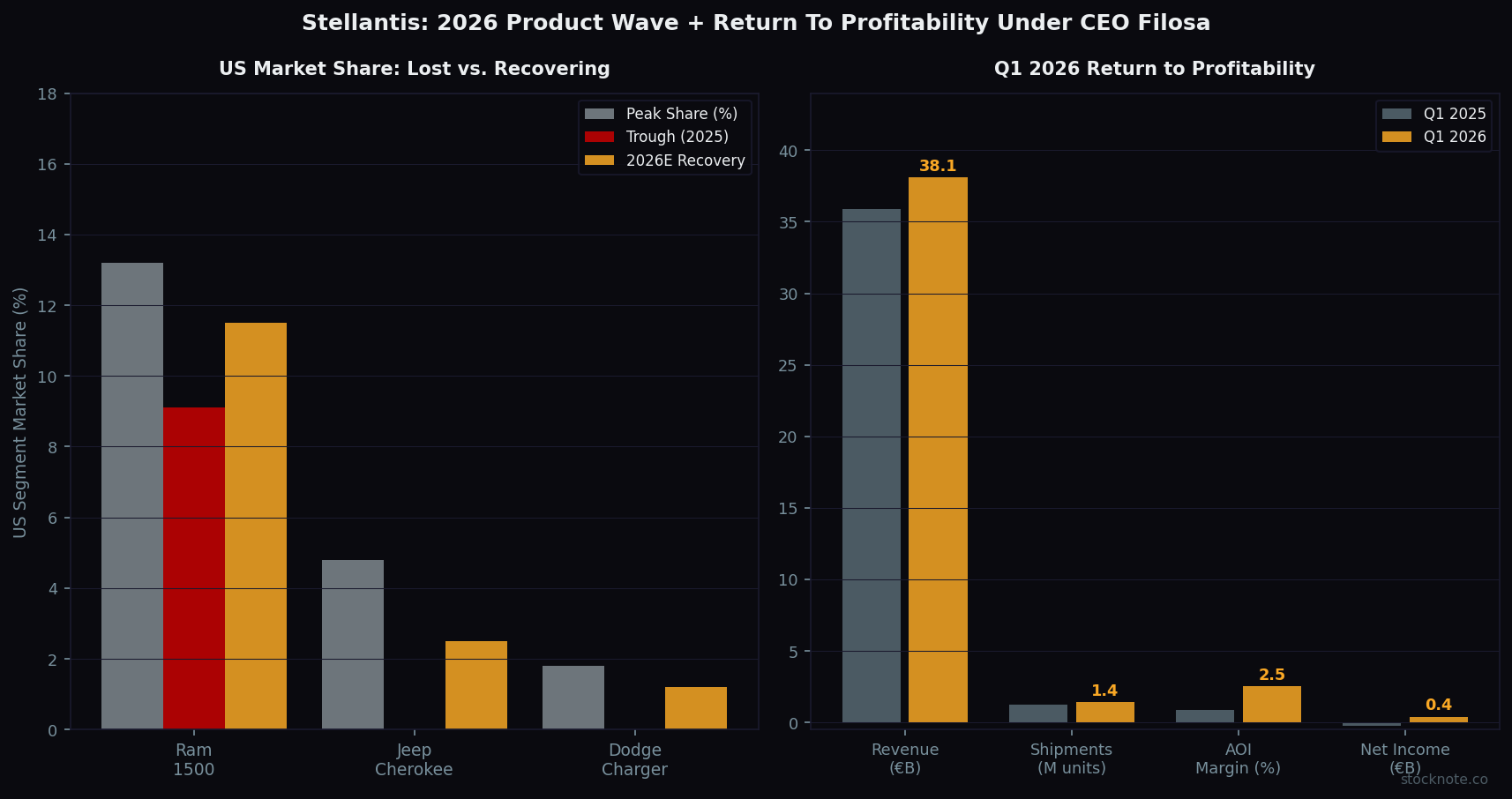
Dodge Charger SIXPACK. The Dodge Charger SIXPACK marks a "decisive re-entry into the ICE muscle-car segment" — the brand's return to the high-octane V6/V8 performance heritage that built Dodge's consumer loyalty. The muscle car market is niche but loyal, and Dodge's absence from it (the previous Charger was discontinued) damaged the brand equity substantially with its core demographic. The SIXPACK's launch timing aligns with the Dodge brand's strategic repositioning as the performance arm of the Stellantis portfolio, distinct from the utility-focused Jeep and the work-focused Ram.
Forensic #2: The Stock Trades Below Net Industrial Liquidity — The Extreme Undervaluation Case
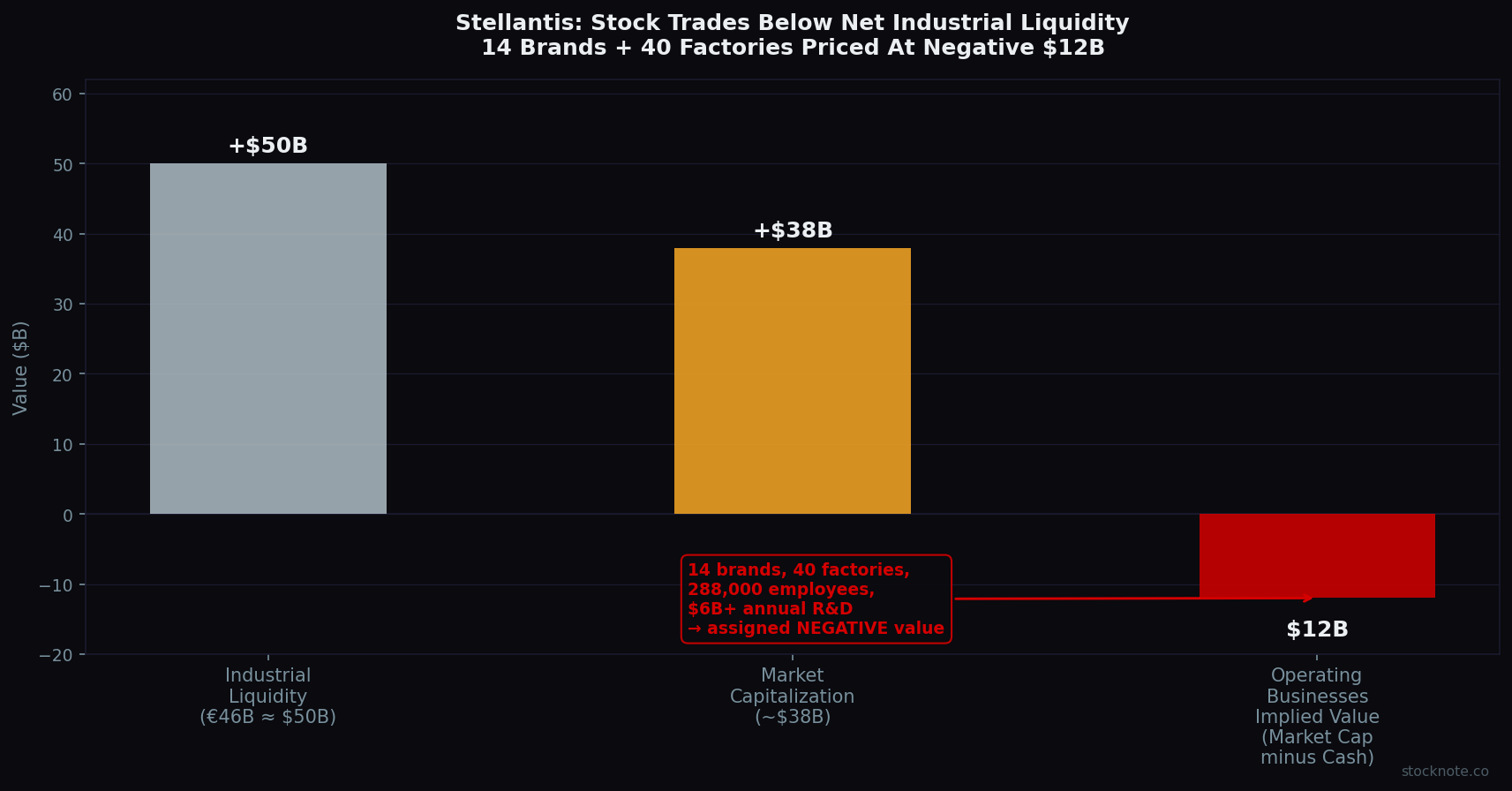
The most striking forensic in the Stellantis investment case is the net cash analysis. At the current STLA share price of approximately $12.50, the market capitalization is approximately $38B. Stellantis's industrial available liquidity at year-end 2025 was €46B ($50B+), including €17B of cash and equivalents plus undrawn credit facilities. Even after accounting for the negative industrial FCF of 2025 and Q1 2026, the remaining industrial liquidity is approximately €35–40B ($38–43B) — roughly equal to or exceeding the entire current equity market cap.
The implication is mathematically stark: the market is currently assigning zero or negative value to 14 car brands, 40 manufacturing facilities, 288,000 employees, and approximately $6B of annual R&D investment. Even in a scenario where Stellantis generates no operating profit for three years and burns €10B of cash, the remaining industrial liquidity would be €25–35B — still equal to or above the current market cap. The equity is trading as if the company will liquidate below book value, which requires assuming the operating businesses generate zero terminal value.
The capital allocation optionality. With €46B of industrial liquidity, Stellantis can either (a) execute the current turnaround without financial stress, (b) make strategic acquisitions of software, battery, or EV technology at current depressed valuations, (c) return capital through dividends and buybacks — the board reinstated the dividend and a €1.4B share buyback authorization is active — or (d) be acquired by a strategic buyer at a premium that reflects the brand portfolio's value. Any of these four outcomes is positive for equity holders at current prices. The first (operational recovery) is already in progress; the fourth (strategic transaction) becomes increasingly plausible as the stock remains below industrial liquidity.
Forensic #3: The Leapmotor EV Platform Provides China Market Optionality At Zero Cost
The third forensic involves Stellantis's 51% stake in Leapmotor International — the joint venture formed in 2024 to distribute Leapmotor-branded electric vehicles outside China. The JV is already delivering results: Leapmotor International shipments are included in Stellantis's Q1 2026 consolidated shipment figures, contributing to the 12% volume growth.
The strategic value. Leapmotor is one of China's fastest-growing EV manufacturers, with a technology stack (including its proprietary central domain controller architecture) that is competitive with BYD at lower cost points. By controlling the international distribution rights through a 51%-owned vehicle, Stellantis gains access to cost-competitive Chinese EV technology for global markets without the intellectual property risks of a full technology transfer. In Europe — where Stellantis's FIAT, Citroën, and Opel brands compete primarily in the value segment — a sub-€25,000 Leapmotor EV is a structural competitive weapon against the incoming wave of Chinese EVs from SAIC, Chery, and Geely. The bear case on Stellantis entirely ignores the value of the Leapmotor relationship, which is zero in every consensus model.
Sum-Of-The-Parts Valuation
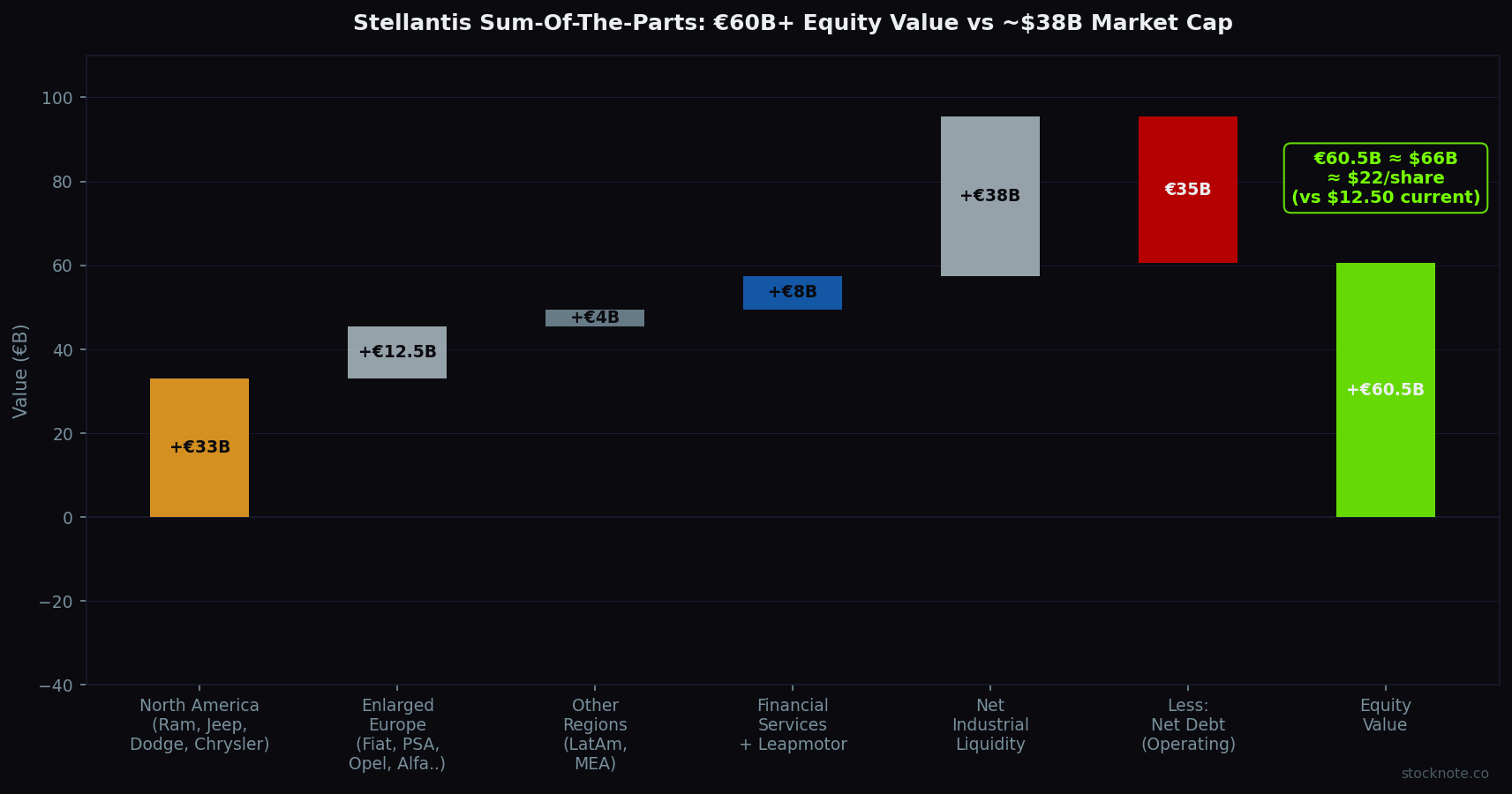
North America (Ram, Jeep, Dodge, Chrysler): Revenue approximately €85B annualized at target margins of 8–10% AOI, EBITDA approximately €11B. At 3x EV/EBITDA (depressed auto multiple reflecting current trough margins) = €33B. Enlarged Europe (Fiat, Peugeot, Citroën, Opel, Alfa Romeo, Maserati, DS): Revenue approximately €60B, EBITDA approximately €5B. At 2.5x = €12.5B. Other Regions (South America, MEA): Revenue approximately €20B, EBITDA approximately €2B. At 2x = €4B. Financial Services (Stellantis Financial): Book value approximately €6B. Leapmotor International JV (51%): Conservative value €2B. Net industrial liquidity: €38B (after FCF burn). Total equity value: €33B + €12.5B + €4B + €6B + €2B + €38B = €95.5B, minus €35B net debt in the operating segments = approximately €60B or approximately $66B at current FX. On approximately 3.0B diluted shares (US ADR basis) = approximately $22 per share. The 12-month target of $18 reflects conservative partial realization as North America volume recovery confirms; the multi-year $26+ reflects the full operational turnaround with margins recovering toward the 8–10% range.
Risks: What Would Break The Thesis
First, the Ram and Jeep product launches disappoint in retail sell-through — if dealer inventory builds without consumer pull-through, the Q2–Q3 AOI margins deteriorate and the industrial FCF remains negative through year-end. Track monthly US retail sales data (J.D. Power, Wards Auto) for Ram 1500 and Jeep Cherokee specifically. Second, tariff escalation above 25% on Mexican-manufactured vehicles — Stellantis's primary North America manufacturing base — imposing structural cost penalties that delay margin recovery. Third, the Leapmotor JV fails to gain traction in European markets, eliminating the EV optionality and confirming the structural competitive disadvantage in battery technology.
Conclusion and Investment Recommendation
Stellantis is a max-pessimism automotive value setup where the stock trades below net industrial liquidity, implying zero value for 14 global car brands and 40 manufacturing facilities. The Q1 2026 return to profitability under new CEO Antonio Filosa confirms the operational turnaround is underway; the North America product wave (Ram HEMI, Jeep Cherokee, Dodge Charger SIXPACK) is precisely targeted at the market share losses of 2023–2025; and the Leapmotor JV provides EV technology optionality at no additional cost. The downside floor is approximately the industrial liquidity itself; the upside is a full brand portfolio recovery. Rating: BUY. 12-month price target: $18. Multi-year intrinsic value: $26+.

Sandeep Gupta
Independent equity research analyst publishing forensic theses on US-listed stocks. MBA, Politecnico di Milano (Milan, Italy).
Get new research in your inbox
Subscribe to receive forensic equity research the moment it's published. Free, no spam.
Related Research
 BA
BA Boeing Out-Delivered Airbus For The First Time Since 2019 — The Production Ramp Math Says $275 (BA)
 DOW
DOW Dow's Q2 Guidance Raise Says The Cyclical Trough Is Behind Us — The Street Is Still Modeling Oversupply (DOW)
 O
O
Discussion
Be the first to comment.