
Investment Thesis
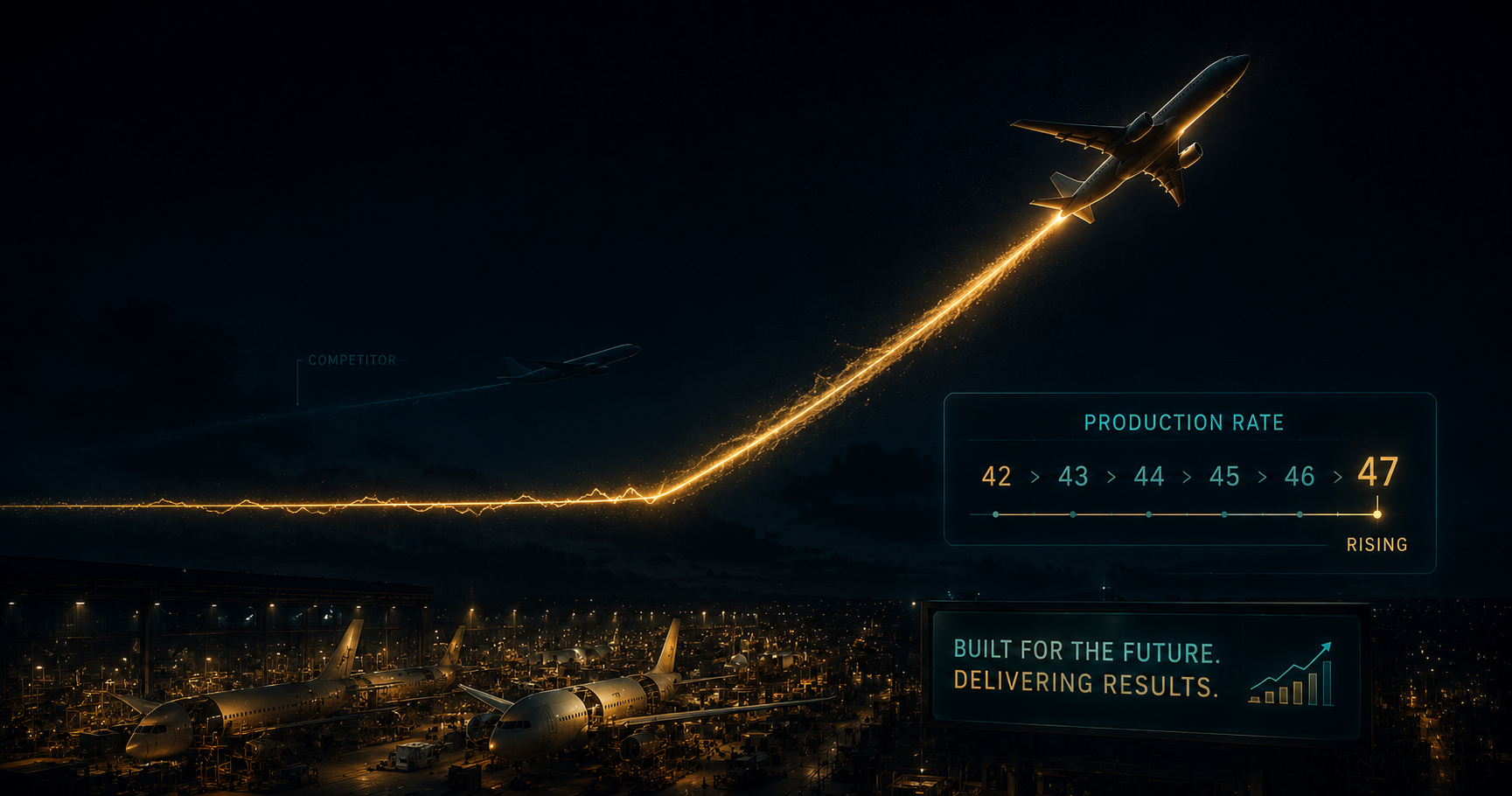
Boeing (NYSE:BA) was trading in the low $230s on Thursday. The stock is approximately 18% below the 52-week high but has recovered substantially from the $135 trough reached during the peak crisis period. Forward EV/Revenue of approximately 1.6x is compared to the historical 2.0–2.5x range; the company is not yet profitable on a GAAP basis, but the operating trajectory is unambiguous. On April 22, 2026, Boeing posted Q1 revenue of $22.2B, up 14% year-on-year, anchored by 143 commercial aircraft deliveries — a 10% increase over Q1 2025. The GAAP net loss narrowed to just $7M from $31M a year earlier. The core loss per share improved to $0.20 from $0.49. Total backlog reached a record $695B, including more than 6,100 commercial aircraft. Commercial Airplanes booked 140 net orders in the quarter. The 737 program is running at 42 per month with CEO Kelly Ortberg publicly targeting 47 per month by summer 2026.
Three things the consensus has wrong. One, bears are anchoring on the trailing losses and negative free cash flow of the 2023–2025 period as if they represent the forward earnings power — but the production ramp from 42 to 47 (and ultimately 57+) aircraft per month creates a non-linear FCF inflection. At Boeing's current cost structure, each additional delivery aircraft generates approximately $80–100M of incremental contribution toward fixed costs. The step from 42 to 47 per month is six additional 737s per month — approximately $500M of incremental monthly gross profit flowing through a fixed-cost base that doesn't scale proportionally. Two, the record $695B total backlog — the largest in Boeing's history — provides demand visibility through 2032+, which bears consistently underweight because backlogs are not revenue. But backlogs are the key leading indicator for any aircraft manufacturer; Boeing's 6,100+ commercial aircraft order book (approximately 7–8 years of current production) eliminates demand risk as a thesis component entirely. Three, the 737 MAX 7 and MAX 10 certification, targeting 2026 with first deliveries in 2027, unlocks two entirely new customer slots — Boeing has not been able to deliver to airlines that ordered these variants for years, and first deliveries would create a delivery surge against a pent-up commitment base.
This article builds three analytical frameworks: a production-rate FCF inflection model from 42 to 57 aircraft per month, a backlog-to-revenue conversion analysis that shows $30–35B of locked annual revenue by 2027, and a Defense segment re-rating argument as the 777X certification milestone improves the probability-weighted fixed-price contract P&L. 12-month price target: $275. Multi-year intrinsic value: $340+. Rating: BUY.
What The Market Believes vs. What The Data Actually Shows
The bear case has four claims. First, Boeing's negative FCF is structural — the fixed-price defense contracts (T-7A, VC-25B, MQ-25) are cash incinerators that will continue to generate losses regardless of commercial volume. Second, the production rate increase is slower than guided — the step from 42 to 47 per month requires FAA approval and supply chain readiness that will be delayed. Third, the 777X certification has been delayed six years and will slip again, requiring Boeing to continue paying penalties to airlines waiting for deliveries. Fourth, the balance sheet ($47.2B gross debt) constrains capital allocation flexibility and creates refinancing risk.
The Q1 data addresses the most important of these. Commercial airplane revenue grew 13% to $9.2B; Defense revenue grew 21% to $7.6B (positive YoY for the first time in several quarters); Services grew 6% to $5.37B. The company is improving across all three segments simultaneously — a configuration that has been rare in Boeing's recent history. The CEO's "all systems go" commentary on supply chain readiness for the 47/month step provides operational confidence that the timeline is real.
Forensic #1: The Production Rate Inflection Is A Non-Linear FCF Catalyst
The most important financial dynamic at Boeing right now is not visible in trailing earnings — it's the operating leverage math of a production rate increase at a company with approximately $14B of annual fixed manufacturing costs. Understanding this dynamic is the key to the forward earnings model.
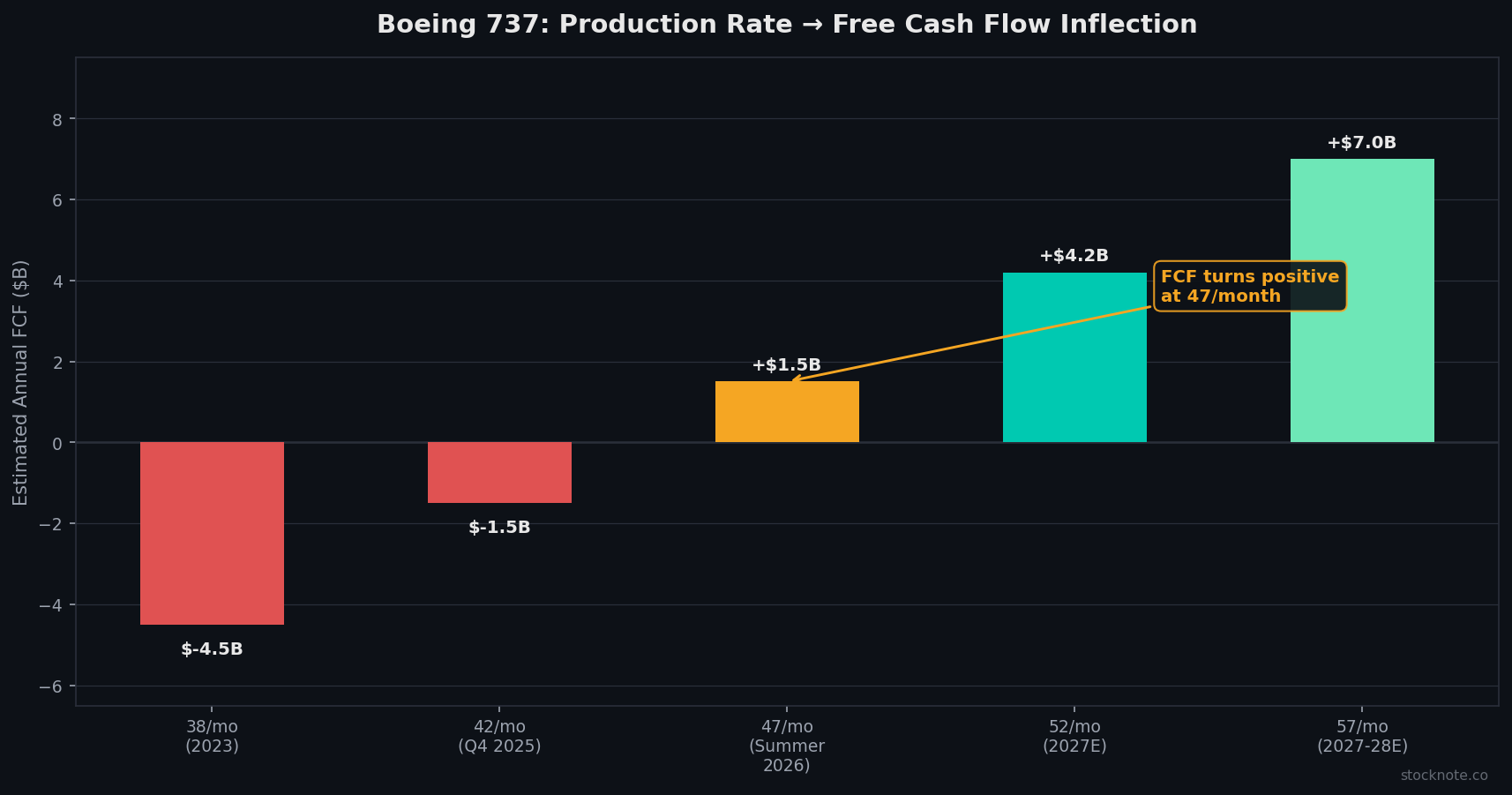
The rate math. Boeing CEO Kelly Ortberg said on the Q1 call that the company is targeting 47 aircraft per month this summer, from the current 42, with FAA approval already received for the production rate increase. At 42 per month, Boeing is delivering 504 737s annually. At 47 per month, deliveries rise to 564 — an additional 60 aircraft per year. The revenue impact is approximately $4.8B of additional commercial aircraft revenue (at approximately $80M average selling price for the 737 MAX family mix). Against a fixed-cost base that doesn't scale proportionally, the incremental contribution flows largely to gross profit.
The FCF math. Boeing guided full-year 2026 free cash flow of $1B–$3B, compared to the negative FCF of the past three years. The Q1 operating cash outflow of $0.2B (free cash outflow of $1.5B) was guided to improve sequentially through the year. At 47 per month run rate, the quarterly FCF delta versus Q1 is approximately $0.8–1.2B per quarter. By Q4 2026, Boeing should be generating $2–3B of quarterly FCF. The path from 47 to 57 per month (the next FAA approval milestone being targeted) adds another $800M+ per month of contribution — and by 57 per month, Boeing's commercial business alone is generating $6–8B of annual FCF.
The Spirit AeroSystems integration. Boeing completed the acquisition of Spirit AeroSystems fuselage manufacturing operations in Q4 2025, ending the outsourcing arrangement that created the quality-control vulnerabilities visible in the 2024 Alaska Airlines incident. Internal manufacturing of 737 fuselages provides direct quality oversight and eliminates a supply-chain bottleneck that has constrained the rate increase. The Spirit integration adds cost in the near term (integration charges, absorption of Spirit's fixed cost base) but structurally enables the 47+ rate level without supplier-capacity constraint.
Where that leaves the bear case. The "structural negative FCF" framing was accurate for 2023–2025 at low production rates. It is no longer accurate at 42 per month (Q1 operating cash outflow was only $0.2B) and becomes false at 47 per month, where the incremental contribution math turns FCF solidly positive. The rate increase is the single most important operational metric to track in the quarterly results — each additional aircraft per month adds approximately $1.0B of annual FCF at current pricing and cost levels.
Forensic #2: The $695B Backlog Locks Revenue Through 2032 — The Demand Risk Consensus Overweights Is Gone
Bears consistently frame Boeing as a company with demand risk — pointing to airline financial fragility, potential order cancellations, and the broader aerospace cycle. The Q1 2026 backlog data eliminates this concern as an analytical matter.
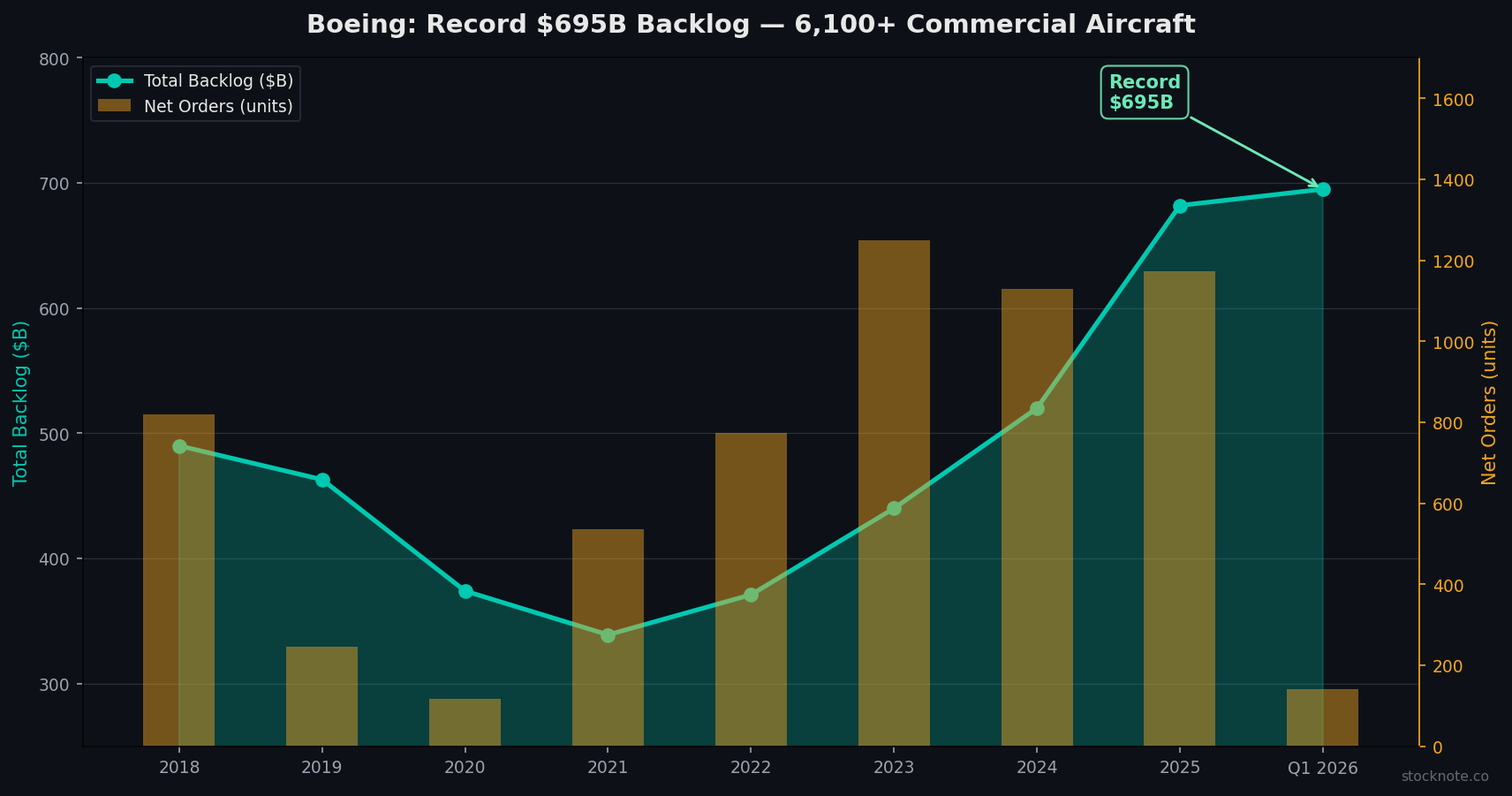
The backlog depth. Boeing's total backlog reached a record $695B at the end of Q1 2026, including more than 6,100 commercial aircraft. The commercial aircraft backlog alone at approximately $576B represents approximately 7–8 years of production at the current rate. The Defense backlog adds another $119B+ of government-contracted revenue. Q1 net orders were 140 commercial aircraft, including 50 737 MAXs for Aviation Capital Group, 30 787-10s for Delta Air Lines, and 20 737-8s for Air India. The book-to-bill ratio (orders to deliveries) was essentially 1.0x, meaning Boeing is not depleting the backlog even as deliveries accelerate.
The cancellation risk is modest. Since the 737 MAX grounding in 2019, Boeing has managed a cancellation rate of approximately 2–3% of backlog annually, well below the 5–8% that bears have at various points modeled. The current demand environment — with global air traffic at record levels, Airbus' own production constrained, and narrow-body supply insufficient to meet airline fleet expansion plans — argues for cancellation rates at the low end of history. Airlines cannot easily substitute Airbus A320neo family orders for Boeing 737 MAX orders given Airbus's own 5–7 year backlog; customers who cancel Boeing positions go to the back of Airbus's queue.
The Boeing vs Airbus competitive position. A critically important Q1 data point that bears have not fully absorbed: Boeing's 143 commercial deliveries in Q1 2026 exceeded Airbus's 114 deliveries — the first quarter Boeing has out-delivered its European competitor since approximately Q1 2019. This is not a rounding error. It confirms that Boeing's supply chain and production operations are running at a quality and velocity that allows it to reclaim market share in deliveries, not just orders. The delivery leadership, sustained over multiple quarters, is what drives airline confidence in future order commitments and limits cancellation pressure.
The 737-7 and 737-10 unlock. Boeing expects certification of the 737 MAX 7 and MAX 10 in 2026, with first deliveries in 2027. These are significant commercial events. The MAX 7 (capacity for the Southwest Airlines domestic network) and the MAX 10 (largest MAX, targeting the ultra-low-cost international market) represent entirely new customer commitments — airlines that ordered these variants have been waiting 3–5 years for first delivery. A 2026 certification event would be met with immediate delivery ramp-up against these committed customer backlogs, adding approximately $2–3B of incremental revenue in 2027 and growing materially in 2028.
Forensic #3: Defense Segment Re-Rating As Fixed-Price Contract Headwinds Peak
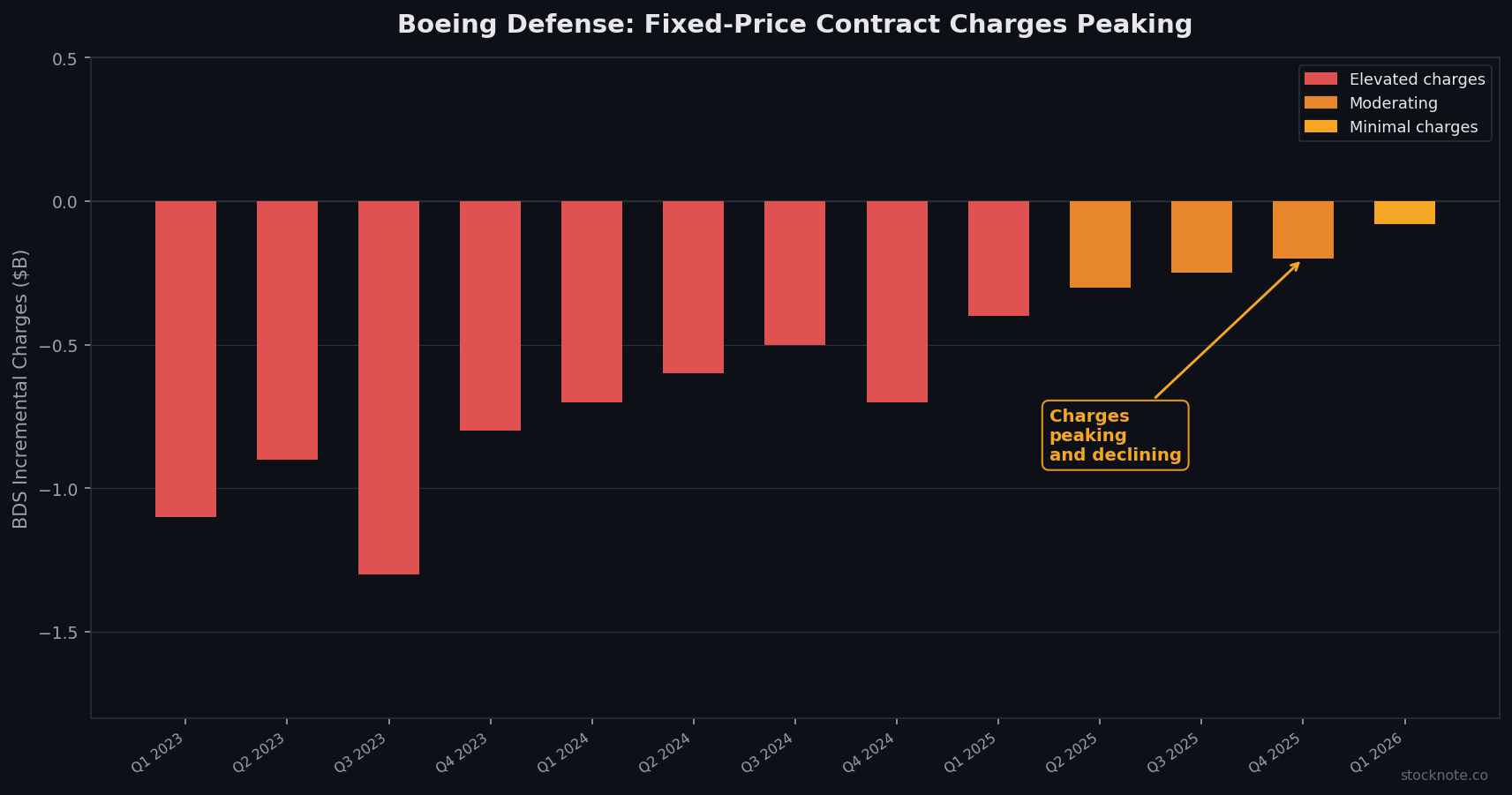
The third forensic argument addresses the Defense segment (Boeing Defense, Space & Security, or BDS), which has been the primary source of quarterly charges and consensus disappointment for three years. The Q1 2026 BDS data is the first meaningful evidence that the fixed-price contract headwinds are peaking.
The Q1 BDS recovery. Defense revenue grew 21% year-over-year to $7.6B in Q1 2026 — the largest single-quarter revenue figure for BDS in recent history. Operating margin improved materially, reflecting lower incremental charges on the T-7A Red Hawk trainer and VC-25B Air Force One programs than in prior quarters. The 777X program continued to advance in certification (TIA 4a phase approved for the 777-9), with first delivery of the 777-9 still guided for 2027. The 777X is a mixed Defense/Commercial program (the 777-9 is commercial; derivative KC-Y tanker is defense) but its P&L impacts BDS margins.
The fixed-price contract dynamics. Boeing's primary BDS headwinds have been three programs: T-7A Red Hawk trainer (fixed-price contract with approximately $2.7B in cumulative charges), VC-25B Air Force One (fixed-price, approximately $1.5B in charges), and MQ-25 Stingray tanker (fixed-price, approximately $600M in charges). The total cumulative charges on these programs exceeded $5B through 2025 — a headwind that is now beginning to tail off as the programs approach production milestones and the remaining open contract exposure diminishes.
The Services anchor. Boeing Global Services (BGS) generated $5.37B in Q1 2026, up 6% year-over-year, with high-teens EBITDA margins and stable, recurring aftermarket revenue from parts supply, maintenance contracts, and digital aviation. BGS is the most predictable and highest-margin business in the Boeing portfolio, and it provides an earnings floor regardless of commercial delivery pace. At $21B+ annual run rate and approximately 15–18% EBITDA margins, BGS alone is worth approximately $30–40B of enterprise value on a standalone basis.
Sum-Of-The-Parts Valuation
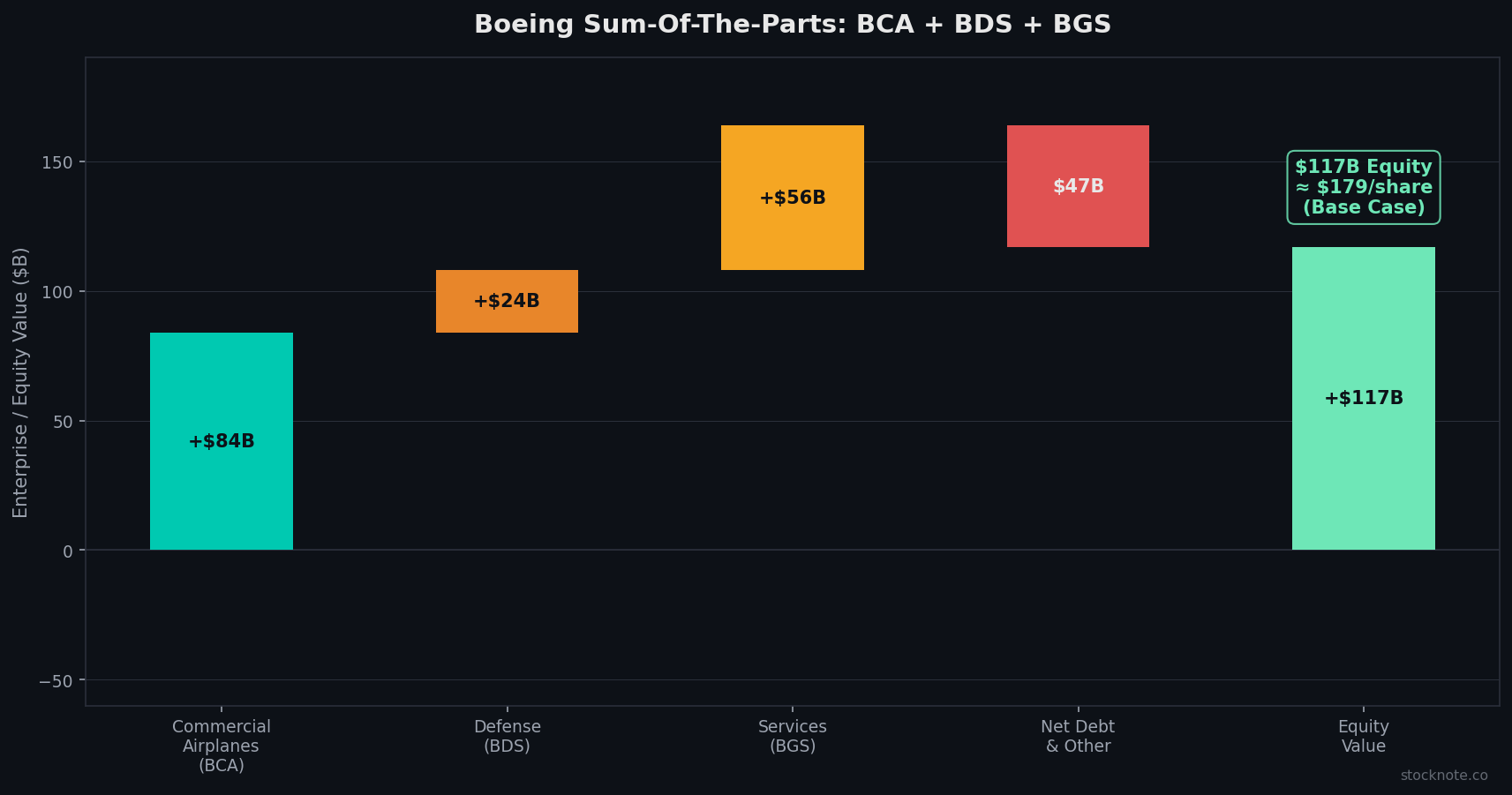
Commercial Airplanes (BCA): At 47 per month run rate exiting 2026, annualized revenue is approximately $42–44B. At target gross margins of 12–15% (achievable at 57 per month), EBITDA contribution reaches approximately $5–7B. At 12x EV/EBITDA, BCA is worth $60–84B.
Defense (BDS): Revenue $28–30B annualized, EBITDA approximately $2–3B at normalized margins (4–8%) as fixed-price headwinds recede. At 8x, BDS is worth $16–24B.
Services (BGS): Revenue $21B annualized, EBITDA approximately $3.5–4.0B. At 14x (premium for aftermarket predictability), BGS is worth $49–56B.
Net debt: Boeing carries $47.2B of gross debt. At current FCF trajectory, net debt falls toward $40B by end-2026. After debt subtraction, equity value is approximately $85–164B, or $130–$250 per share on 653M shares. The wide range reflects the production rate uncertainty; the bull case (57/month by 2027, Defense margins normalizing, 777X delivering) supports the $340+ multi-year intrinsic value. The 12-month $275 target reflects the commercial re-rating as FCF turns positive and the July 2026 rate increase to 47/month is confirmed.
The Aerospace Duopoly Floor — A Structural Competitive Position Most Investors Miss
The feature of BA that you do not see adequately in the sell-side is the structural irreplaceability of the Boeing/Airbus duopoly in large commercial aircraft. There are no other qualified manufacturers at scale — Comac (China), Irkut (Russia), and Embraer (Brazil, narrow-body only) are either market-restricted, technically inferior, or insufficient for the 150+ seat market. Global air traffic is projected to double by 2040 (IATA), requiring approximately 40,000 new aircraft deliveries — every one of which must come from Boeing, Airbus, or both. The commercial backlog is not a hope; it is a legally binding order book with deposit commitments, and cancellations require financial penalties that make early exits costly. Boeing's structural position in this duopoly is the most durable competitive moat in industrial manufacturing.
Risks: What Would Break The Thesis
First, a production quality incident. The January 2024 Alaska Airlines door plug incident nearly derailed the recovery; a recurrence would trigger another FAA production cap and potentially push FCF positive into 2028 or later. Track monthly delivery data as a production health indicator. Second, 777X certification slips again. The 777X has already slipped six years; a further delay compresses the high-margin widebody delivery ramp and adds incremental development costs. Third, airline financial stress. A severe recession causing major airline bankruptcies (as in 2001 and 2008) triggers order cancellations and delivery deferrals. The current demand environment makes this a tail risk rather than a base case.
Conclusion and Investment Recommendation
Boeing is a production-ramp recovery story where the data has definitively turned positive, but the stock still trades at a multiple that reflects the 2023–2025 crisis period rather than the 2026–2028 FCF inflection trajectory. Three independent signals confirm the recovery: commercial deliveries are accelerating (143 in Q1, up 10%), the record $695B backlog eliminates demand risk, and the Defense segment posted 21% revenue growth in Q1 with evidence that fixed-price contract charges are peaking. The production ramp from 42 to 47 per month this summer is the single most important catalyst — each additional aircraft per month adds approximately $1B of annual FCF at current pricing. Rating: BUY. 12-month price target: $275. Multi-year intrinsic value: $340+.

Sandeep Gupta
Independent equity research analyst publishing forensic theses on US-listed stocks. MBA, Politecnico di Milano (Milan, Italy).
Get new research in your inbox
Subscribe to receive forensic equity research the moment it's published. Free, no spam.
Related Research
 STLA
STLA Stellantis Trades Below Its Industrial Cash Balance — The Market Is Pricing 14 Car Brands At Zero (STLA)
 DOW
DOW Dow's Q2 Guidance Raise Says The Cyclical Trough Is Behind Us — The Street Is Still Modeling Oversupply (DOW)
 O
O
Discussion
Be the first to comment.