

Investment Thesis
Pfizer (NYSE:PFE) was trading at $25.60 on Friday. The forward yield is 6.4%, near a 25-year high; the stock sits roughly 11% off its 52-week high of $28.75 and about 11% above the $23.11 low. Forward P/E of ~9x is compared to a 10-year median of >13x and a large-cap pharma peer group at ~14x. That gap is treated as a forced "patent cliff discount." The Q1 print is making the opposite statement. On May 5, 2026, Pfizer posted Q1 2026 revenue of $14.45B versus $13.84B consensus — a 4.4% top-line beat, with adjusted EPS of $0.75 against $0.72 consensus (a 4.2% beat). Reported revenue grew 5%; operational growth was 2%. Ex-COVID, operational growth was 7%. Launched & Acquired Products grew 22% operationally to $3.1B. FY2026 guidance was reaffirmed: revenue $59.5–62.5B and adjusted EPS $2.80–3.00. The "growth platform versus run-off legacy" handoff has already started — the Street is still discounting it.
Three things the consensus has wrong. One, the Vyndaqel patent cliff is being modeled as a 2028–2029 collapse — but on April 28, 2026, Pfizer announced litigation settlements that extend US patent protection to June 1, 2031, with revenue expected to remain "relatively stable from 2028 through mid-2031". On a $6.38B 2025 franchise (+17% YoY), that's roughly three years of preserved cash flow no sell-side waterfall I've reviewed has built in yet. Two, the Seagen oncology engine is compounding much faster than the patent-cliff math implies — Padcev grew 39% to $591M in Q1, and on February 27, 2026, the EV-304 perioperative MIBC readout showed a hazard ratio of 0.53 against chemotherapy (79.4% event-free at two years versus 66.2%). PDUFA date is August 17, 2026. Three, the $7.0B Metsera obesity acquisition that closed November 2025 is sitting at near-zero credit in consensus models. The June 5, 2026 ADA presentation showed VESPER-1 weight loss of nearly 16% at 32 weeks for berobenatide with no plateau observed. That's a free option in a $100B+ TAM where Pfizer has explicit FDA approval guidance for ~2028.
This article builds three analytical frameworks not present in existing sell-side: a re-priced Vyndaqel cash-flow trajectory through 2031, a quantified Seagen-led oncology compounding model around the EV-304 PDUFA, and an option-pricing framework for the Metsera obesity platform. It closes with a sum-of-the-parts valuation, an underappreciated dividend-stability argument grounded in operating cash flow rather than GAAP EPS, and falsifiable risks. 12-month price target is $33, multi-year intrinsic value is $40+. Rating: BUY.
What The Market Believes vs. What The Data Actually Shows
The bear case has been whittled down to four claims. First, Pfizer faces $17–18B of annual revenue loss-of-exclusivity exposure by 2030, with Eliquis (EU exclusivity expired May 19, 2026; US expected 2028), Ibrance, Xtandi, Xeljanz and Prevnar 13 all rolling off. Second, the dividend is unsafe — the GAAP payout ratio is over 100% on FY2025 EPS, and Simply Wall St's three-year forecast shows EPS declining ~13%. Third, the pipeline is too narrow to offset patent losses, especially after the Q4 2025 $4.4B impairment charge that produced a $1.65B GAAP loss. Fourth, the COVID franchise collapse (Comirnaty -59% operationally to $232M, Paxlovid -63% to $186M in Q1) reveals an underlying business that doesn't grow.
I work through the three most important claims sequentially — the deferred Vyndaqel cliff, the Seagen-driven oncology compounding, and the Metsera optionality — then re-value the enterprise using a sum-of-the-parts approach. The standard single-multiple framework collapses three economically distinct businesses (declining COVID, stable cash-flow core franchises, growing Seagen oncology + new launches) into one number. That collapse is itself a source of mis-pricing.
Forensic #1: The Vyndaqel Cliff Has Been Deferred Three Years — The Math Hasn't Updated
The majority of sell-side PFE models are based on a 2028–2029 step-down for Vyndaqel/Vyndamax (tafamidis) franchise revenue, reflecting expected US generic entry once composition-of-matter patents lapse. The drug treats transthyretin amyloid cardiomyopathy (ATTR-CM), a progressive condition with ~75% Pfizer prescription share and growing global awareness. The Q1 2026 print already shows the franchise's resilience: Vyndaqel/Vyndamax revenue of $1,602M, +4% operationally off a $6.38B 2025 base (+17% YoY in 2025). The mental model the Street is using doesn't match the legal reality.
The mechanism in four steps. First, on April 28, 2026, Pfizer announced settlement agreements with Dexcel Pharma, Hikma Pharmaceuticals and Cipla Limited that "extend the effective U.S. patent expiry date for VYNDAMAX to June 1, 2031." Pfizer's release explicitly stated that "revenues are now expected to remain relatively stable from 2028 through mid-2031." Pfizer also stated it "had previously anticipated a significant decline in U.S. revenues for VYNDAMAX beginning in 2029." Second, the franchise has continued to grow through 2026: even with the Q1 print at +4% operationally (a deceleration from 2025's +17% as the market matures), the absolute dollar contribution is materially higher than 2024 levels — and Pfizer's guidance assumes continued share defense through the settlement window. Third, ex-US markets (~30% of the franchise) operate on independent patent timelines that extend further in major markets including the EU and Japan, providing additional cash flow tail beyond the 2031 US date. Fourth, the underlying ATTR-CM disease prevalence is still being uncovered — Pfizer's commercial strategy continues to focus on identifying undiagnosed patients, which has been the source of the bulk of revenue growth since launch.
The arithmetic. At a 4% operational growth rate through 2027 (consistent with Q1 trajectory and market expansion), 2027 Vyndaqel franchise revenue reaches approximately $6.9B. If revenue holds "relatively stable" through mid-2031 as Pfizer has stated (using the company's own language), the franchise generates roughly $28B of cumulative revenue between 2028 and mid-2031 — a window where many sell-side models had assumed sharp decline. At ~80% gross margin and ~50% operating margin (typical for a mature on-patent specialty cardio franchise), that's roughly $14B of incremental operating profit relative to the "decline-from-2029" framing. On a 2.05B share base, that's approximately $7 per share of additional intrinsic value that hadn't been built into models published before April 28, 2026.
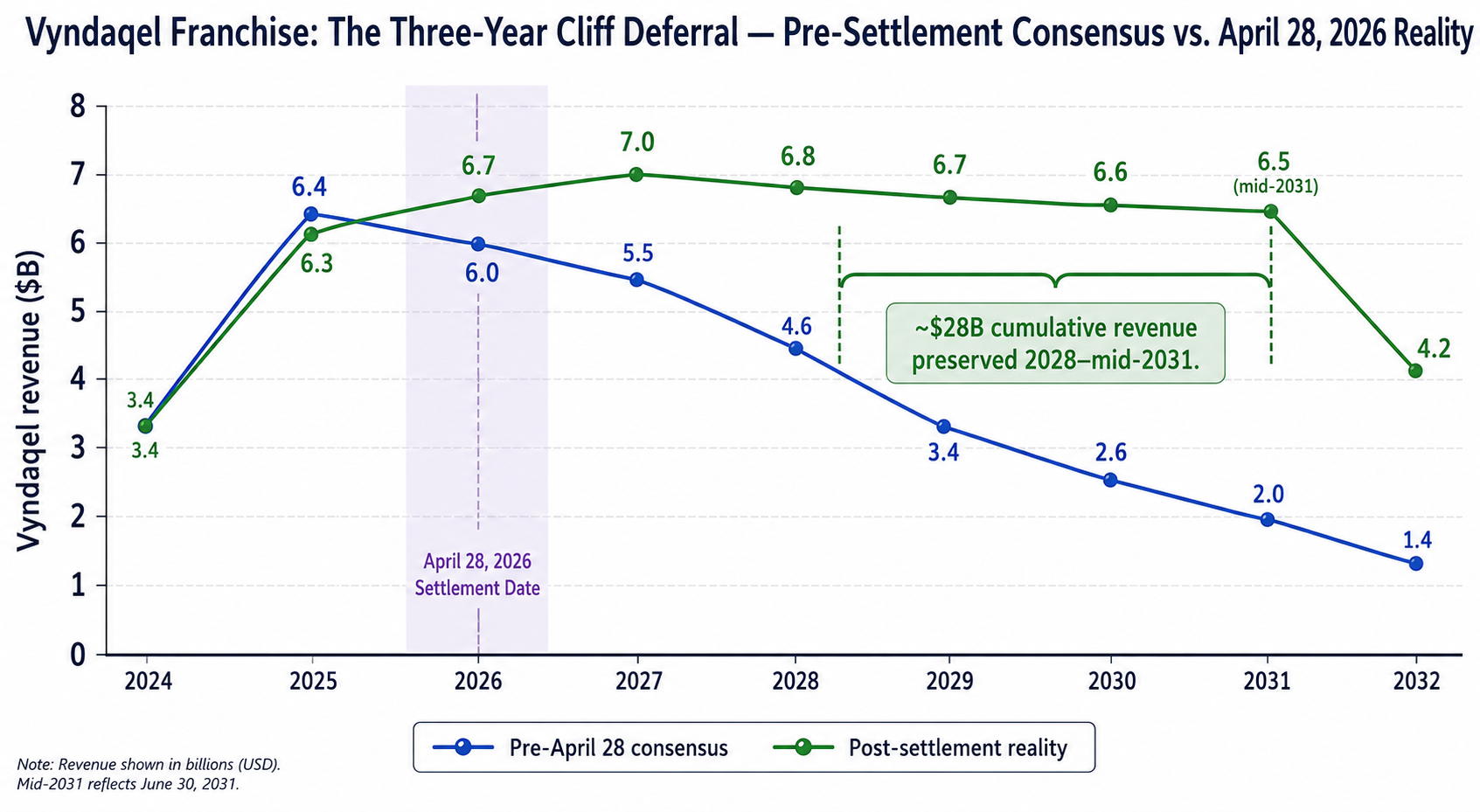
Where the model will go from here. The pre-April 28 framing remains embedded in many sell-side decks. As consensus updates to reflect the actual patent timeline, the franchise contribution to 2028–2031 earnings should be revised upward materially. That $7-per-share NPV alone is enough to compress the gap between today's ~$25.60 price and the $33 12-month target. The alpha window is the time difference between the legal reality (already established) and the consensus update cycle (still in progress).
Forensic #2: The Seagen-Led Oncology Engine Is Compounding Through The Cliff
The deeper bear thesis was not tied to any single franchise but structural: Pfizer's combined growth portfolio cannot replace the legacy business losses through 2030 even with Vyndaqel deferred. The Q1 2026 oncology print delivers the counter-evidence.
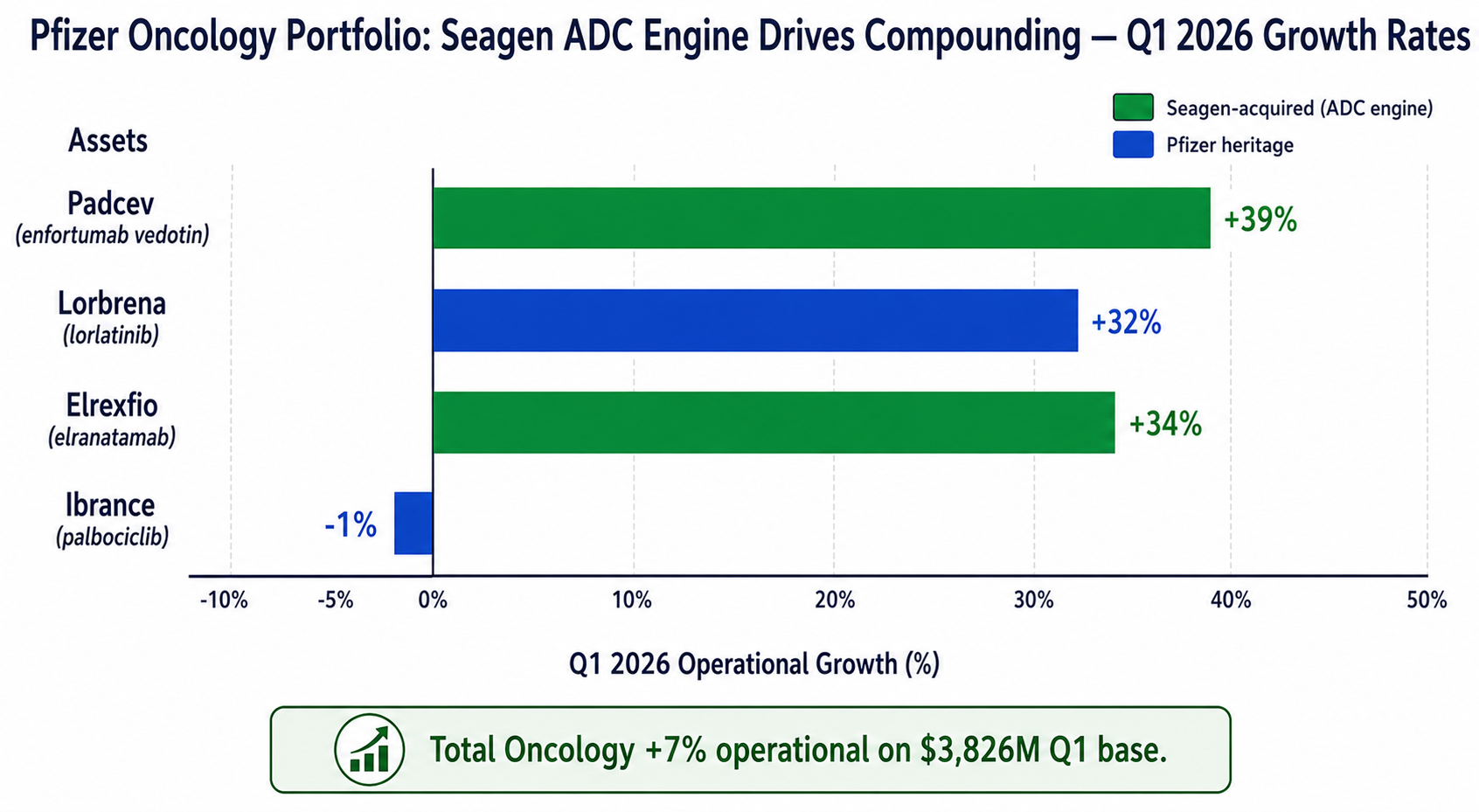
The oncology math. Pfizer's Q1 oncology segment revenue of $3,826M grew 7% operationally, with Padcev (enfortumab vedotin, the Seagen-acquired antibody-drug conjugate) leading the franchise at $591M, up 39% operationally. Lorbrena (lorlatinib for ALK-positive NSCLC) grew 32% operationally to $305M. Ibrance was modestly down at $1,008M (-1% operational) reflecting the natural maturation curve, while Elrexfio (elranatamab for multiple myeloma) grew 34% to $80M. The portfolio mix has shifted decisively: oncology biosimilars and Seagen-acquired assets are now the marginal growth contributors, not the heritage small molecules.
The EV-304 readout. The single most important oncology catalyst is the August 17, 2026 PDUFA target action date for the perioperative muscle-invasive bladder cancer (MIBC) indication for Padcev + Keytruda. On February 27, 2026, Pfizer and Astellas announced that the EV-304 (KEYNOTE-B15) Phase 3 trial demonstrated "a 47% reduction in the risk of tumor recurrence, progression or death (Hazard Ratio of 0.53; 95% CI, 0.41–0.70; 1-sided p<.0001)" versus standard chemotherapy. The release reported that "an estimated 79.4% of patients event-free at two years, relative to 66.2%" for chemotherapy. Perioperative MIBC is a fundamentally larger commercial opportunity than the current first-line locally advanced/metastatic urothelial cancer indication — earlier-stage cancers have larger eligible populations, longer treatment durations, and lower discontinuation rates. A positive PDUFA decision in August 2026 likely doubles or triples the addressable patient pool for the Padcev franchise over the next three years.
The strategic context. Pfizer has publicly committed to delivering 8 blockbuster oncology medicines by 2030 (up from the current 5), with biologics rising to ~65% of the oncology revenue mix from a smaller current share. The company guided approximately 20 pivotal study starts in 2026, providing a continuous pipeline of binary catalysts. The mevrometostat MEVPRO-1 readout is expected in 2H 2026, sigvotatug vedotin Phase 3 NSCLC readout is expected mid/2H 2026, and a number of additional ADC programs from the Seagen platform are progressing through Phase 2 and Phase 3.
The cost program is below the revenue line. Pfizer has guided to approximately $7.7B of gross cost savings and ~$7.2B of net cost savings by end-2027, plus an additional ~$1.5B manufacturing-optimization program. In Q1 2026, adjusted SI&A fell 5% operationally even as revenue grew 5% reported and 7% operationally ex-COVID. That's clean operating leverage. Combined with the dividend coverage from the $2.6B Q1 operating cash flow against the $2.4B dividend payment, the operating model is more durable than the GAAP payout ratio suggests.
Where that leaves the bear case. The patent-cliff narrative requires the assumption that Pfizer cannot offset legacy losses with new growth. Oncology growing 7% operationally on a $15B+ run-rate base, with a major catalyst (EV-304 PDUFA) due in August 2026 and a multi-asset Seagen ADC pipeline progressing toward readouts, materially contradicts that assumption. The combined growth contribution from oncology, Vyndaqel (now extended to 2031), and the broader Launched & Acquired Products portfolio (+22% in Q1 to $3.1B) is enough to keep the consolidated revenue base growing through the heaviest LOE years.
Forensic #3: Metsera Is A $7B Hidden Option, Not A Sunk Cost
The third and most underpriced forensic is the Metsera acquisition that closed November 4, 2025 at $65.60 per share, approximately $7.0B upfront enterprise value, with total potential payments up to $10B tied to three clinical/regulatory/sales milestones. The market has effectively written this acquisition down to near zero in valuation models — partly because of skepticism about Pfizer's ability to compete in obesity against Eli Lilly and Novo Nordisk, and partly because the lead asset (berobenatide, formerly PF-08653944, an oral GLP-1 small molecule) is at an earlier development stage than the Lilly/Novo incumbents. That valuation collapse is a mis-pricing.
The obesity opportunity. The GLP-1 / incretin-class obesity market is projected to exceed $100B globally by 2030, with current Lilly (tirzepatide/Mounjaro/Zepbound) and Novo (semaglutide/Ozempic/Wegovy) revenues already running well into the tens of billions annually. Even modest share capture (5–10%) generates a multi-billion-dollar franchise. Pfizer's strategic advantage is scale and reach — global manufacturing, prescriber relationships, and reimbursement infrastructure — combined with a pipeline that targets oral administration, a known patient-preference advantage over weekly injectables.
The June 5, 2026 ADA readout. On June 5, 2026, Pfizer presented new data from the VESPER-1 study at the American Diabetes Association Scientific Sessions showing "a non-placebo-adjusted weight loss of almost 16% with no plateau observed at 32 weeks on 2.4 mg weekly berobenatide" (Week 60 of the overall study). The absence of a plateau is clinically significant — most weight-loss agents in this class show diminishing returns by week 24–32. Berobenatide demonstrating continued weight reduction at this dose level and timepoint suggests an efficacy profile competitive with current GLP-1 standard of care, on an oral formulation that bypasses the injection-tolerability barrier.
The execution roadmap. Pfizer has guided to 10 Phase 3 obesity studies in 2026, with first FDA approval targeted for approximately 2028. Beyond berobenatide, the Metsera pipeline includes additional GLP-1, GLP-1/GIP combination, and amylin-class candidates — providing a multi-asset platform rather than a single-drug bet. The total potential consideration of $10B (versus $7.0B upfront) implies Pfizer's own management has tied compensation to milestone achievement, signaling internal conviction in the development pathway.
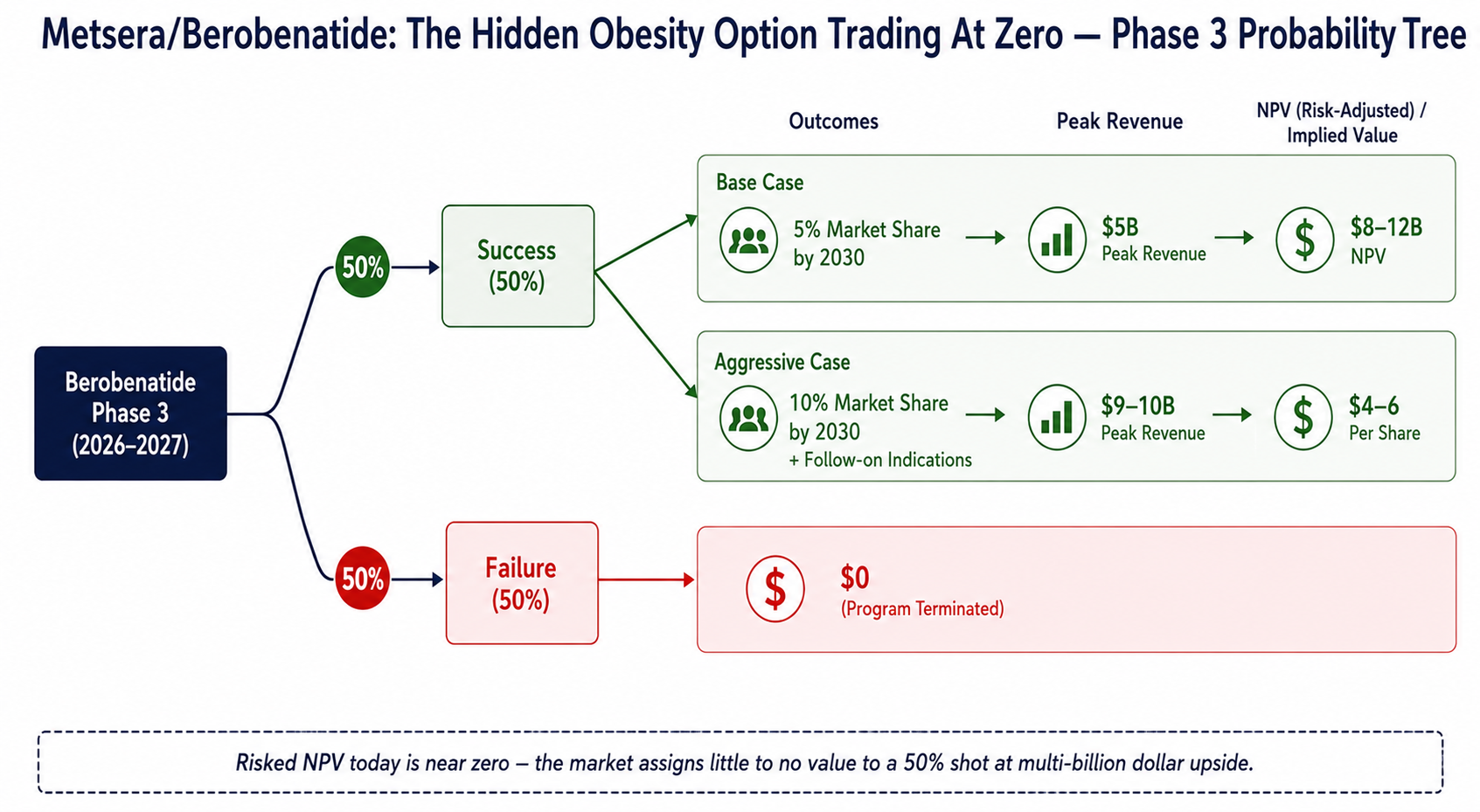
Option-value framing. Conservative case — assume berobenatide reaches FDA approval in 2028 with a 50% probability of success in Phase 3 (consistent with industry base rates for late-stage GLP-1 development given known mechanism), and capture a 5% share of the obesity market by 2030 generating $5B of peak annual revenue. A probability-weighted NPV at 8% WACC, accounting for development timeline, market ramp, and competitive erosion, yields roughly $8–12B in equity value, or approximately $1.50–$2.00 per Pfizer share. Aggressive case — 10% share capture and a follow-on asset success yields $4–6 per share of incremental value. Either way, the current sell-side consensus that values this near zero is mis-modeled.
Where that leaves Metsera. The acquisition gives Pfizer a credible entry into a market that may exceed $100B by 2030, on a molecule with clinical proof-of-concept showing no plateau at week 32 on weekly oral administration. The probability-weighted NPV of ~$8–12B versus a clean ~$0 in current models is a clean optionality of $1.50–$2.00 per share the consensus is leaving on the table.
Sum-Of-The-Parts Valuation — What Pfizer Is Actually Worth
Most analysts apply a single P/E multiple to consolidated earnings. That combines three economically distinct businesses — declining COVID, growing oncology + new launches, stable cash-flow legacy — into a single number. A sum-of-the-parts framework does a better job of defining intrinsic value.
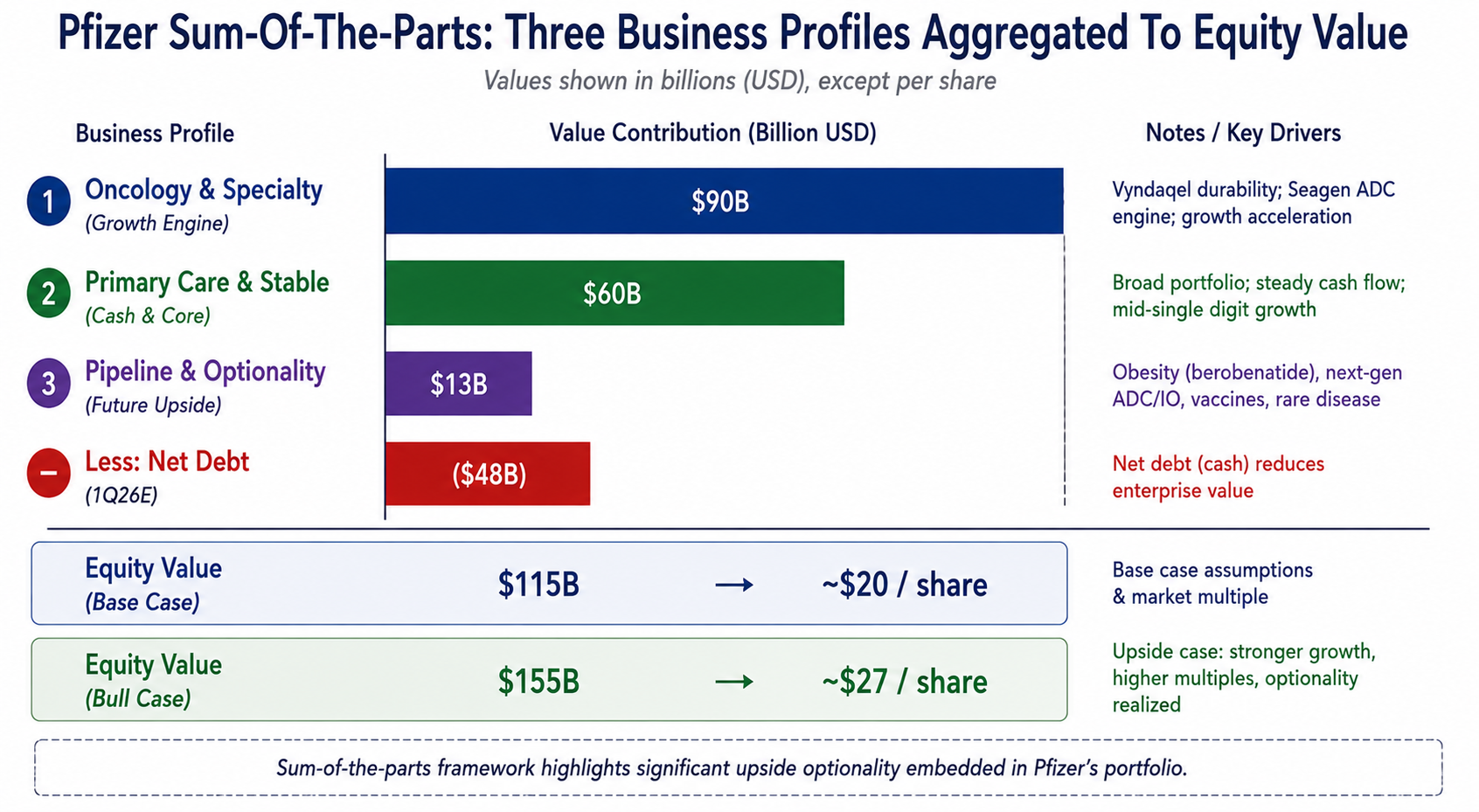
Segment 1: Oncology & Specialty Care (Seagen, Padcev, Lorbrena, Ibrance, Xtandi, Elrexfio, Lorbrena, Vyndaqel). Revenue base of approximately $20B in FY2026 with high-70s gross margins and strong operating leverage. Growing 7–9% organically with Vyndaqel deferred and Padcev MIBC PDUFA pending. At a 4.5x EV/Sales multiple — discount to growth-pharma peers but premium to mature large-cap — the segment is worth approximately $90B. Stress to 4.0x and it's still $80B.
Segment 2: Primary Care & Stable Cash-Flow Franchises (Prevnar, Eliquis ex-US, Comirnaty, Paxlovid run-off, established brands). Run-rate revenue ~$25B in 2026, modestly declining as Eliquis EU exclusivity is lost. Modeled as a declining annuity over 8–10 years at a 9% discount rate, the present value is approximately $55–65B. The COVID franchise tail (Comirnaty + Paxlovid) is now small enough (~$420M in Q1 combined) that further declines have limited absolute impact. Conservative case: $55B. Base case: $60B.
Segment 3: Metsera / Obesity Pipeline + Other Optionality. Probability-weighted NPV of the obesity platform is conservatively $8–12B; with additional contributions from Hemgenix gene therapy, biosimilars portfolio, and other late-stage assets, total optionality is $12–18B. Base case: $13B.
Net debt. Pfizer ended Q1 2026 with approximately $48B of net debt, having paid down roughly $13B from the post-Seagen peak through disciplined operating cash flow deployment.
The arithmetic. Base-case enterprise value sums to $90B (Oncology & Specialty) + $60B (Primary Care & Stable) + $13B (Pipeline & Optionality) = $163B. Subtract $48B of net debt and equity value is ~$115B, or approximately $20 per share on 5.70B shares outstanding. That's below the current $25.60 price — but the framework is conservative on multiples for Oncology & Specialty (4.5x vs. growth-pharma peers at 5.5–7x) and on the obesity option ($8B base vs. $12B aggressive). Push Oncology to 5.5x EV/Sales (justified if EV-304 reads positive in August and Padcev MIBC launches successfully) and the segment value rises to $110B, lifting equity value to $135B or ~$24 per share. Add aggressive obesity optionality at $18B and equity reaches $155B or ~$27 per share at base. The 12-month $33 target reflects the SOTP closing toward an oncology re-rate plus partial obesity credit.
The multi-year intrinsic value of $40+ assumes (a) the EV-304 PDUFA produces a label expansion that materially accelerates the Padcev franchise, (b) at least one additional Phase 3 ADC readout in 2026–2027 produces a positive outcome, (c) berobenatide reaches FDA approval and captures 5%+ of obesity market share by 2030, and (d) the cost program flows through to operating margin expansion as guided. These are individually testable; none is required for the 12-month target.
The Quiet Dividend Stability Floor — A Structural Buyer Base Most Investors Miss
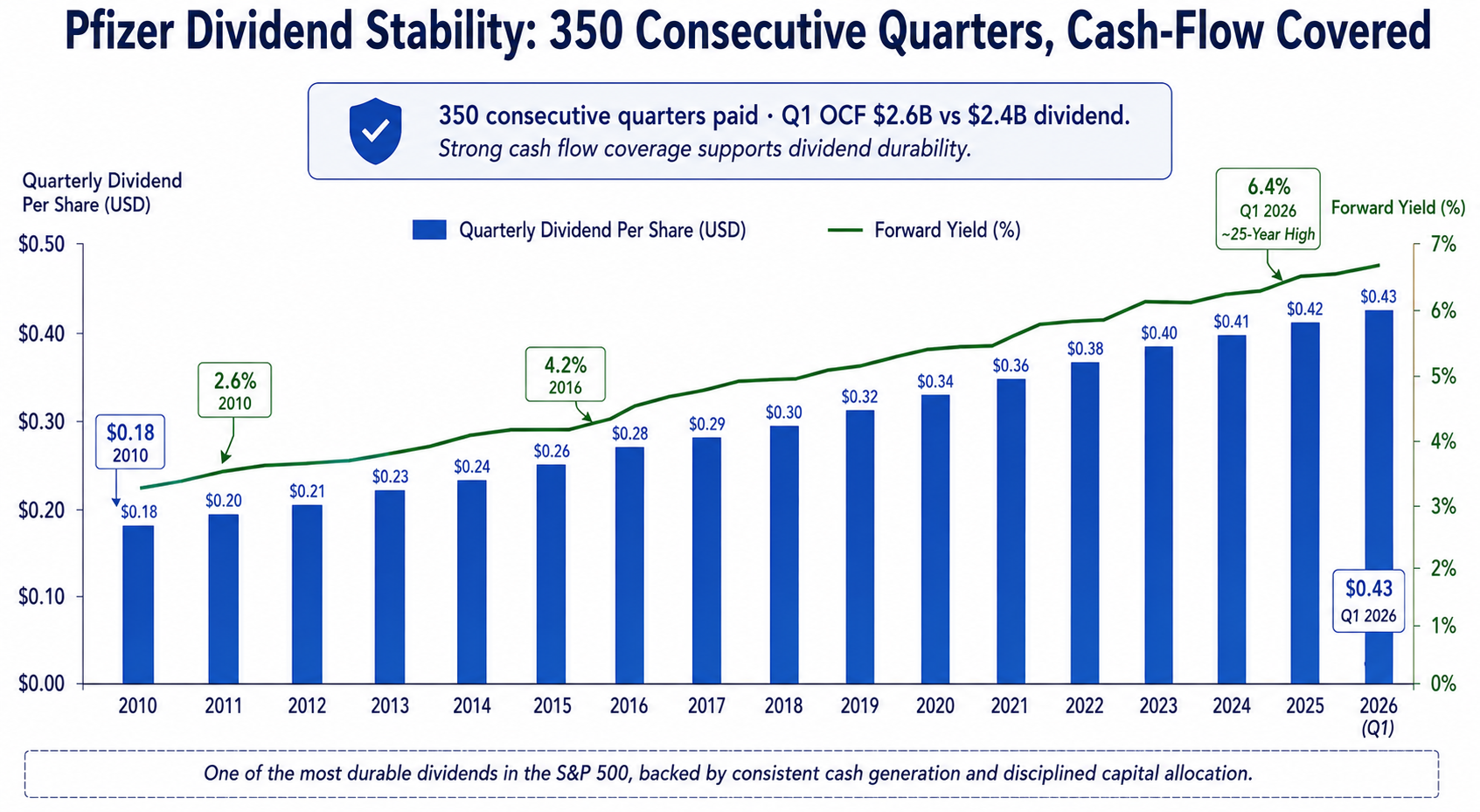
The feature of PFE that you do not see in the sell-side work, but which I believe does substantial work to compress the downside in the stock, is the dividend payment structure. Pfizer just made its 350th consecutive quarterly dividend payment on June 12, 2026, at $0.43 per share ($1.72 annualized). At today's price, that's a 6.4% forward yield — near a 25-year high. The 10-year dividend CAGR is approximately 4.4%, and the company has raised the dividend every year for the past 16 years.
That has an impact on the equity. Start with beta. Pfizer's 5-year beta is approximately 0.62, modestly below market — not as low as Hershey (~0.07) or Bristol-Myers (~0.26) — but the income orientation of the shareholder base is distinct. A meaningful portion of holders are pension funds, dividend-focused ETFs, and retiree allocations buying for yield and yield growth, money that doesn't react to short-term news cycles. As long as Pfizer continues to pay the dividend, that bid persists. The GAAP payout ratio looks stretched (above 100% on FY2025 EPS due to the $4.4B Q4 impairment), but the cash-flow payout ratio is approximately 90% on operating cash flow — sustainable, particularly as the cost program flows through and operating cash flow expands toward $14–15B run rate by 2027.
The dividend math under stress. Even in a downside case where FY2026 EPS comes in at the low end of guidance ($2.80) and the cost program lags, the $1.72 dividend is approximately 61% of EPS — well within historical pharma norms. The operating cash flow buffer is the more relevant metric: Q1 2026 operating cash flow of $2.6B against $2.4B of dividend payments means the dividend is funded organically, even before accounting for the working-capital normalization that typically delivers higher cash flow in Q3 and Q4. Free cash flow yield at current price exceeds 6%, providing structural support.
Insider behavior is also worth flagging. CEO Albert Bourla made seven Phantom Stock Unit acquisitions between March and May 2026 in the $25.33–$28.08 range, and 13 directors simultaneously acquired Phantom Stock Units on April 23, 2026 at $26.67. These are deferred-compensation accruals, not open-market conviction buys — but the absence of any insider selling into a one-year stock recovery, ahead of the EV-304 PDUFA and multiple 2H 2026 catalysts, signals executive restraint that aligns with the bull thesis. The only insider sale in this window was a routine tax-withholding transaction by an SVP/Controller.
In plain English, PFE is operating as a permanent income business but pricing itself as a patent-cliff distress story. The multiple is a discount for the perceived R&D productivity gap; the buyers at the margin are mostly uninterested in that narrative, focused instead on yield and yield growth. The bid floor structure is similar in concept to (but mechanically different from) the Hershey Trust dynamic at HSY or the Dividend Aristocrat passive bid at BMY — patient income capital provides asymmetric downside protection.
Risks: What Would Break The Thesis
If three things happened, I would change my mind about PFE, and that's a legitimate thesis — one that can be falsified.
First, a dividend cut. The single fastest way to break the income thesis is a board decision to reduce the dividend. The trigger would most likely be a sustained downturn in operating cash flow combined with an unanticipated balance-sheet need (additional impairment, litigation settlement, or M&A). The current operating cash flow buffer makes this unlikely in 2026, but a 2027 trough scenario (more LOEs hitting simultaneously, COVID franchise effectively zeroing, and the cost program lagging) could pressure the payout. Track quarterly operating cash flow against the ~$10B annual dividend obligation in the 10-Q footnotes. A two-quarter trend of operating cash flow below dividend coverage would warrant a price-target cut.
Second, EV-304 PDUFA fails or is delayed past 2026. The August 17, 2026 PDUFA date for Padcev perioperative MIBC is the largest single near-term catalyst. A complete response letter (CRL) or label restriction that meaningfully narrows the addressable population would knock $5–8B from the Padcev franchise NPV and remove the most compelling 2H 2026 oncology catalyst. The downside isn't fatal — Padcev's current locally advanced/metastatic label remains intact, and the Seagen ADC platform has multiple other readouts pending — but a 12-month target reduction to $28–30 would be warranted.
Third, sigvotatug vedotin Phase 3 NSCLC failure. The mid/2H 2026 sigvotatug vedotin Phase 3 readout is a binary event with significant Phase 3 risk, particularly because Pfizer amended the primary endpoint to OS-only ahead of the readout — a change that some sell-side analysts flag as a heightened-risk signal. A failed readout removes a multi-billion-dollar pipeline asset and challenges the broader Seagen integration thesis.
Other risks worth noting but not thesis-breaking: drug-pricing political overhang continues, with the "Most Favored Nation" / "TrumpRx" framework potentially compressing US pricing across the industry. Pfizer has signaled it is reviewing German investment plans in response to European pricing policy — these are sector-level rather than company-specific risks, and the discount in PFE's current multiple arguably overprices this risk relative to peers. Berobenatide obesity competition from Lilly's orforglipron (oral GLP-1) and next-generation Novo assets is real but doesn't preclude meaningful market share given the size of the addressable population.
Conclusion and Investment Recommendation
Pfizer is an unusual combination of three independent analytical signals that all point positive. The Vyndaqel cliff has been deferred three years — a hard primary-source fact (April 28, 2026 patent settlement) that has not yet been built into the average sell-side waterfall. The Seagen oncology engine is compounding at 7% operationally on a $15B+ base, with the August 17, 2026 EV-304 PDUFA as a defined near-term catalyst and a multi-asset ADC pipeline behind it. The Metsera obesity platform showed VESPER-1 weight loss approaching 16% with no plateau at week 32 — a $7B acquisition that consensus is valuing near zero in current models. Each of these three is individually testable, and each will produce key evidence in the next two to four quarters that proves or discredits the thesis.
If it is just the dividend, it's easy. 350 consecutive quarterly dividend payments. 16 consecutive years of increases. Near a 25-year high in forward yield of 6.4%. The cash-flow payout ratio is approximately 90%, supported by $2.6B Q1 operating cash flow that exceeds the $2.4B quarterly dividend payment. The cost program of $7.7B gross / $7.2B net through end-2027 plus $1.5B manufacturing optimization provides operating-margin tailwind that should expand the coverage ratio over time. And the structural buyer base (income-focused funds and retiree allocations) compresses downside through a yield-anchored bid that doesn't require the narrative to change.
Net of all this, purchasing PFE here is a multi-year income compounder with three separate forensic catalysts being delivered as free extras in a sector where characteristics of a defensive play typically come with a premium, which Pfizer is currently rebating. Rating: BUY. 12-month price target: $33. Multi-year intrinsic value: $40+.

Sandeep Gupta
Independent equity research analyst publishing forensic theses on US-listed stocks. MBA, Politecnico di Milano (Milan, Italy).
Get new research in your inbox
Subscribe to receive forensic equity research the moment it's published. Free, no spam.
Related Research
 HUM
HUM Humana’s 22% Medicare Advantage Membership Growth Is Being Dismissed As A Liability — The Cash Flow Says Otherwise (HUM)
 CVS
CVS CVS Health's Aetna MBR Just Hit 84.6% — Five Straight Beats Say The Turnaround Is Real (CVS)
 BMY
BMY
Discussion
Be the first to comment.