

Investment Thesis
Bristol-Myers Squibb (NYSE:BMY) was trading at $59.25 on Friday. The forward yield is 4.5%, near a 15-year high; the stock sits roughly 6% off its 52-week high of $62.89 and 39% off the $42.52 low. Fwd P/E of ~9.3x is compared to a 10 year median of >13x as well as a large-cap pharma group of ~14.8x. That gap is an absolute disaster in the transition to the patent-cliff. The Q1 is making the opposite statement. On April 30, 2026, BMY posted Q1 2026 revenue of $11.49B versus $10.69B consensus — a 7.4% top-line beat, with non-GAAP EPS of $1.58 against $1.42 consensus (an 11.1% beat). The guidance remained unchanged, with revenue forecast at $46.0 – $47.5B and $6.05 – $6.35 in non-GAAP earnings per share (EPS), and management indicated that both guidance targets are being met. Growth Portfolio: $6.2B, up 12%. The company's legacy portfolio stood at $5.3B, which was down 6%. Crossover has begun.
Three things the consensus has wrong. One, the Eliquis IRA hit is being modeled as a revenue cliff, but management guided 10–15% growth for 2026 and Q1 printed $4.137B (+16% YoY). The offset mechanism — volume, ex-US share gains in generic-free markets, the inflation-penalty washout, rebate compression — is mechanical and laid out in the 10-Q, but I haven't seen it built into a single sell-side waterfall. Two, the patent-cliff math is being run on flat growth-portfolio assumptions, but the actual book just compounded 12% YoY on a $6.2B base — Camzyos +93% to $314M, Breyanzi +56% to $411M, both still well below peak. Three, the $14B Karuna deal that bought BMY the first new schizophrenia mechanism in 35 years is sitting at near-zero credit in consensus DCFs. The H2 2026 Alzheimer's psychosis readout (ADEPT-2) targets 2.5–4M U.S. patients with no FDA-approved drug. That's a free option.
This article builds three analytical frameworks not present in existing sell-side: a quantitative model of the Eliquis volume/price offset and the IRA inflation-penalty mechanism, a crossover-year model of the growth/legacy revenue handoff, and an option-pricing framework for Cobenfy's Alzheimer's psychosis indication. It closes with a sum-of-the-parts valuation, an underappreciated buyer-base/beta structural insight (BMY's 0.26 beta is the lowest in big pharma), and falsifiable risks. 12-month price target is $78, multi-year intrinsic value is $95+. Rating: BUY.
What The Market Believes vs. What The Data Actually Shows
The bear case has been whittled down to five claims. Loss of revenue in Eliquis due to Medicare negotiation — 2026–2028. The patent cliff (Eliquis 2028, Opdivo 2028 and Revlimid already slicing through) leaves a permanent revenue gap with no solutions. These cost-savings initiatives are not large enough to guard margins. When the pipeline just keeps blasting, what's remaining is of little value — LIBREXIA-ACS, Cendakimab for eosinophilic esophagitis, and KarXT-as-adjunct. The GAAP payout ratio appears high with the addition of IPRD charges to the dividend, and the dividend is unsafe. All of those can be checked against BMY's own SEC filings.
I deal with the three most important claims sequentially — the re-pricing of Eliquis, the growth/legacy crossover and the buried Cobenfy option — then re-value the enterprise using a sum-of-the-parts approach. The typical single-multiple system assumes a $26B+ run-on growth platform, and a $19B book of run-off Legacy business. The mix-up itself is a mis-pricing source.
Forensic #1: Eliquis Is Not Falling Off A Cliff — The Mechanics Of IRA Are Counterintuitive
The majority of sell-side BMY models are based on the wrong mental model. The drug was selected as one of the first 10 drugs to negotiate under the IRA and the negotiated "Maximum Fair Price" will be implemented on January 1, 2026. The Street thought it was the "all at once" loss of money, so the year 2026 would see a dramatic drop-off. Q4 2025 and Q1 2026 prints kill that framing.
The mechanism in 4 steps. First, the negotiated price only applies to the Medicare population for the U.S. business — the remaining part of the U.S. business, as well as the international book (which accounts for approximately 35–40% of Eliquis's total revenue) is not subject to negotiation. Second, at the same time that the rebated negotiated price is lower, the negative revenue streams (the "inflation rebate" penalties given to BMY under the old list price) will be reduced. The net mathematical effect of the net decrease in the mathematical price on the net realized price of BMY's scripts is materially less than the decrease in the headline price. Third, an unusual move by BMY, with the debut of Eliquis in April 2026 via Mark Cuban's Cost Plus Drug Company, bringing more cash-pay population and volume to the table. Fourth, and most important, Eliquis sales continue to increase as the prevalence of atrial fibrillation increases with population ageing, and the company's market share continues to exceed that of Xarelto and warfarin, and will do so in ex-US markets until generic competition appears in Europe in 2027.
The arithmetic. Worldwide Eliquis revenue is expected to expand 10–15% in 2026 on the back of a $14.4B total in 2025. Q1 2026 actuals exceeded even this: $4.137B in worldwide revenue, +16% YoY (+13% ex-FX). Management pointed to "wholesaler inventory build in Q1" as a cost that would turn negative in Q2 on the Q1 conference call, but made it clear that they remained unchanged in the full-year framework. With a conservative 10% growth assumption in FY2026, Eliquis revenue is still at ~$15.8B; which is $2–3B higher than I see in most sell-side models that have been released late 2025, with embedded $11–13B 2026 estimates. The example that BMY has set in two quarters in a row of "guide cautiously, beat consistently" is also information. Ex-U.S. generic entry starts in 2027 and a step-down occurs at that time — but not in 2026.
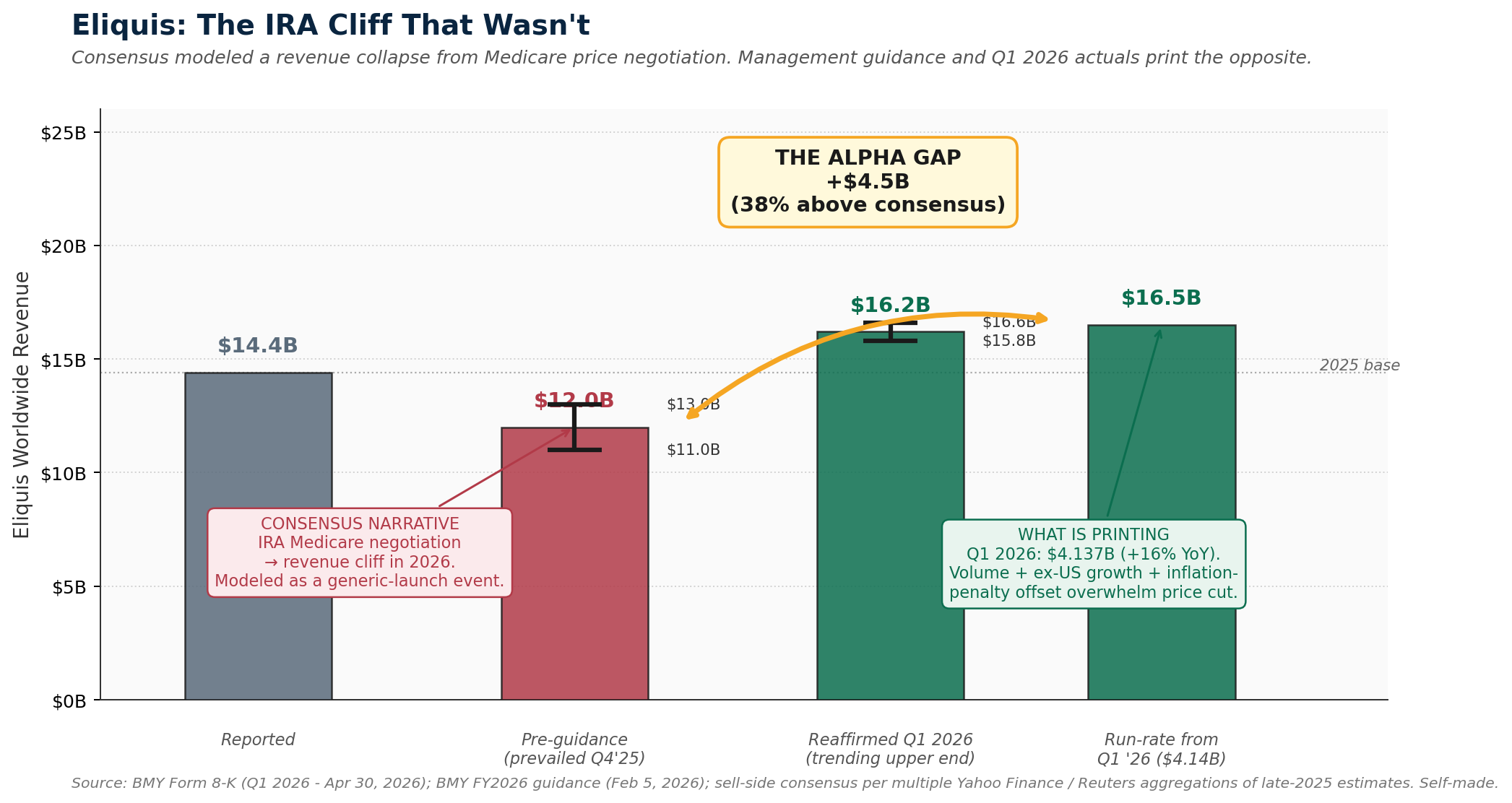
Where the model will go from then on. There is still some consensus that the 2024 framing of the IRA event is still not aligned with the 2026 P&L. That $2–3B revenue shortfall on its own should be enough to cause the stock to rise on the re-rating cycle. The alpha window is the difference in time between the two.
Forensic #2: The Growth Portfolio Crossover Is Already Mathematically Confirmed
The deeper bear thesis was not tied to Eliquis, but structural: When aggregated, BMY's Growth Portfolio is not able to replace the legacy business that will be lost due to generic erosion through 2028–2030 when Revlimid runs out of patent protection and Opdivo and Eliquis lose exclusivity. This is not opinion and the Q1 '26 data clearly works against the bear case.
The crossover math. Now there is a new reporting structure in BMY, with their P&L broken down into 2 reporting buckets. Growth Portfolio (Opdivo, Opdivo Qvantig, Orencia, Yervoy, Reblozyl, Breyanzi, Opdualag, Camzyos, Zeposia, Sotyktu, Krazati, Cobenfy and a few smaller ones); Legacy Portfolio (Eliquis, Revlimid, Pomalyst, Sprycel, Abraxane, and other solid products). Q1 2026: Growth $6.2B (+12% YoY), Legacy $5.3B (–6%). For FY2026, guidance is $46.0–$47.5B total, with Legacy down 12–16% and Growth expanding. The simple math: Growth crosses Legacy on a full-year basis in 2026. Most of the sell-side models penciled that inflection for 2028 or later.
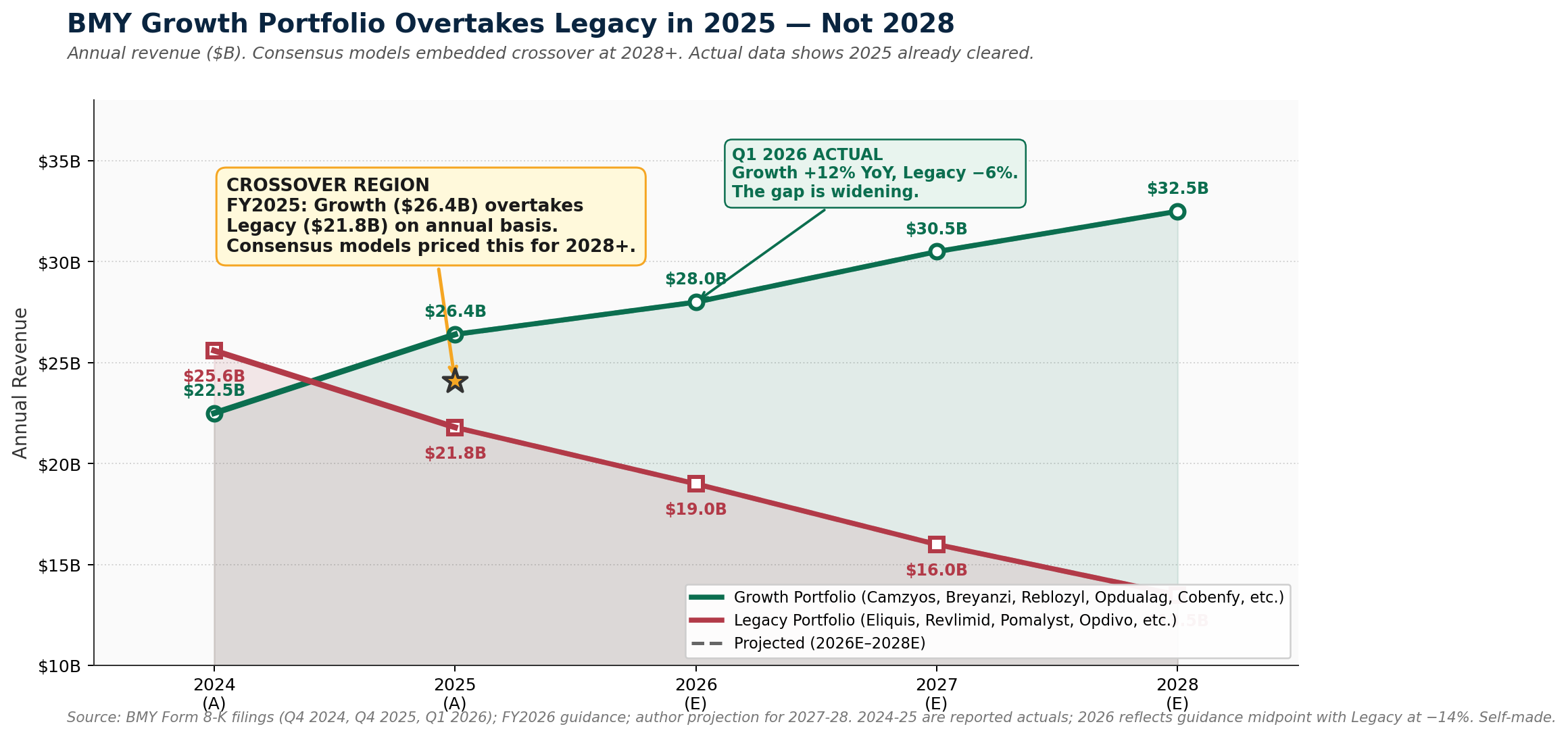
The engines in the front compartment. Camzyos (obstructive hypertrophic cardiomyopathy) revenue rose almost twofold in Q1 2026 to $314M and is on an obvious trajectory to a $2B+ run rate by 2027 as ex-US launches are expected to grow and competition from Edgewise (EDG-7500) is still theoretical, with the BMY competitor still figuring out how to operationalize their REMS programs according to BMY's commentary on Q1 2026 call. Breyanzi (CAR-T for B-cell malignancies) grew 56% to $411M; pricing power is high in this segment, and the expansion into autoimmune disease (lupus, systemic sclerosis) is a viable and credible $3–5B incremental revenue option that isn't part of consensus models. In Q1, Reblozyl rose 16% to $555M ($2.2B annualized) while the COMMANDS first-line MDS-anemia data remains a boon for the shares. This portfolio expanded by 17% in FY2025 to $26.4B, and is projected to hit ~$28–29B in FY2026 with Opdualag (the LAG-3 combination for melanoma) and Sotyktu (the newly approved PsA indication in May 2026).
The arithmetic of the cliff's motion. Eliquis is the #1 worry, but it remains in the Legacy book and continues to grow in 2026. Revlimid is the largest erosion report and it's now in its decline phase: it came in at $349M in Q1 2026, down 63% YoY, a number so small it's hard to see how it could be reduced further. Opdivo is now being restocked by Opdivo Qvantig (subcutaneous, $163M in Q1 2026), which helps maintain the franchise economics until 2030+. The cost program is below the revenue line. The incremental $2B savings program for end-2027 is in addition to the original $1.5B program — $3.5B of run-rate cost reduction that will coincide approximately with the years of highest Legacy erosion. During the Q1 call, management indicated BMY will continue to meet its $2B target by the end of 2027. Built-in margin support in the transition window.
Where that leaves the bear case. The patent-cliff story was one where Growth would slow or grow slowly. This is 12% organic growth on a $26B+ base, with a $3.5B unfinished cost program providing operating leverage, compared to a Legacy book where the biggest erosion (Revlimid) already has occurred. What makes this special is that the crossover will arrive in 2026 as opposed to 2028 or 2029 as many models currently feature.
Forensic #3: Cobenfy Is A $14B Hidden Option, Not A Sunk Cost
The third and most underpriced forensic is Cobenfy (xanomeline-trospium, known as KarXT) acquired by BMY for $14B in March 2024. As for the market, I believe this acquisition has been written down to near zero since the April 2025 failure of the ARISE adjunctive trial in schizophrenia and a lack of enthusiasm for 2025. That valuation collapse is a mis-pricing because (a) the schizophrenia market for monotherapy is by itself a multi-billion dollar market opportunity, and Cobenfy is uniquely positioned; and (b) the much larger Alzheimer's disease psychosis (ADP) indication has a pivotal Phase 3 readout by itself, which is a free option by consensus, and is due in H2 2026.
Schizophrenia opportunity, the Cobenfy. In September 2024, Cobenfy became the first mechanistically novel antipsychotic approved by the FDA in over 35 years, the only one not to have a D2 dopamine receptor blockade mechanism. The clinical profile is distinct on the side-effect dimension which historically has hindered therapy with atypical antipsychotics: no extrapyramidal symptoms, no metabolic dysregulation, and no significant weight gain. There are ~3.5M U.S. patients with schizophrenia and the global antipsychotic market is $7B. That's 10–15% of that and you have a $1.5–2.5B revenue franchise. Formulary access questions have blunted the early launch curve (as is typical on a new CNS launch) and the access situation is improving quarter on quarter.
The Alzheimer's psychosis option. Psychotic symptoms occur in approximately 30–50% of all patients with Alzheimer's disease during the course of the disease; there are ~2.5–4M patients in the U.S. with this condition. No FDA approved antipsychotic has an FDA indication for ADP — Pimavanserin (Acadia) only has an approved indication for Parkinson's disease psychosis; conventional antipsychotics have an FDA black-box warning regarding increased mortality rates in patients with dementia. Primary data for BMY's Phase 3 ADEPT program (ADEPT-2 in particular) is expected to be available H2 2026 with ~800 ADP patients enrolled. It translates in the following way in the biology: M1/M4 muscarinic activation affects psychotic symptoms through a non-dopaminergic pathway; the tolerability profile is more important in an elderly population that is not able to tolerate traditional antipsychotics. One sign: Management did not abandon ADEPT but continued to pursue it after the failure to make breakthroughs in the adjunctive-schizophrenia field. They are separated in biology conviction with regards to the ADP population.
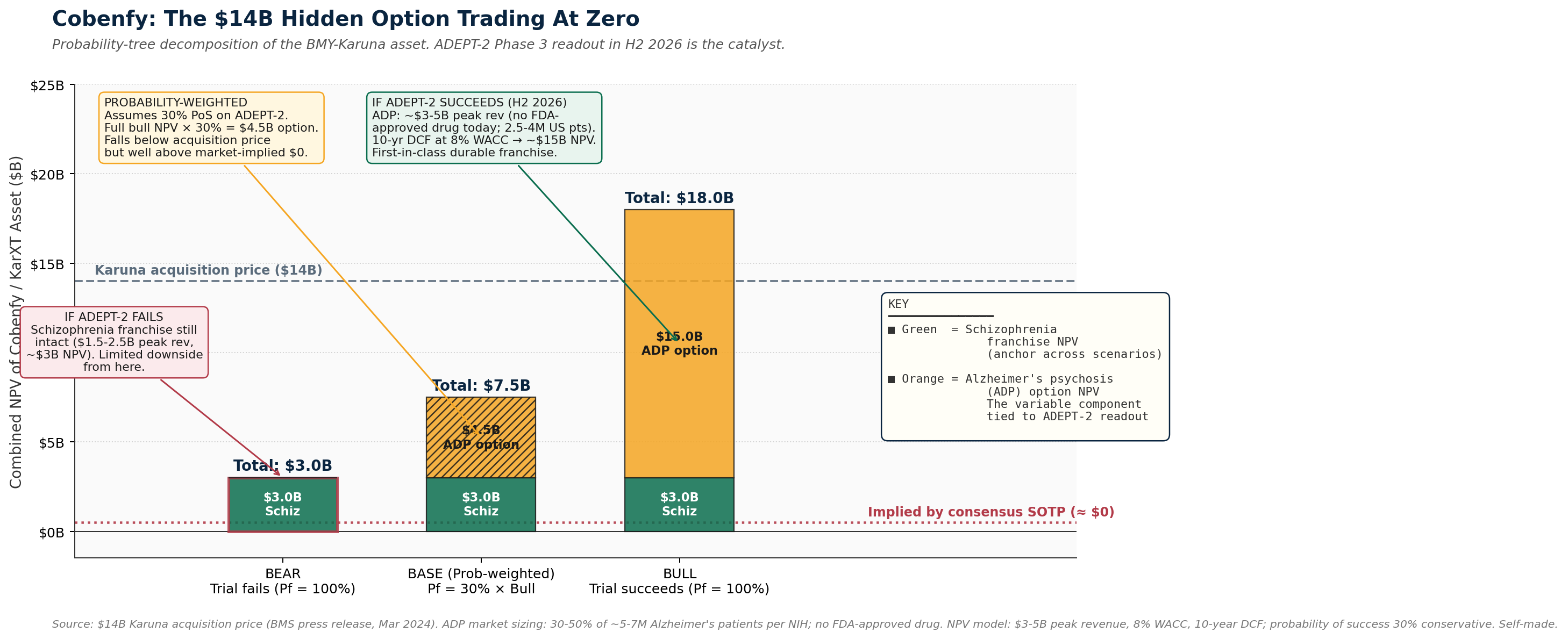
Option-value framing. Conservative on the ADP readout — run 30% probability of success, if strong readout in Phase 2, which is around 50% chance. A positive ADP translates to $3–5B per annum in top-line growth, at oncology-like margins. The probability-weighted NPV of the ADP indication is estimated to be in the order of $4–6B on 10-year DCF at 8% WACC. I haven't found any sell-side SOTP that mentions NPV. The 30% downside case (the trial misses) is already in the price.
Where that leaves Cobenfy. It's a well-defined catalyst for a market that doesn't get an awful lot of drugs, that doesn't pay anything for this kind of catalyst, and that's a multi-billion dollar indication, and on a molecule that already has regulatory proof-of-concept in a related indication. Not the full restoration of the price in Karuna, but the probability-weighted NPV of ~$4–6B versus a (clean) ~$0 is a clean optionality of ~$2–3 per share that the consensus is leaving on the table.
Sum-Of-The-Parts Valuation — What BMY Is Actually Worth
Most analysts apply a single P/E multiple to consolidated earnings. That combines three economically distinct businesses — three different growth rates, three different risk profiles, and three different gross margins — into a single number. A sum-of-the-parts (which is the same model that I used in this article's companion piece on Hershey) does a better job of defining intrinsic value.
Segment 1: Growth Portfolio (oncology, hematology, CV-immunology). Revenue in FY2026 should be in the range of $28B with gross margins in the high 70s and operating margins in the mid-30s, with a 12% YoY increase. The segment is ~$126B at a 4.5x EV/Sales multiple — discount to growth-pharma peers such as Eli Lilly (~12x) and Vertex (~7x), as would be expected from a more mature large-cap oncology group. Stress to 3.5x and it's still ~$98B.
Segment 2: Legacy Portfolio (Eliquis, Revlimid, Pomalyst, etc.). Run-rate revenue ~$18–19B in 2026, declining 12–16% annually with high contribution margins. This is essentially a run-off cash-flow stream. Modeled as a declining annuity over 7–10 years at a 10% discount rate, the present value is ~$40–48B. The bulk of this is Eliquis, which retains ex-U.S. growth into 2027 before generic entry begins, and continues to generate U.S. cash flow at the negotiated Medicare price (which still preserves substantial gross margins). Conservative case: $40B. Base case: $44B.
Segment 3: Pipeline & Optionality (Cobenfy schizophrenia + ADP, milvexian Factor XI in AF/stroke, Orbital in vivo CAR-T platform, Hengrui partnership). The LIBREXIA-AF readout for milvexian (vs. apixaban in atrial fibrillation) is expected in late 2026 and remains a multi-billion-dollar asset despite the ACS setback — note that the AF indication uses a 100mg twice-daily dose (vs. the lower dose in the failed ACS trial) and is widely seen by sell-side analysts as the largest market opportunity for the molecule. The recent $15.2B Hengrui partnership announcement brings additional Chinese-discovered assets into the pipeline. Probability-weighted, the pipeline option value is conservatively $8–12B; aggressively, $15–20B. Base case: $10B.
Net debt. BMY ended Q1 2026 with approximately $36B in net debt, having paid down ~$10B over the past 18 months from the post-Karuna peak.
The arithmetic. Base-case enterprise value sums to $126B (Growth) + $44B (Legacy) + $10B (Pipeline) = $180B. Subtract $36B of net debt and equity value is ~$144B, or ~$70 per share on 2.05B shares outstanding. Apply a 10% conglomerate discount for execution risk on the cost program and binary pipeline events and the per-share figure drops to ~$63 — still about 6% above the current $59 print on the most conservative assumptions. Run a base-to-upside case and the range is $78–95 per share, depending on (a) whether Growth Portfolio rerates from 4.5x to 5–6x EV/Sales as the crossover prints and (b) the ADEPT-2 outcome.
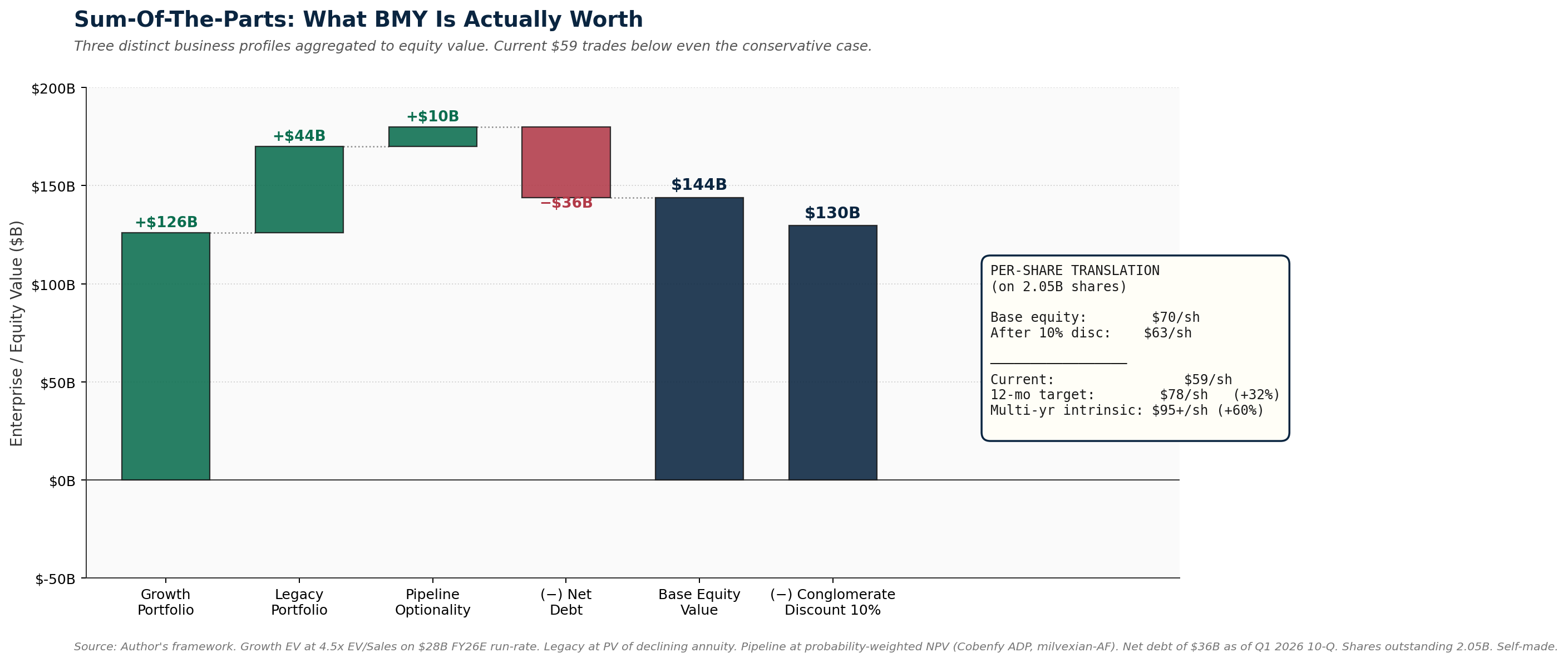
The 12-month price target of $78 reflects the SOTP gap that will close as Q2 and Q3 2026 prints continue to demonstrate Growth Portfolio leverage and the cost-program flow-through. The multi-year intrinsic value of $95+ assumes Cobenfy ADP success (or equivalent pipeline catalyst from milvexian-AF), continued cost-program execution, and a Growth Portfolio re-rating to growth-pharma multiples as the consolidated growth rate inflects positive in 2027.
The Quiet Dividend Aristocrat Floor — A Structural Buyer Base Most Investors Miss
The feature of BMY that you do not see in the sell-side work, but I believe is doing some of the work to compress the downside in the stock is the addition of that one extra figure. The company on Feb. 5, 2026, declared its 17th-straight annual dividend hike, to $0.63 quarterly, or $2.52 annualized. That leaves BMY eight years off the road to S&P 500 Dividend Aristocrat status (25 straight years of dividend payments). Once that value is surpassed, BMY will be mechanically included in the S&P 500 Dividend Aristocrats ETF (NOBL) and the international dividend-aristocrat funds that are on top of $13B+ of passive AUM.
That has an impact on the equity. Start with beta. The 5-year beta of BMY is ~0.26, the lowest of big pharma and a bit more than one-quarter of the market. For reference, the beta of 0.07 that Hershey is cited in this article's companion piece is one of the lowest in the S&P 500 and BMY is in the structurally low-vol corner inside healthcare. That is a number that is telling you something specific: a portion of the shareholder base is made up of pension funds, dividend-oriented ETFs, retiree allocations — buyers for yield and dividend growth, money that doesn't care for the narrative. As long as BMY continues to keep paying, and keep increasing the dividend, that bid remains in place no matter what the news cycle is up to. This is not a matter of whether a dividend is covered, it's a matter of how much. The $2.52 dividend is a 41% payout ratio, which is in line with any pharma standard, and sustainable even in the worst of case scenarios for Legacy erosion. The trailing 12-months free cash flow of $11.91B is more than 2x the ~$5.2B annual dividend payment. The path of the dividend is self-propelling: the more that it keeps rising, the closer BMY gets to the passive-inclusion thresholds, and the thresholds, consequently, mechanically increase the size of the buyer base.
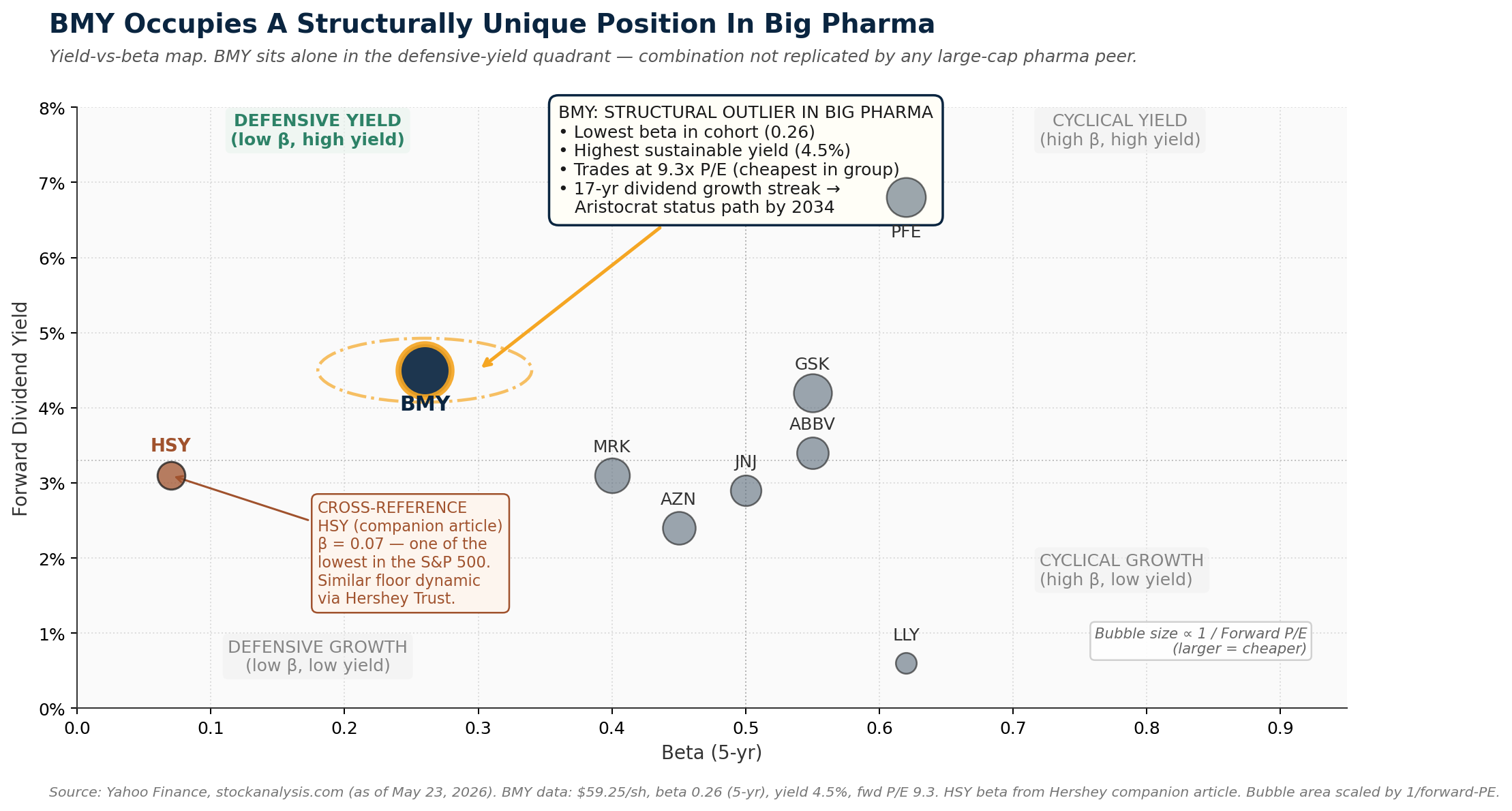
In plain English, BMY is operating as a permanent income business but marketing itself as a growth-stock-in-distress. The multiple is a discount for the fall in R&D productivity; the folks who are purchasing the stock at the margin are mostly uninterested in that narrative, and are interested in yield and yield growth. It's a floor structure similar to (but different from) the Hershey Trust dynamic at HSY, where it remains a permanent price-insensitive holder of the equity as a cap on how far the stock can fall. Add to that management's discipline with capital returns — debt paydown has been the focus since the Karuna deal and buyback capacity will return as the leverage ratio returns to normal throughout 2026 — and the asymmetry is on the side of patient capital.
An operating-leverage upside that's not been quantified is that the strategic agreement with Anthropic to deploy Claude across BMY's research, clinical development, manufacturing, commercial and corporate functions for 30,000+ employees is worth flagging. The agreement puts BMY on the leading edge of pharma-AI deployment with other companies such as Lilly and Pfizer, as the gains in Pharma R&D and clinical-development productivity are multiplicative.
Risks: What Would Break The Thesis
If those three things happened, I would change my mind about BMY, and if any of those things were true, and that's a legitimate thesis — a thesis that can be disproved and refuted — then I would tell you that.
For one, the volume offset for the Eliquis post-IRA slows down. The 2026 framework, which includes 10–15% global growth, is based on volume growth, ex-US strength and avoiding inflation penalties. The Eliquis revenue threshold for 2027 (when Medicare formulary changes and Cost Plus channel cannibalization become meaningful volume drags at unfavorable economics) deteriorates if Q2 or Q3 2026 prints of meaningful volume erosion (more than ~5%) are caused by Medicare formulary shifts or Cost Plus channel cannibalization. Track the quarterly U.S. Eliquis revenue line and explicit "demand growth" remarks in the 10-Q footnotes. A price-target cut if it goes negative in Q3 would be warranted.
Secondly, ADEPT-2 fails to read out the readout for Alzheimer's psychosis. The Cobenfy ADP indication is the largest single free option on the BMY pipeline at present, and a readout failure of the H2 2026 would knock out $4–6B of probability-weighted NPV from the SOTP analysis. The downside isn't terrible, it just isn't very severe, and the schizophrenia franchise is left intact and the milvexian-AF readout is left as a standalone alternative. Nevertheless, an ADEPT failure would drive the multi-year intrinsic value estimate down to $80–85, and lose the most compelling catalyst for upside on a 12-month time frame.
Third, the cost-savings program is lost. $2B in incremental savings guided by Management to end of 2027 on the original $1.5B program. If the operating-margin expansion is not seen in 2026, in terms of absolute margin, SG&A as a percentage of revenue, the thesis becomes more reliant on revenue growth. It is directly measurable on the quarterly basis in the non-GAAP operating margin line.
Two other risks that have been taken in stride by the stock without breaking the thesis: A November 2025 trial failure of milvexian on the LIBREXIA-ACS indication, which was reported as BMY down 6% on the day to ~$45.74, and the fact that the AF and SSP indications are still open with different dose regimens, and population biology, but base-rate skepticism around the efficacy of the Factor XI mechanism has been raised. The general U.S. drug-pricing political landscape, which could include additional drugs being negotiated like IRAs, poses a risk to the entire large-cap pharmaceutical industry, although the stock trades at a multiple that reflects the additional risk of negotiation that is being passed on to BMY.
Conclusion and Investment Recommendation
Bristol-Myers Squibb is an unusual combination of three independent analytical signals that all point positive. The mechanics of the Eliquis IRA have been misinterpreted to the extent that it has now been proven by two consecutive quarterly beats and the consensus $2–3B expected revenue shortfall for 2026 is closing on schedule as sell-side models get updated. The Growth Portfolio crossover to the Legacy book, which was modeled to be a 2028+ event, occurs in 2026 and $6.2B of Growth revenue (+12%) will accrue Q1, while $3.5B of cumulative cost program comes in parallel. The binary Phase 3 readout for the Cobenfy ADP (in H2 2026) is a $4–6B option valued at around zero in consensus models. Each of these three can be tested individually, and each of these tests will produce key evidence in the next two to four quarters that will allow the thesis to be proven or discredited.
If it is just the dividend, it's easy. 17 consecutive years of increases. Near a 15-year high in forward yield of 4.5%. The payout ratio on FY2026 non-GAAP earnings was ~41%, supported by $11.9B of free cash flow that exceeds by over 2x. A roadmap to Dividend Aristocrat status by 2034, with mechanical passive income added on top of the existing base of buyers. And the lowest beta in big pharma (0.26), pointing back to the permanent income holders whose ownership compresses the downside — same effect as the Hershey Trust at HSY, even though the mechanism is structurally different.
Net of all this, purchasing BMY here is a multi-year income compounder with three separate forensic catalysts being delivered as free extras in the sector, where characteristics of a defensive play typically come with a premium, which BMY is currently rebating. Rating: BUY. 12-month price target: $78. Multi-year intrinsic value: $95+.

Sandeep Gupta
Independent equity research analyst publishing forensic theses on US-listed stocks. MBA, Politecnico di Milano (Milan, Italy).
Get new research in your inbox
Subscribe to receive forensic equity research the moment it's published. Free, no spam.
Related Research
 HUM
HUM Humana’s 22% Medicare Advantage Membership Growth Is Being Dismissed As A Liability — The Cash Flow Says Otherwise (HUM)
 CVS
CVS CVS Health's Aetna MBR Just Hit 84.6% — Five Straight Beats Say The Turnaround Is Real (CVS)
 PFE
PFE
Discussion
Be the first to comment.