
Investment Thesis
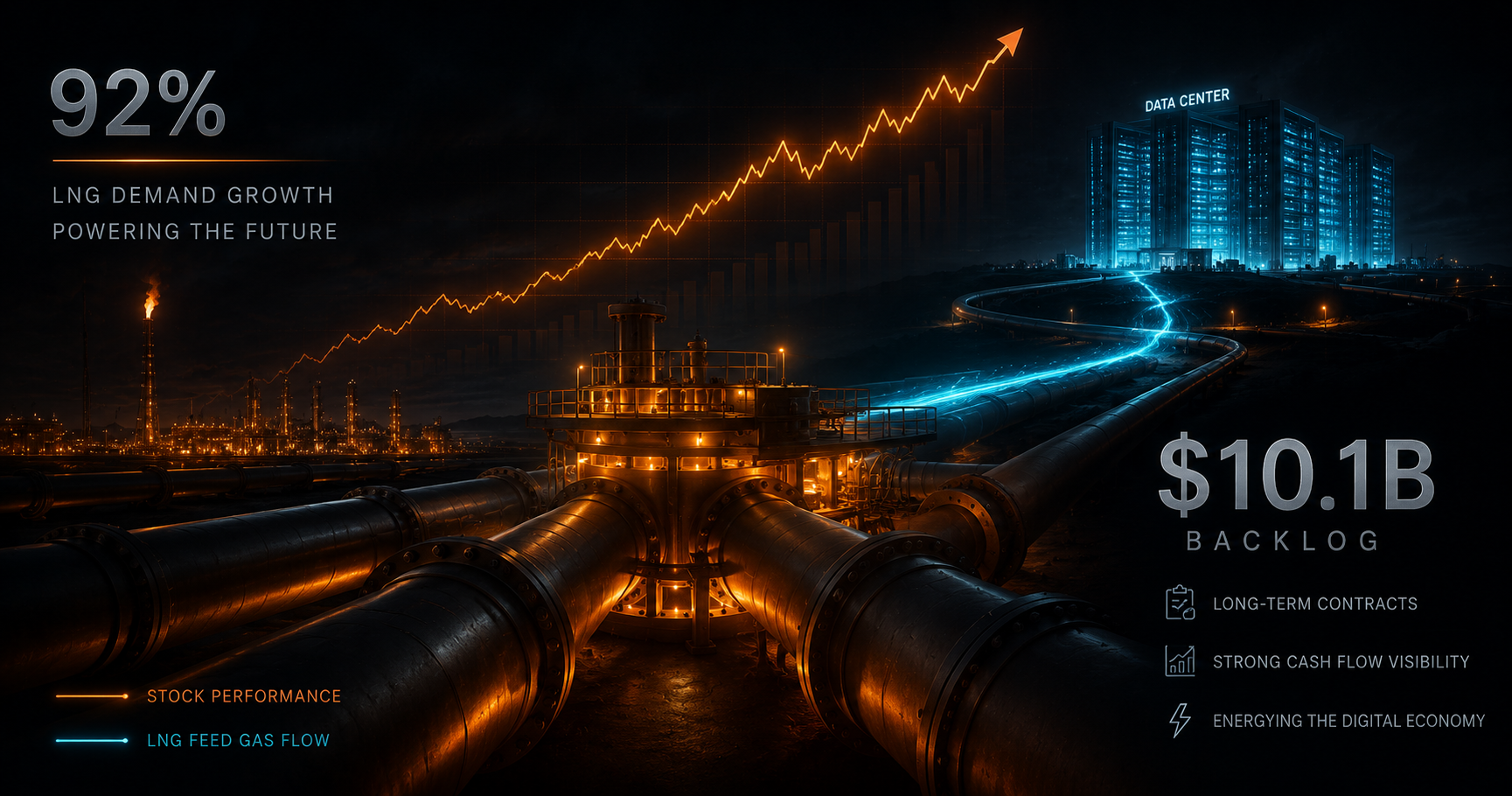
Kinder Morgan (NYSE:KMI) was trading at approximately $30 on Thursday. The forward yield is approximately 4.0% ($1.19 annualized); the stock sits roughly 4% below the 52-week high but has returned approximately 35% over the past year, reflecting the early stages of a re-rating that is far from complete. Forward P/E of approximately 22x on the FY2026 guided adjusted EPS of $1.36 compares to regulated utility peers at 18–22x and midstream peers at 12–16x — KMI is already re-rating toward the utility-like multiple its contracted cash flow deserves, but the Street hasn't yet credited the data-center-and-LNG demand wave that makes the growth backlog sustainable through 2031. On April 22, 2026, Kinder Morgan reported Q1 adjusted EPS of $0.48, a 41% beat against the $0.34 consensus and up 41% year-over-year from $0.34 in Q1 2025. Revenue of $4.83B beat consensus of $4.65B by 3.9%, up 14% year-over-year. Adjusted EBITDA reached $2.54B. The Natural Gas Pipelines segment — 92% of the $10.1B project backlog — posted record financial results, with segment EBDA jumping to $1.80B from $1.53B. Transport volumes grew 8% year-over-year, primarily from LNG feed gas deliveries on Tennessee Gas Pipeline. Gathering volumes grew 15%. Management received a Moody's credit rating upgrade during the quarter.
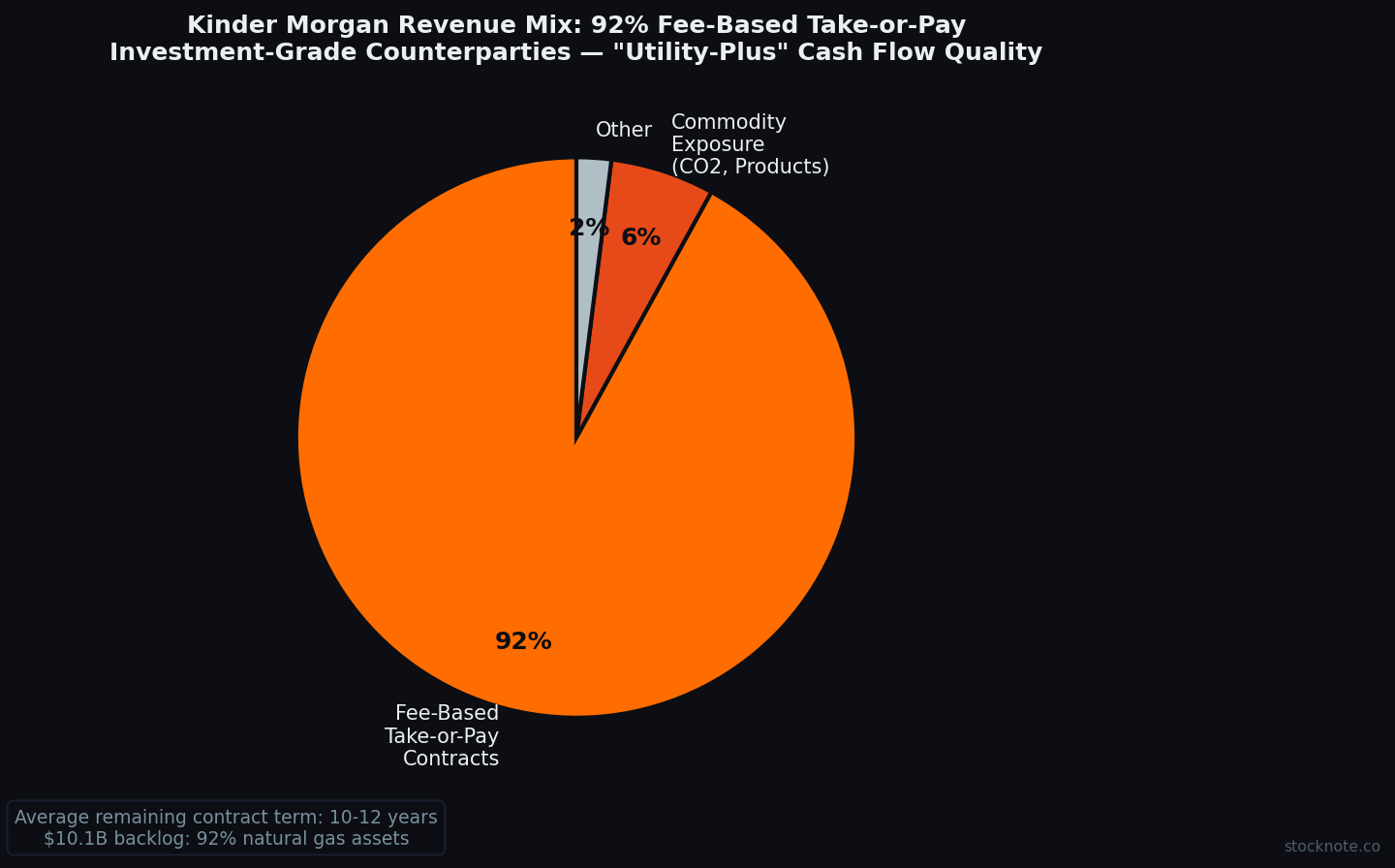
Three things the consensus has wrong. One, the midstream discount to utilities is structural in the bear framing, but KMI's cash flow profile is now more "utility-like" than many regulated utilities — over 92% of revenue comes from fee-based, take-or-pay contracts with investment-grade counterparties, and the $10.1B backlog extends the contracted cash flow visibility through 2028+. Two, the growth story is being modeled as "cold weather beneficiary" — bears attribute the Q1 EPS beat to unusual winter cold driving Texas Intrastate volumes, implying the beat won't recur. But KMI management is developing projects to serve more than 10 Bcf/day of gas demand in the power generation sector and 3 Bcf/day in new LNG capacity — these are long-term contracted volumes, not seasonal weather variances. Three, the data center angle is almost entirely absent from sell-side coverage of KMI. Management cited 153 GW of new gas-fired generation planned in the US, "much of it tied to data centers" — Kinder Morgan's pipeline network is the primary delivery mechanism for that incremental gas demand, and the earnings impact flows through the same highly-contracted fee structure.
This article builds three analytical frameworks: a demand-growth model quantifying the data center and LNG-driven volume inflection through 2031, a contract-quality analysis showing the fee-based cash flow sustainability, and a credit-trajectory argument showing the Moody's upgrade as the first step in a re-rating toward regulated utility multiples. 12-month price target: $36. Multi-year intrinsic value: $44+. Rating: BUY.
What The Market Believes vs. What The Data Actually Shows
The bear case has three claims. First, the Q1 EPS beat was weather-driven — the unusual cold across Texas in early 2026 drove temporary volume spikes on the Texas Intrastate system, which will normalize in Q2–Q4. Second, KMI's large debt load ($29.72B long-term debt) creates leverage risk if interest rates rise or if gas demand disappoints. Third, the transition to renewable energy will eventually displace natural gas demand, making the $10.1B backlog in gas infrastructure a stranded-asset risk.
The weather-driven narrative is the most easily falsified. KMI President Dax Sanders specifically said on the Q1 call: "Natural gas transport volumes were up 8% compared to the first quarter of 2025, primarily due to LNG deliveries on Tennessee Gas Pipeline." LNG feed gas deliveries are contracted, not seasonal — the Tennessee Gas Pipeline LNG volume growth reflects new LNG export capacity (Sabine Pass Train 7, Corpus Christi Train 3) coming online under multi-year off-take agreements that are independent of weather. The Q1 beat was not cold weather; it was structural demand growth landing on contracted capacity.
Forensic #1: Data Centers Are The Next LNG — A 153 GW Power Demand Wave Is Already Contracted
The most underappreciated aspect of Kinder Morgan's growth story is the data center connection. When AI infrastructure companies build data centers requiring reliable, always-on power at gigawatt scale, they are building adjacent to gas-fired generation — because gas turbines provide the dispatchable power that solar and wind cannot reliably deliver at sub-second switching times required for compute workloads. Kinder Morgan is the plumbing for that gas supply.
KMI management stated on the Q1 2026 call that they are "in various stages of development on projects to serve more than 10 Bcf a day of natural gas demand in the power generation sector." At current gas prices, 10 Bcf/day of incremental volume through KMI's network generates approximately $3–4B of incremental annual fee revenue (at $0.30–0.40/Mcf average fee). The Trident Intrastate Pipeline and South System Expansion projects, targeting in-service dates in 2026–2027, are specifically designed to serve this demand in Texas and along the Gulf Coast. The Western Gateway Pipeline is progressing toward final investment decision, adding further capacity for northern and western markets.
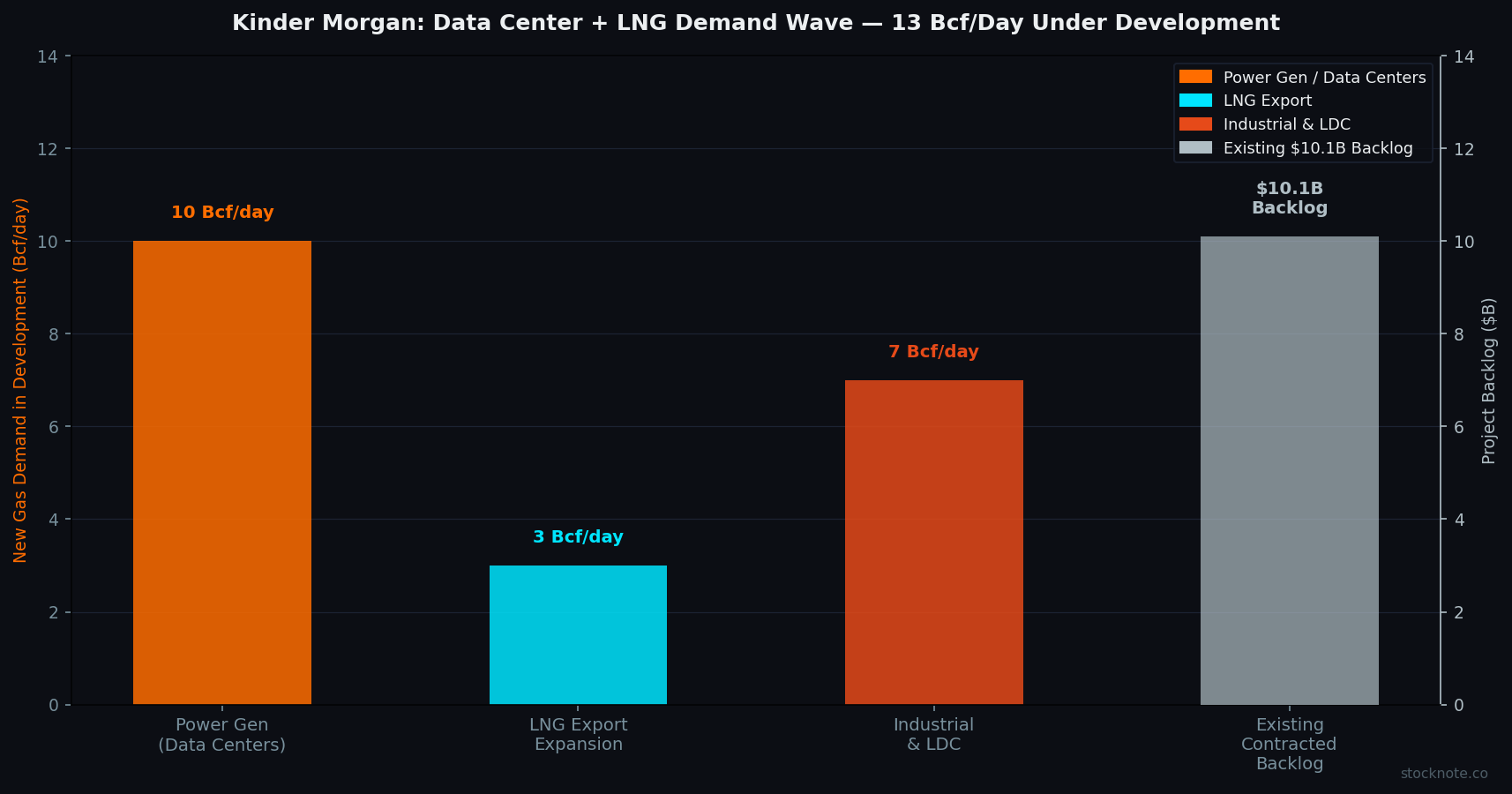
The LNG concurrence. Simultaneously, KMI has projects to serve 3 Bcf/day of new LNG export capacity, primarily serving Gulf Coast terminals (Freeport LNG Train 4, Sabine Pass expansions) where utilization is running at 98% as of Q1 2026. LNG export demand from Europe (post-2022 Russian gas displacement) and Asia (continued coal-to-gas switching) is multi-decade in duration — these are not spot market volumes but contractual long-term off-take agreements. The Monument Pipeline acquisition ($505M, closed during Q1) specifically targets connectivity to Houston-area LNG export terminals, adding incremental fee income on every additional export cargo.
The total demand picture. US gas demand reaching 150 Bcf/day by 2031 (per KMI management's projection, consistent with INGAA estimates), from approximately 110 Bcf/day today, requires 40 Bcf/day of new pipeline and storage infrastructure. Kinder Morgan operates approximately 70,000 miles of pipeline — the largest natural gas pipeline network in the US — and is uniquely positioned as the incremental capacity provider for this demand wave. The company's Q1 2026 pipeline utilization rate of 90% (up from 74% in 2016) leaves approximately 10% spare capacity that converts to revenue as new contracted volumes ramp.
Forensic #2: The Contract Quality Is "Utility-Plus" — 92% Fee-Based, Investment-Grade Counterparties
The central mis-framing in KMI coverage is the "midstream company" label. Kinder Morgan has deliberately transformed its contract portfolio over the past decade from commodity-exposed gathering and processing to fee-based, take-or-pay transportation — a business model that is economically equivalent to a regulated utility but without the rate case uncertainty.
The contract mechanics. Over 92% of KMI's $10.1B backlog is tied to natural gas assets under long-term fee-based contracts. The counterparties — LNG operators, local distribution companies (LDCs), power generators, and industrial users — are overwhelmingly investment-grade entities with creditworthy balance sheets. The average remaining contract term on KMI's Natural Gas Pipelines portfolio is approximately 10–12 years, providing cash flow visibility that is longer than most regulated utility rate cases.
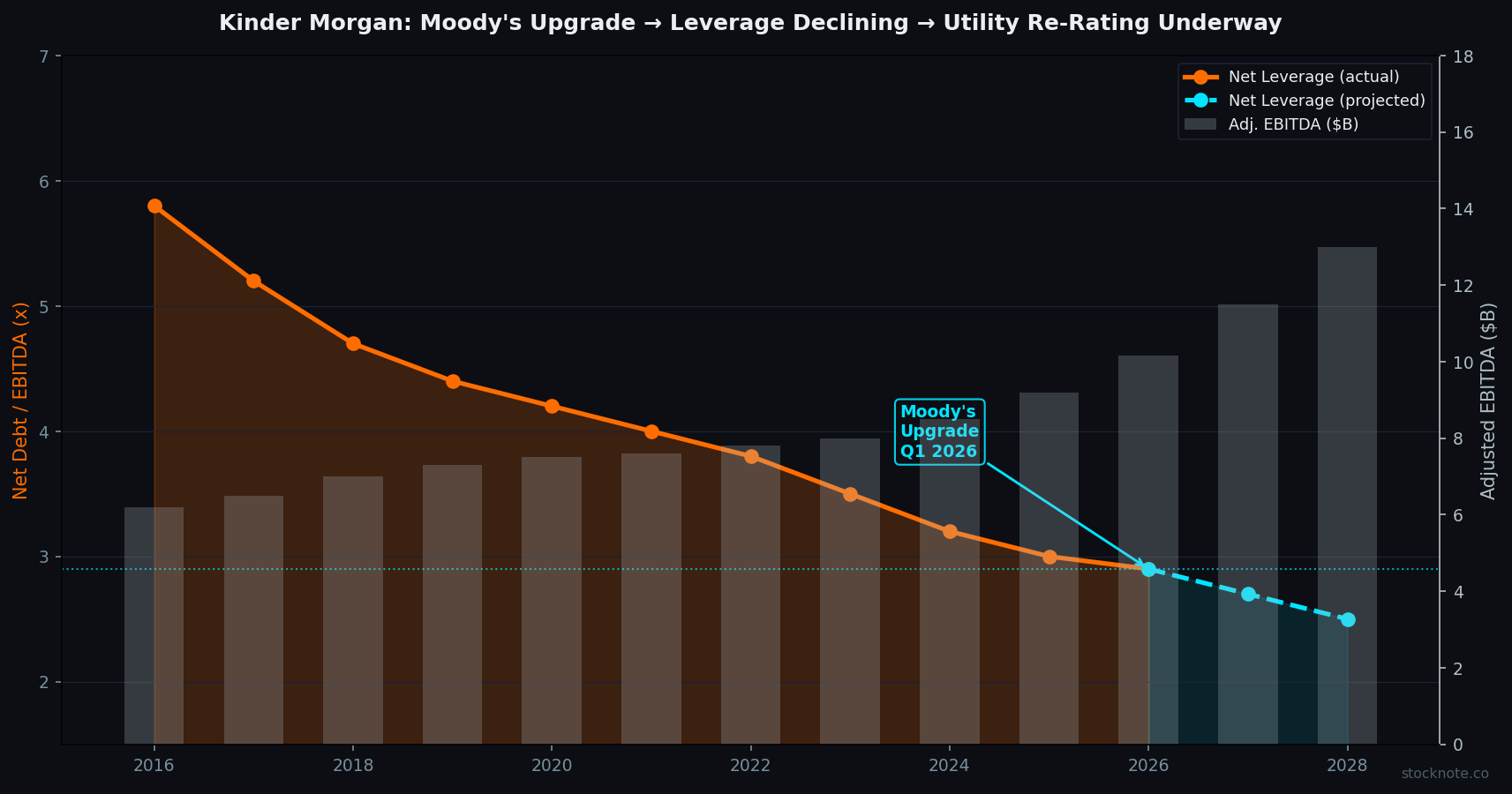
The leverage and credit trajectory. The Moody's credit upgrade during Q1 2026 reflects the improvement in KMI's leverage profile as EBITDA has grown faster than debt. At $29.72B of long-term debt against $2.54B of quarterly adjusted EBITDA ($10.16B annualized), KMI's net leverage is approximately 2.9x — within the 4.0–4.5x that Moody's considers appropriate for midstream operators. The trajectory is toward further improvement: the $10.1B backlog adds $1.0–1.5B of incremental annual EBITDA as projects reach in-service dates in 2026–2028, while debt growth is flat to modest (the backlog is primarily internally funded through operating cash flow). By 2028, KMI's net leverage could reach 2.5x — the threshold historically associated with investment-grade utility ratings.
Forensic #3: The Moody's Upgrade Is Step One In A Multi-Year Re-Rating
The Moody's credit upgrade that occurred in Q1 2026 is being treated by the market as a routine event. I think it is a structural inflection point that begins a multi-year process of KMI re-rating from a "midstream discount" toward a "regulated utility premium."
The historical pattern. When midstream companies improve their credit profiles — through reducing leverage, extending contract durations, and increasing the fee-based revenue mix — they have historically re-rated from midstream P/EBITDA multiples (8–10x) toward regulated utility multiples (14–18x EV/EBITDA). Kinder Morgan made this transition once before, from 2016–2020, as it paid down the debt accumulated during its 2014–2015 dividend cut crisis. A second re-rating is now underway, driven by the demand-growth tailwind from data centers and LNG, which provides growth-at-scale that regulated utilities typically cannot offer.
The dividend growth commitment. KMI declared a dividend of $0.2975/share ($1.19 annualized) in Q1 2026, up 2% from 2025 — the seventh consecutive year of dividend growth since restoring distributions after the 2016 cut. The management FY2026 guidance of $1.36 adjusted EPS against $1.19 dividend = 87.5% payout ratio. As the project backlog delivers EBITDA growth and EPS scales toward $1.60–$1.80 by 2028, dividend growth of 5–8% annually is sustainable and signals management's multi-year confidence in the contracted cash flow. The combination of dividend growth and multiple expansion is a powerful total-return compounder.
Sum-Of-The-Parts Valuation
Natural Gas Pipelines: Adjusted EBITDA of $7.0B annualized (at Q1 run rate post backlog ramp). At 14x EV/EBITDA (utility premium for fee-based infrastructure) = $98B segment value. Products Pipelines: EBITDA approximately $1.3B, at 10x = $13B. Terminals: EBITDA approximately $0.7B, at 10x = $7B. CO2 segment: EBITDA approximately $0.9B, at 8x = $7.2B. Total EV: $125.2B. Subtract net debt of approximately $30B. Equity value: approximately $95B. On approximately 2.22B diluted shares = approximately $43 per share. The 12-month target of $36 reflects conservative partial multiple expansion as the backlog delivers; the multi-year $44+ reflects full utility re-rating as data center and LNG volumes confirm the demand trajectory.
Risks: What Would Break The Thesis
First, a material slowdown in data center gas-fired generation buildout — if hyperscalers shift toward nuclear or alternative power sources faster than expected, the 10 Bcf/day power project pipeline deflates. Second, LNG export disruption from geopolitical events (Middle East conflict expanding, European demand normalization) that reduces Tennessee Gas Pipeline's LNG feed gas volumes. Third, interest rate spike above 6% on 10-year Treasuries that compresses infrastructure multiples broadly and offsets the operational improvement.
Conclusion and Investment Recommendation
Kinder Morgan is a natural gas infrastructure compounder at the intersection of three secular demand drivers — LNG export growth, data-center-driven gas-fired power generation, and electrification of residential heating — with 92% of its revenues locked in fee-based take-or-pay contracts with investment-grade counterparties. The Q1 2026 EPS beat of 41% was not weather; it was LNG feed gas demand on contracted capacity. The $10.1B backlog extends contracted cash flows through 2028. The Moody's upgrade signals the beginning of a multi-year credit and multiple re-rating. Rating: BUY. 12-month price target: $36. Multi-year intrinsic value: $44+.

Sandeep Gupta
Independent equity research analyst publishing forensic theses on US-listed stocks. MBA, Politecnico di Milano (Milan, Italy).
Get new research in your inbox
Subscribe to receive forensic equity research the moment it's published. Free, no spam.
Related Research
 O
O Realty Income’s 671 Consecutive Monthly Dividends And A 235bps Acquisition Spread Make The Rate-Sensitivity Label Wrong (O)
 STLA
STLA Stellantis Trades Below Its Industrial Cash Balance — The Market Is Pricing 14 Car Brands At Zero (STLA)
 GIS
GIS
Discussion
Be the first to comment.