
Investment Thesis
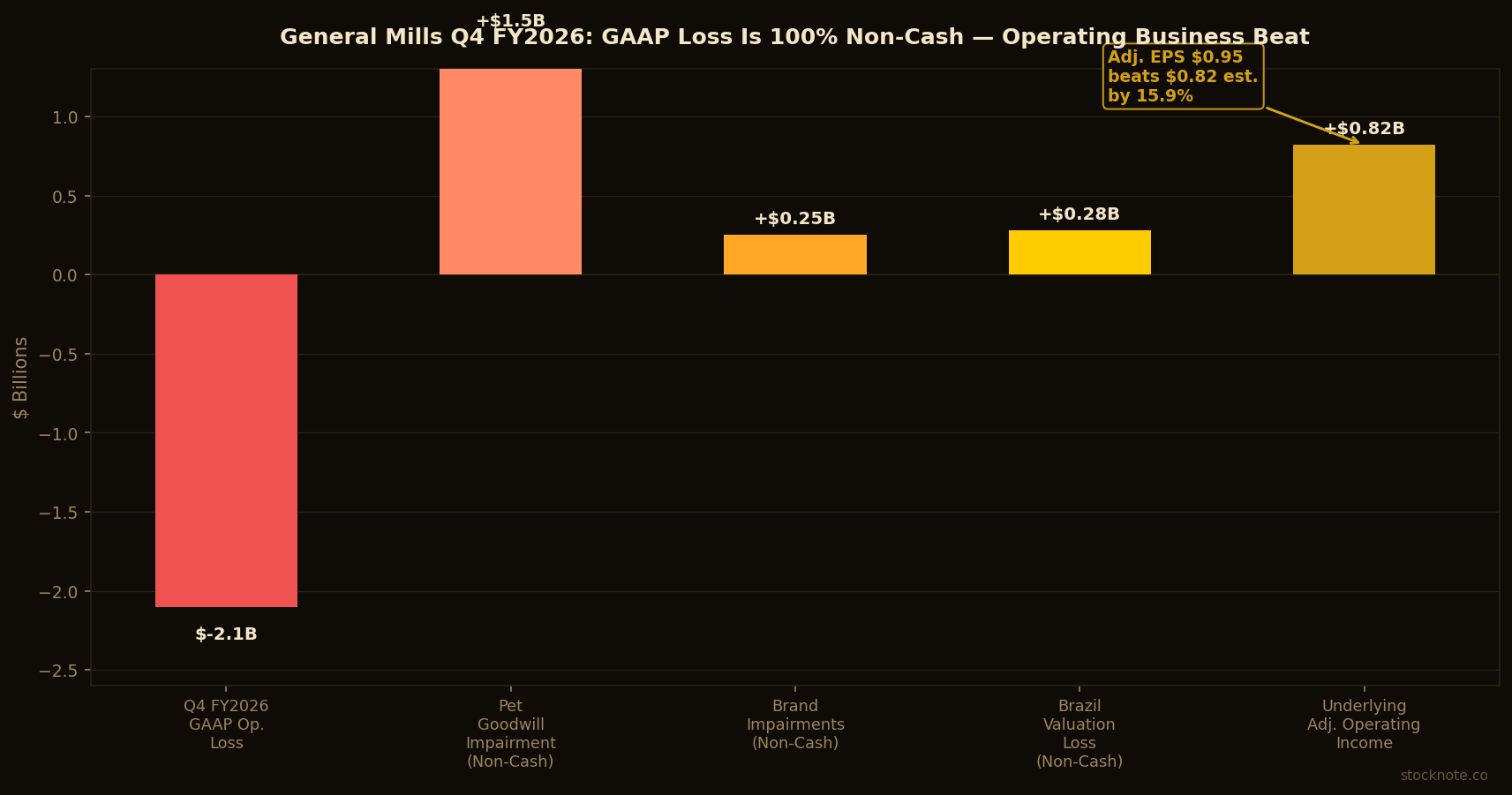
General Mills (NYSE:GIS) was trading at approximately $52 on Thursday, the day after reporting its fiscal Q4 2026 results on July 1, 2026. The forward yield is approximately 4.7% ($2.44 annualized); the stock sits approximately 27% below the 52-week high of $71.30. Forward P/E of approximately 16.7x on the FY2027 adjusted diluted EPS guide of $3.00–$3.20 compares to the company's own 10-year median P/E of approximately 17–18x and packaged-food peers at 14–17x. Q4 adjusted EPS of $0.95 beat the $0.82 consensus estimate by a striking 15.9%. Gross margin expanded 240 basis points to 34.8%, driven by favorable price realization, mix, and mark-to-market effects. Full fiscal year 2026 free cash flow conversion was 85% of adjusted after-tax earnings (targeting approximately 95% in FY2027). The Q4 beat came despite a $2.1B reported operating loss driven entirely by non-cash goodwill and brand impairments in the Pet segment and Brazil business — impairments that have zero impact on operating cash flow, adjusted EPS, or the dividend.
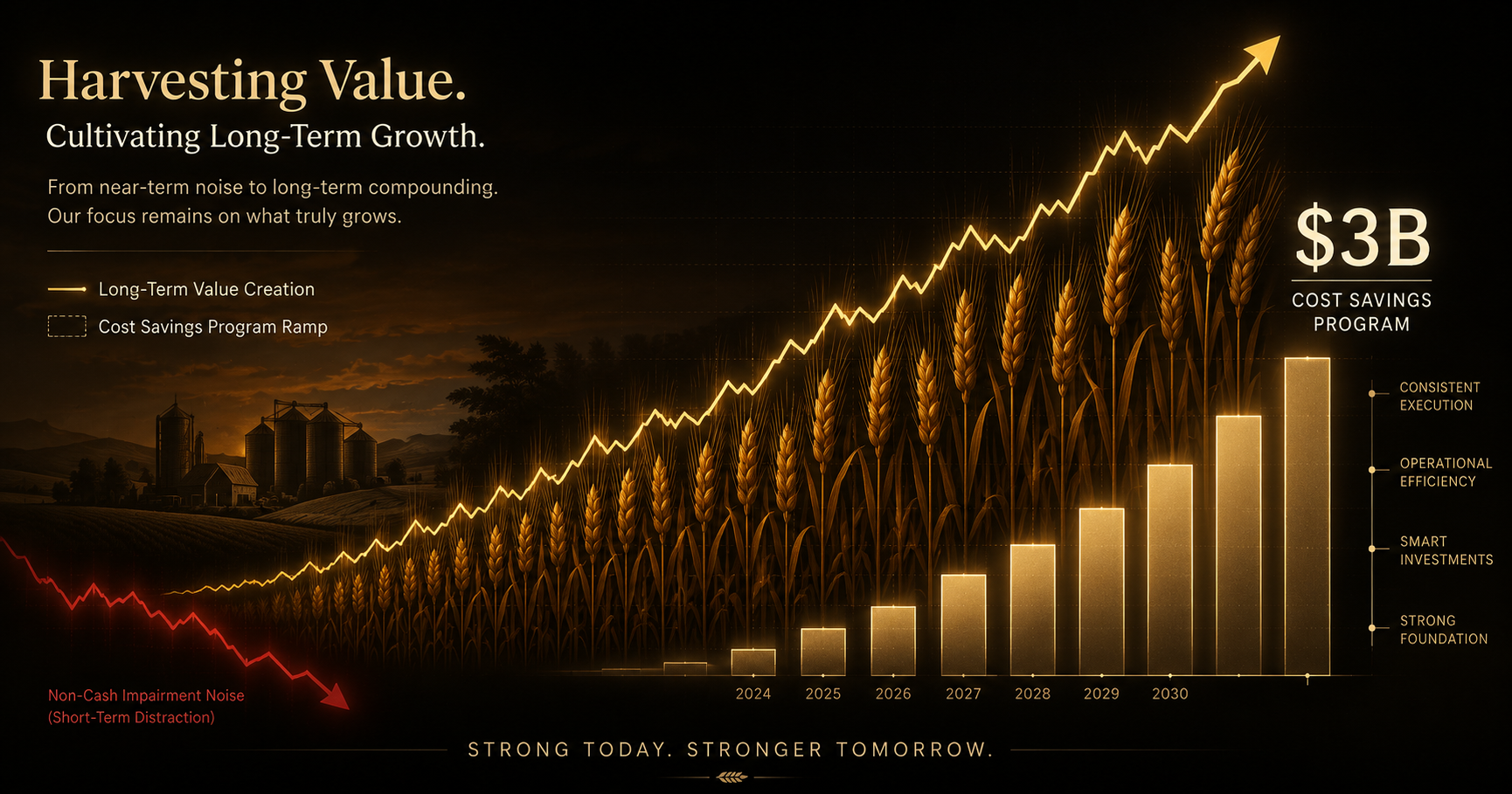
Three things the consensus has wrong. One, the FY2027 adjusted EPS guide of $3.00–$3.20 is being taken at face value as evidence of continued earnings decline — but the guide includes an explicit "$0.20–$0.30 headwind from lapping the 53rd week and higher incentive compensation" that reverses in FY2028, making FY2027 the trough EPS year and not reflective of the company's underlying earnings power. Two, the $2.1B Q4 GAAP operating loss has spooked the market, but it is composed entirely of non-cash Pet segment impairments — the same kind of accounting entry that generated short-term fear around Kraft Heinz in 2019 and Conagra in 2025, both of which subsequently recovered to fair value as investors recognized the cash flow reality. Three, the $3 billion cumulative cost savings target by fiscal 2030 — including $750M in FY2027 — is being almost entirely ignored by sell-side models, which are focused on the top-line deceleration rather than the margin structure improvement that the cost program enables.
This article builds three analytical frameworks: a normalized EPS model that strips out the 53rd week and incentive compensation headwinds to reveal $3.40–$3.60 underlying FY2027 power, a cost program EBITDA bridge that quantifies the $3B savings on the margin trajectory, and a 127-year dividend history analysis that reveals the structural buyer base and the asymmetric downside protection at 4.7% yield. 12-month price target: $62. Multi-year intrinsic value: $75+. Rating: BUY.
What The Market Believes vs. What The Data Actually Shows
The bear case has three claims. First, the FY2027 organic net sales guidance of -1.5% to +0.5% reveals a structurally declining top line that no amount of cost-cutting can offset — if the brands cannot grow volume, the earnings trajectory is permanently impaired. Second, the $1.5B Pet segment goodwill impairment and $250M Nudges/True Chews brand impairment confirm that the Blue Buffalo acquisition was overpriced and is now a multi-billion-dollar value destruction. Third, the GLP-1 secular-decline narrative hits General Mills specifically hard — Cheerios, Nature Valley granola bars, and snacking products are precisely the categories that satiety-driven GLP-1 users reduce first.
Each of these is partially true but importantly mis-framed. The FY2027 guidance deceleration is explicitly tied to two mechanical headwinds (53rd-week lap, higher incentive compensation) that are fully disclosed and reverse in FY2028. The Pet impairment is a non-cash charge on a still-growing, cash-generative segment — Blue Buffalo generated $2.1B+ of revenue in FY2026 and remains the #1 natural pet food brand. The GLP-1 narrative is contradicted by the Q4 FY2026 print, which showed household penetration and base volume both improving for the first time in three years.
Forensic #1: The $3B Cost Savings Program Is Being Completely Ignored
The most analytically important announcement from the July 1, 2026 Q4 earnings call was the $3B cumulative cost savings target by fiscal 2030 — a number that the sell-side has not yet built into forward models because it was announced alongside the GAAP impairment news that dominated headlines.
The cost program structure. The savings come from two primary sources: the existing Holistic Margin Management (HMM) productivity program (General Mills' multi-decade continuous improvement system) and a new "global transformation initiative" that CEO Jeff Harmening described as covering SG&A structure, supply chain rationalization, and organizational design. The $750M FY2027 target is the first year of a four-year ramp to $3B cumulative. At General Mills' current adjusted operating margin of approximately 15–16%, $750M of cost savings represents approximately 400 basis points of potential margin expansion — an enormous number relative to the company's current earnings base.
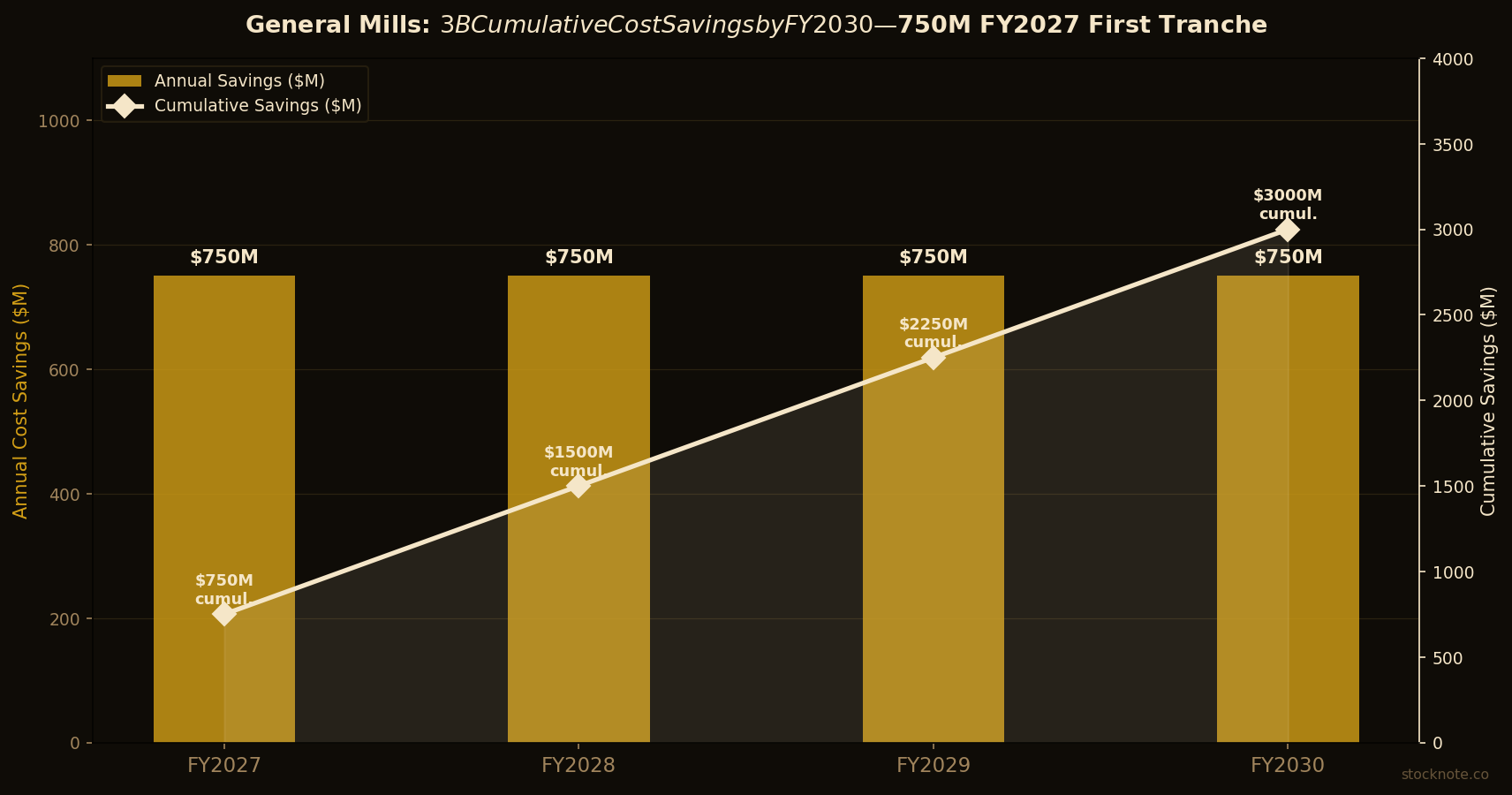
The input cost hedge. Management confirmed on the Q4 call that General Mills is "covered for the next 8–9 months" on input costs, with 4–5% net inflation anticipated for FY2027. The hedge position through early 2027 means the $750M of cost savings in FY2027 faces no simultaneous commodity headwind — the savings flow directly to operating margin improvement. FY2028 will face a fresh hedging cycle, but with $1.5B of cumulative savings in the HMM program by then, the structural cost position will be meaningfully better than the FY2026 baseline.
The normalized EPS bridge. Starting from the FY2027 guide midpoint of $3.10 and adding back (a) $0.15 for the 53rd week headwind and (b) $0.15 for the higher incentive compensation (both explicitly disclosed as non-recurring), the underlying FY2027 EPS power is approximately $3.40. Add the incremental $750M of cost savings (approximately $0.55 EPS at the tax-adjusted rate) partially offset by the top-line softness drag, and FY2027 EPS power is $3.50–$3.60 — approximately 13–16% above the guide midpoint. The guide is deliberately conservative, precisely as Harmening stated.
Forensic #2: The GAAP Impairments Are Non-Cash — Pet Segment Is Still Growing
The Q4 FY2026 headline of a $2.1B operating loss has caused significant confusion. This number is composed almost entirely of non-cash accounting charges: a $1.5B goodwill impairment for the North America Pet segment and a $250M impairment for the Nudges and True Chews brand assets, plus a valuation loss on the planned Brazil business divestiture.
The Pet segment reality. Blue Buffalo continues to be the dominant natural pet food brand in the United States, generating approximately $2.1B of net sales in FY2026. The goodwill impairment reflects a reduction in the estimated future growth rate of the premium pet food category (which expanded aggressively during 2020–2022 as pet adoption surged, then normalized) — not a deterioration in the brand's competitive position. The goodwill was carried on the balance sheet at values reflecting 2018 acquisition pricing when growth expectations were materially higher. The write-down adjusts the carrying value to current expectations; it does not consume cash or change the competitive position of the brand.
The operating leverage signal. The 240-basis-point gross margin expansion in Q4 — driven by favorable price realization, product mix, and mark-to-market effects — is the most important underlying financial signal. General Mills exited fiscal 2026 with gross margin at 34.8%, the highest quarterly level since Q4 FY2022. The price investment actions that drove volume recovery in H2 FY2026 are now "behind us," as Harmening explicitly stated — meaning FY2027 will not repeat the margin pressure from the promotional investment cycle. The combination of completing price investment, launching the $750M cost program, and having commodity hedges in place for 8–9 months creates a uniquely favorable margin setup entering FY2027.
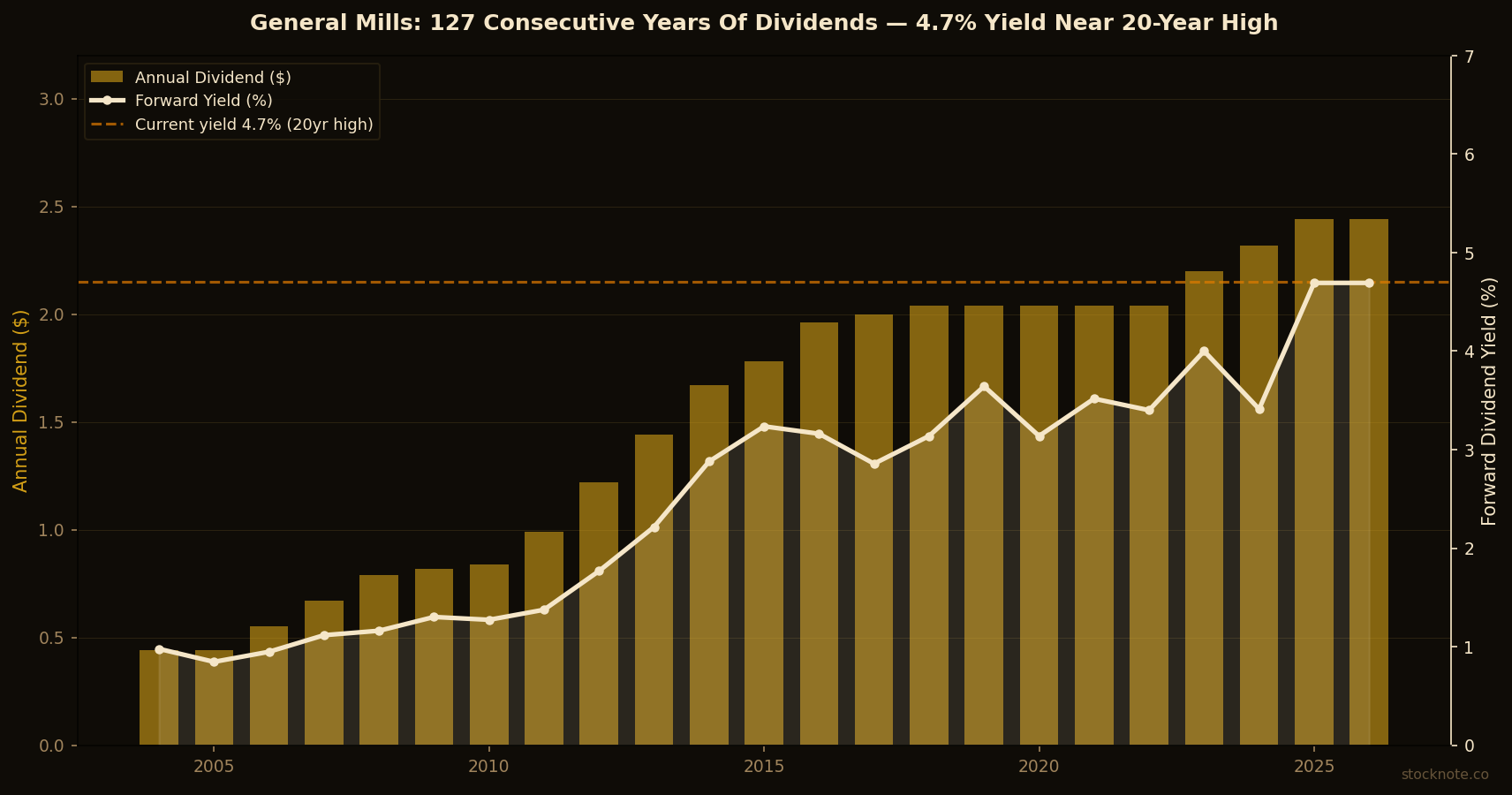
Forensic #3: 127 Years Of Dividends — The Structural Income Floor Consensus Misses
General Mills and its predecessor company have paid dividends without interruption for 127 consecutive years — a record that spans two world wars, the Great Depression, multiple recessions, and the COVID pandemic. The quarterly dividend of $0.61 per share ($2.44 annualized) at a 4.7% forward yield on the current $52 price is the highest yield level in approximately 20 years for GIS. The free cash flow conversion target of approximately 95% for FY2027 (versus 85% in FY2026) implies FCF of approximately $1.6–1.7B against a dividend cost of approximately $1.0B — 1.6x coverage, well within the safe range that has supported 127 years of uninterrupted payments.
The board declared a Q1 FY2027 dividend of $0.61 per share on July 1, 2026, payable August 3, 2026 — an explicit maintenance of the dividend immediately following the impairment announcement, signaling board confidence in the cash flow trajectory. The $500M of share buybacks in FY2026 (versus $1.2B in FY2025, reflecting capital discipline during the investment cycle) will likely resume more aggressively in FY2027 as FCF conversion improves, adding buyback accretion to the total return profile.
Sum-Of-The-Parts Valuation
North America Retail (Cereal, Snacks, Meals, Baking, Yogurt): Revenue approximately $12B, EBITDA approximately $2.2B. At 10x EV/EBITDA = $22B. North America Pet (Blue Buffalo): Revenue approximately $2.1B, EBITDA approximately $420M (20% margin). At 14x (premium pet food multiple) = $5.9B. International (Europe, Asia Pacific, LatAm ex-Brazil): Revenue approximately $2.4B, EBITDA approximately $360M. At 8x = $2.9B. Foodservice: Revenue approximately $2B, EBITDA approximately $300M. At 8x = $2.4B. Total EV: $33.2B. Subtract net debt of approximately $10.5B. Equity value: approximately $22.7B. On approximately 381M diluted shares = approximately $60 per share. In the bull case (Pet at 16x, cost program fully credited at $750M EBITDA by FY2027), equity value rises to $27B or $71 per share, supporting the multi-year $75+ target.
Risks: What Would Break The Thesis
First, the FY2027 Q1 print (September 2026) showing organic sales worsening to -3% or below — an outcome that would suggest the brand investment cycle is not restoring volume as guided. Second, the $750M FY2027 cost savings target underdelivers by 30%+ — a risk given that transformation programs often encounter implementation delays. Third, an accelerated private-label market share gain in cereal, snacks, or pet food driven by continued consumer income pressure, suggesting the pricing power thesis is breaking.
Conclusion and Investment Recommendation
General Mills is a max-pessimism setup where a 15.9% Q4 adjusted EPS beat and a $3B cost savings program announcement were buried under $2.1B of non-cash impairments in the headline. The GAAP impairments are accounting entries with zero cash impact; the EPS beat, the 240bps gross margin expansion, and the 127th consecutive year of dividends are the real business. The $3B cost program — $750M landing in FY2027 alone — is being entirely ignored by a consensus focused on the top-line deceleration. At 4.7% yield and a 127-year dividend record, the downside floor is structural. Rating: BUY. 12-month price target: $62. Multi-year intrinsic value: $75+.

Sandeep Gupta
Independent equity research analyst publishing forensic theses on US-listed stocks. MBA, Politecnico di Milano (Milan, Italy).
Get new research in your inbox
Subscribe to receive forensic equity research the moment it's published. Free, no spam.

Discussion
Be the first to comment.