

Investment Thesis
Shares of Altria Group (NYSE:MO) finished at nearly $72 on Thursday, about 3% off its 52-week high, which was set at $74.56, and some 32% above the low ($54.70). That seems like a weird time to put out a bull case: the stock is already up around 27% this year, and is just below its all-time highs. But the re-rating is incomplete. MO continues to trade around 13x trailing earnings and 12.8x the FY2026 adjusted-EPS guidance midpoint of $5.64, well below a ten-year average price-to-earnings ratio near 19x and a consumer-defensive sector multiple over 20x, while its forward dividend yield of ~5.9% remains comfortably above the broad market. And the gap exists because consensus is still working off of a terminal-decline model on a business whose own Q1 2026 print refutes it.
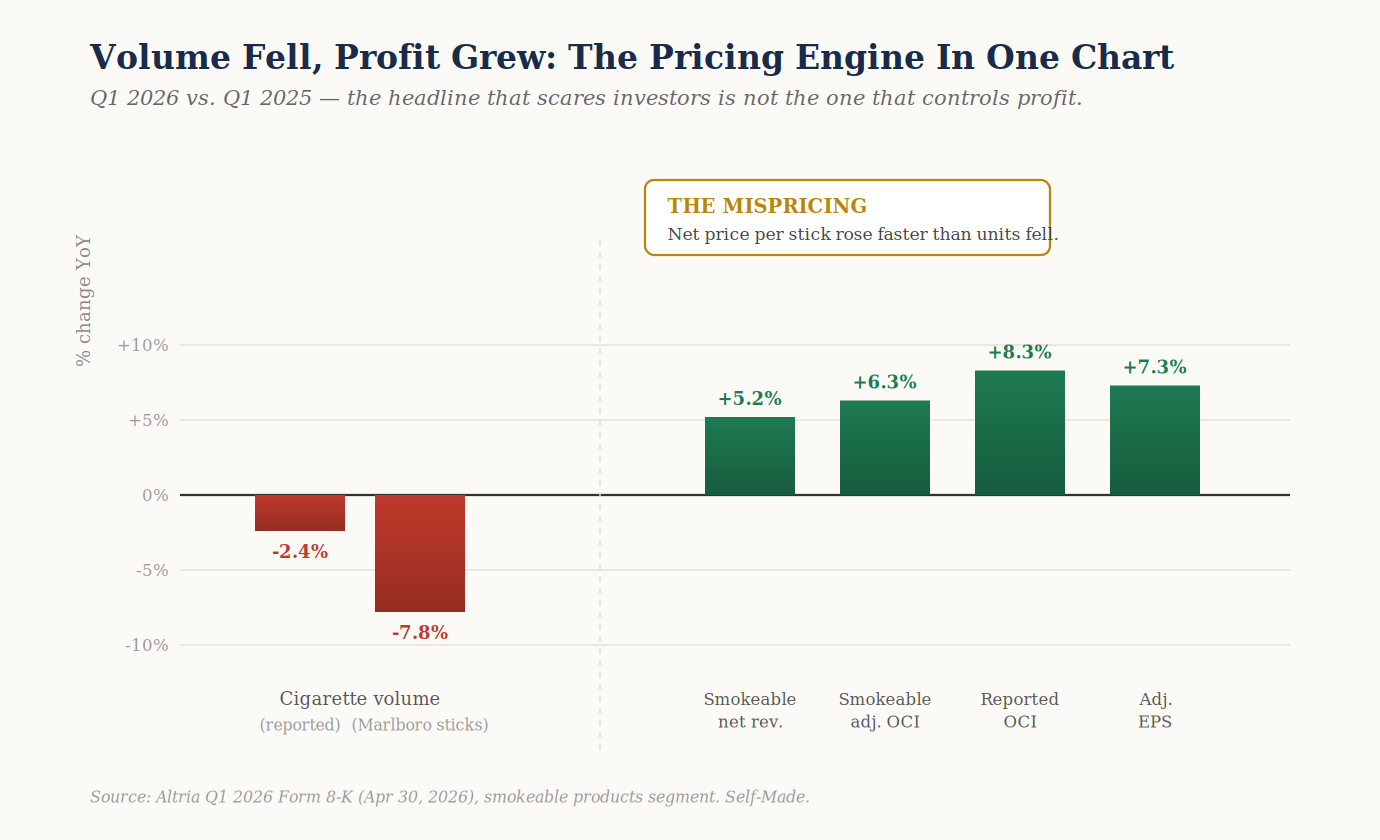
The numbers that matter. The company had Q1 net revenues of $5.43B (+3.2% YoY) and revenues net of excise taxes of $4.76B (+5.3%) on April 30, 2026 — Altria adjusted diluted EPS rose 7.3% to an adjusted $1.32, versus the ~$1.25 consensus. Management reiterated full-year adjusted EPS guidance of $5.56–$5.72, representing a 2.5–5.5% increase over the $5.42 FY2025 base. The cigarette volume is the headline that bears watch, and it did precisely what every bear feared: reported total domestic cigarette shipment volume decreased 2.4% (about 4% adjusting for trade inventory); Marlboro sticks down -7.8%. At the same time, smokeable-segment operating companies income (OCI) increased 8.3% to $2.67B, while adjusted OCI margin expanded 0.7 points to 65.1%. This is your one line thesis: volume down, segment profit up.
Three falsehoods promoted by the consensus. One, the "volume cliff" on a combustibles basis is modeled as a profit cliff but net price on an effectively monopoly branded premium franchise has made up for volume decline for more than 10 years and again in Q1. Two, the new smoke-free portfolio was written to zero post 2025 NJOY impairments — but on! volume grew by 17.6% and FDA authorizations for on! PLUS are widening the runway. The Street pays full price for the decline, while they pay nothing for the optionality. Three, the ~$8.9B ABI equity stake on the balance sheet is a separately listed, liquid, monetizable asset, and becomes a black box when consolidated-P/E models net it into the blob. Our work is built around three highly needed — but almost entirely unutilized in sell-side work — analytical frames (a pricing-power/volume-elasticity model; an option frame on the smoke-free evolution; a sum-of-the-parts that bifurcates the cash machine from the ABI stake), closes with a buyer-base floor, and falsifiable risks. Price Target: 12-month $82; multi-year intrinsic value of $95+. Rating: BUY.
What The Market Believes vs. What The Data Actually Shows
This bear case boils down to five statements. Cigarette volumes are in secular leading decline. Pricing power has limits and will sooner or later fail to make up for that decline. The smoke-free pivot, go figure — NJOY was busted, on! is losing pouch share to ZYN, and no scaled next-gen product. The dividend yield is astronomically high. That is a permanent overhang as well, because U.S. regulatory and litigation risk is present all the time. All of these are easily verifiable against Altria SEC filings rather than narrative; and the first two — the ones that actually drive the multiple — are those most directly negated by a Q1 2026 print.
I do it the bottom up, using a sum-of-the-parts basis first, and take on the three most important stuff in order — pricing-vs-volume mechanism, mispriced smokeless option and buried ABI ownership stake. The single-multiple analysis lumps a ~65%-margin pricing machine, a transition-stage smoke-free book along with a multi-billion-dollar listed equity stake in one clump. This conflation is by itself an important source of wrong pricing.
Forensic #1: The Volume Cliff Is A Pricing Engine in a Disguise
In MO models cigarette (unit) volume is the single biggest proxy for the profit of cigarettes. It is not. Altria, the largest U.S. cigarette seller, has the leading premium franchise in one of most price-inelastic consumer categories known to humankind. In the first quarter of 2026, Marlboro's retail share was 39.7% of the total category, while its market share in the premium segment actually increased by a tenth point to 59.5%. If a company has that share in a category with a captive consumer, the physics are such that list-price inflation drops immediately to the bottom line at very high incremental margins, historically outpacing volume erosion rates.
The mechanism, in three steps. Initially net price increases on Marlboro and the premium book by PM USA; with excise tax & manufacturing cost largely fixed per stick most of that increase flows straight to OCI. Second, the portfolio company pursues a purposeful total portfolio strategy: as income pressures force some consumers to discount, Altria grabs them instead of losing them — discount spark plugs Basic jumped to 2.6% retail share from 0.2% a year earlier; total PM USA cigarette retail share actually grew for the quarter by 0.4 points to 45.4%, even while Marlboro fell back. Third, the margin management is not only about revenues — as part of our Optimize & Accelerate program cost discipline supports margins underneath the revenue line during this transition.
The arithmetic. Q1 2026 total cigarette volume decreased by 2.4%, smokeable net revenue (net of excise) increased by 5.2% and smokeable adjusted OCI increased by 6.3%. Extrapolate that dynamic to the full year: even at an even-more-drastic ~4% adjusted volume decline management projected, the unit trend is still gross-profit-spread positive, because realized price per stick outran units. It is the same elasticity insight that justifies higher quality staples theses elsewhere — in other words the market looks at the volume headline and prices a profit collapse which is then mechanically prevented by pricing. The honest caveat — this works until it does not work. The model breaks the day price rises cause revenue net of price to turn negative when volume declines quickly enough. But Q1 2026 was not the day, and management's recent reaffirmed guidance says that 2026 will also not be the year — at least, in any economically meaningful capacity.
The forensic finding: consensus is buying the volume line and neglecting the price line. The smokeable space is not a burning platform — it is a high-margin annuity with what almost feels like a contractual pricing escalator, and the 8.3% Q1 OCI growth demonstrates that the escalator still works.
Forensic #2: The Smoke-Free Option The Market Marked To Zero
The market did what markets do with a failed acquisition: after taking about $2.2B in cumulative non-cash impairments on its NJOY e-vapor unit through 2025, including an $873M goodwill charge that cratered Q1 2025 before the ITC exclusion order kept NJOY ACE from getting into the U.S. market, management ground forward and the P/E gave zero credit to the smoke-free transition. That is the mispricing. A failed e-vapor SKU and a failed transition are not the same, while oral-nicotine and contract-manufacturing have quietly been working.
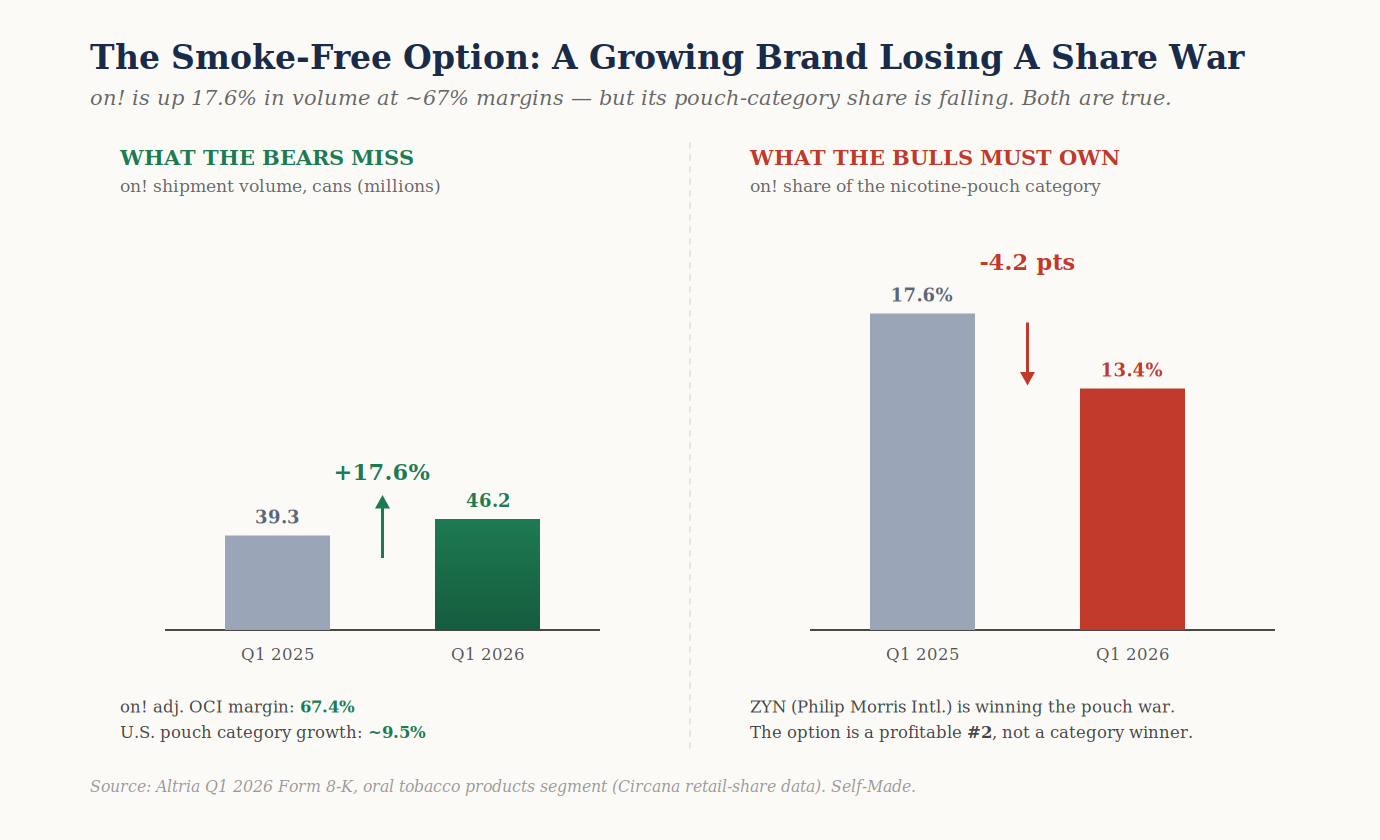
What is actually printing. on! pouch shipment volume for Q1 2026 increased by 17.6% YoY to 46.2M cans, and Helix expanded on! PLUS nationwide after receiving FDA marketing authorizations in December 2025. Oral-tobacco segment OCI margins remain extraordinary at 67.4% adjusted. On a separate note, Altria has started producing contract-manufactured export cigarette volume (610M sticks in Q1 from none a year earlier) — a new, capital-light revenue line that simply wasn't part of past models.
The honest other side. This is where the thesis has to be looked out for, because the bear actually has real bullets in their gun. on! has lost out, with its share of the nicotine-pouch category dropping 4.2 points YoY to 13.4% and its share of the total oral category falling to 7.8%. ZYN, manufactured by Philip Morris International, is the pouch-war winner. The smoke-free "option" here is not about "Altria wins next-gen nicotine," — that bet is with PM. Your range is smaller and more defense-ready: on! is growing volume and sitting on 67% margins inside a category that is growing at 9.5%, and the FDA approval on top of this with nationwide on! PLUS rollout gives it a multi-year runway even as a number-two player but right in the mix. The market is pricing on! as a stock vanishing to zero; the results are for a profitable, expanding, FDA-approved second brand. The space in between those two is the free option.
Frame it conservatively. Even if the smoke-free and contract-manufacturing bits are only fractionally as valuable (on a probability-weighted basis) as the cash Altria has poured into the business — collectively worth even $4–8B of enterprise value versus zero according to a pure combustible-runoff model — that roughly represents up to $2–$5 per share of optionality consensus is leaving on the table.
Forensic #3: The Stake Of ABI That Is Hidden On The Balance Sheet
The third mistake is not analytical, but rather structural: one combined P/E multiple quietly nets an enormous, separately traded equity asset into operating earnings. As of the Q1 2026 balance sheet, Altria books its equity investments — overwhelmingly its stake in Anheuser-Busch InBev (NYSE:BUD) — at almost $8.9B of fair value. That amounts to about 7–8% of Altria's ~$120B market cap sitting as a liquid, monetizable holding, which the company has sold before (blocks sold in 2024, proceeds used for buyback acceleration).
Why this matters for the multiple. ABI's share of equity income from the investment (approximately $159M in Q1 2026) flows back through to reported earnings, so a naive P/E will both count this ABI income and not recognize the value of this ABI asset. A neater read is to value the tobacco operations on their own cash flows, then add a fair-market value for that liquid ABI stake in one go as a discrete line item. The stake will be pressed into service for buybacks opportunistically, management has indicated, to the degree required — and, no, the asset is not stuck; it is a source of per-share accretion and balance-sheet flexibility that the consolidated multiple does not give credit.
Altria's Actual Value: Sum-Of-The-Parts
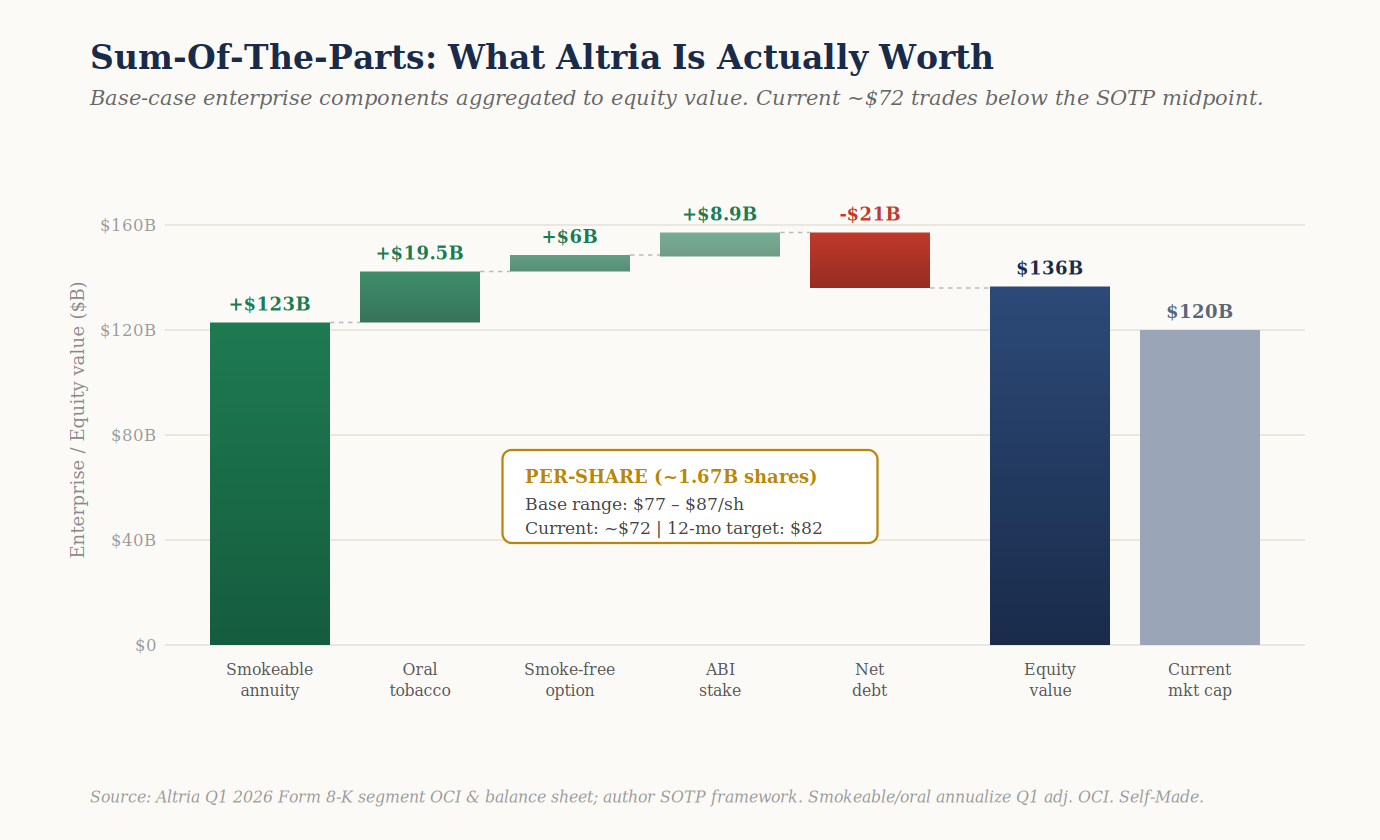
The multiple applied tends to be one multiple, to consolidated EPS. This mixes a ~65%-margin pricing annuity with a transition-stage smoke-free book and an equity stake in the listed company into one number, systematically underestimating the cash engine. A sum-of-the-parts provides an answer that is materially different.
| Component | Basis | Value |
|---|---|---|
| Smokeable (cash annuity) | ~$10.7B adj. OCI run-rate, 11–12x | $118–128B |
| Oral tobacco | ~$1.75B adj. OCI run-rate, 10–12x | $18–21B |
| Smoke-free / contract mfg. option | Probability-weighted | $4–8B |
| ABI equity stake | Fair value, balance sheet as of end of Q1 2026 | $8.9B |
| Less: net debt | Net debt = ~$24.6B total debt − $3.5B cash | ($21B) |
| Equity value | ≈ 1.67B shares | $128–145B |
| Per share | Base → upside | $77–$87 |
Source: Altria Q1 2026 Form 8-K (Apr 30, 2026) segment OCI and balance-sheet data; author SOTP framework. Smokeable annualizes Q1 adjusted OCI; multiples value to staples peers for secular volume decline. Self-made.
The arithmetic. For Q1 adjusted segment OCI, smokeable and oral add roughly $10.7B (annualizing) and $1.75B respectively. We use an 11–12x multiple on the smokeable annuity (not based on its staples peers, as we believe this category will see secular decline), a 10–12x multiple on the oral opportunity, and conservatively value the smoke-free/contract-manufacturing option at $4–8B, with the ABI stake at its $8.9B carrying value, then net -$21B in debt for an equity value of $128–$145B — or roughly $77–$87/shr on a 1.67B share count. The current ~$72 is below the mid-point of that range even ahead of any re-rating in the pricing annuity toward staples multiples. The $82 12-month target reflects the shrinking SOTP gap as Q2/Q3 prints remain consistent with OCI growth on falling volume; the multi-year $95+ figure assumes the smoke-free option gets credited and the buyback continues to grind down share count.
The Buyback and Dividend Floor — A Self-Perpetuating Demand Source
The primary moat that mitigates MO's biggest downside risk is actually the cash-return machine itself. The firm pays a $1.06 quarterly dividend ($4.24 annualized), good for ~5.9%, and management has committed to mid-single-digit dividend growth annually through 2028, as it has delivered for 18 consecutive years now. The company returned about $8B across dividends and buybacks; in Q1 2026 alone it paid roughly $1.78B on dividends and $280M on buybacks, at a 76–88% payout on adjusted EPS (high, but funded by free cash flow), while the ~$8.9B ABI stake can convert its resource into buybacks when needed as it was in fiscal year 2024, with weighted diluted share count reducing by around 1% YoY to 1.67B shares.
What this means in plain English: MO acts like a constant income product. Income funds, retiree allocations, dividend-growth ETFs — they buy yield and the dividend-growth streak, not the volume story, so a huge slice of the shareholder base. In the meantime, that bid is structurally price-insensitive: Altria plans to keep on raising and paying, so that capital sits tight through the news cycle. That gives you a low-beta profile (about 0.5); a self-reinforcing floor — the buyback mechanically raises EPS and dividend-per-share even as volumes fall; and this is why, despite a vanishing unit base, the stock has compounded total return for decades now.
Risks: What Would Break The Thesis
First, pricing power finally cracks. That nags the whole Forensic #1, which is predicated on net price outpacing volume deterioration. But if any quarter post the report shows smokeable net-of-excise revenue going negative — i.e., volume erosion steeper than ~5–6% outweighing price increase — this annuity framing is less compelling and we would factor in a target cut. Keep an eye on the quarterly smokeable net-revenue and OCI lines and any commentary from mgmt on elasticity. The likely accelerants are illicit disposable e-vapor and discount down-trading.
Second, smoke-free keeps losing. on! is no longer a share-winner in pouches. If on! volume growth stalls and margins compress while ZYN continues to gain share, the smoke-free option in the SOTP implodes into something close to $0 (which is what the bears already assume), pushing intrinsic value down $2–$5/share. This is the most easily falsifiable portion of the thesis and needs to be watched closely.
Third, regulation or litigation re-rates the whole sector lower. A federal menthol ban, nicotine-cap rule or litigation cycle — the hottest efforts to reduce combustibles — would drive cash flows from combustibles to zero over time. The counter is that MO already trades at a multiple indicating much of this risk — but a true regulatory shock is not in the ~13x.
The stock has absorbed two risks without imperilling the thesis: 2025 impairments in NJOY and exclusion from the ITC (already baked into reported numbers and largely behind the company); the CEO transition to Salvatore Mancuso as of May 2026 (a continuity appointment, not a strategic rupture). And each of the three core claims is independently testable and will print evidence over the next 2–4 quarters.
Conclusion and Investment Recommendation
Altria Group Inc (MO) is one of those rare stocks in which the headline that terrifies investors — plunging cigarette volumes — is also the same headline shown by the data that does not drive profits. After all, Q1 2026 settled the central question: a volume decline of 2.4% and an 8.3% rise in smokeable OCI. The pricing engine still works. Adding to that mechanical reality are two mispriced add-ons — a smoke-free book the market has marked at zero but that is growing faster and still returns ~67% margins, and a low-tens-of-$bn stake in ABI that consolidated multiples overlook.
The $77–$87 sum-of-the-parts is also conservative to some degree compared to today at $72, while the dividend case is a solid standalone: 18 years of uninterrupted growth, 5.9% yield near multi-year highs, buyback self-funded, and a structurally price-insensitive income buyer base supporting downside. This isn't a thesis of "deep value left for dead" — the stock has already started to re-rate — but rather that this re-rating is only getting started as the market still misinterprets the price discovery mechanism, reading it as ongoing decline. Rating: BUY. 12-month price target: $82. Multi-year intrinsic value: $95+.
Disclaimer: This is not investment advice; this article is intended for informational purposes only. The author may have positions in any securities discussed. Readers should do their own research and due diligence. Source: All figures derived from Altria SEC filings and public market prices before the last week in May 2026.

Sandeep Gupta
Independent equity research analyst publishing forensic theses on US-listed stocks. MBA, Politecnico di Milano (Milan, Italy).
Get new research in your inbox
Subscribe to receive forensic equity research the moment it's published. Free, no spam.
Related Research
 GIS
GIS General Mills Beat Estimates By 16% But The Market Saw Only The Impairment — The $3B Cost Program Is Being Ignored (GIS)
 KHC
KHC Kraft Heinz's 7% Yield Is Priced For A Dividend Cut The Cash Flow Doesn't Support (KHC)
 CAG
CAG
Discussion
Be the first to comment.