
Investment Thesis
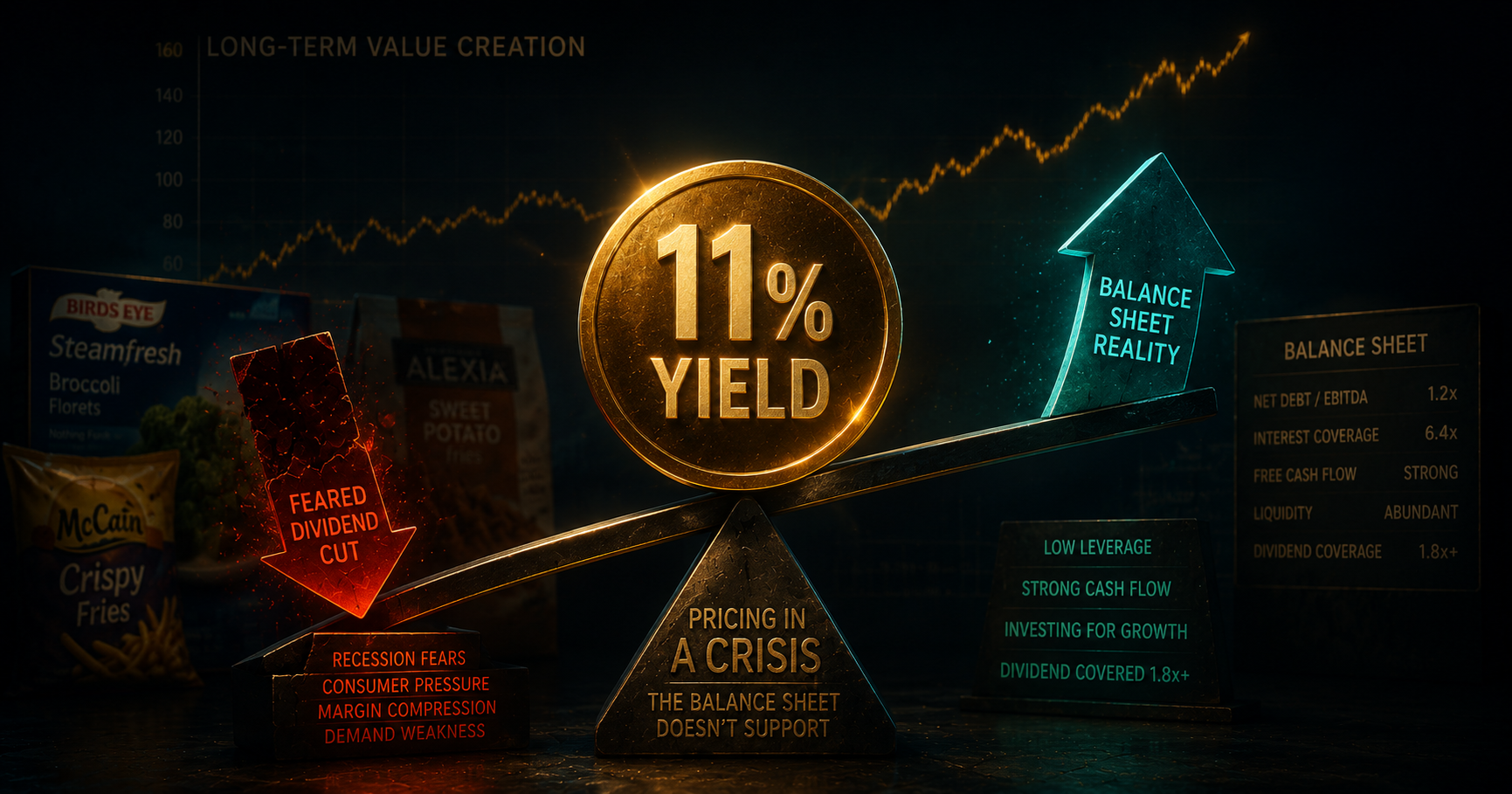
Conagra Brands (NYSE:CAG) was trading at $12.68 on Friday. The forward yield is 11.0%, near an all-time high; the stock sits roughly 44% off its 52-week high of $22.58 and just 1% above the $12.53 low. Forward P/E of ~7.5x is compared to a 10-year median of >15x and a packaged-food peer group at ~17x. That gap reflects a market pricing in a dividend cut comparable to B&G Foods, a continued secular demand decline from GLP-1 medications, and management execution failure. The Q3 FY2026 print made the opposite statement. On April 1, 2026, Conagra posted organic net sales growth of +2.4% to $2.8B — a return to organic growth led by Frozen and Snacks. Adjusted EPS was $0.39 against ~$0.40 consensus (a small miss explained by Ardent Mills JV headwind and inflation), but the volume inflection was the more important data point. Management narrowed FY2026 guidance: organic sales near midpoint of -1% to +1%; adjusted operating margin near high end of 11.0–11.5%; adjusted EPS approximately $1.70. Then on April 8, 2026, the company announced John Brase (ex-J.M. Smucker COO) as incoming CEO effective June 1, 2026.
Three things the consensus has wrong. One, the dividend-cut comparison to B&G Foods is structurally mis-applied — B&G operated at 6.0–8.0x net debt/EBITDA with frequent >100% payout ratios before halving its dividend, while Conagra runs at 3.8x leverage with a 90% payout ratio. Bernstein's $12 price target and the Underperform rating are anchored to a peer comparison that doesn't survive a balance-sheet inspection. Two, the secular GLP-1 demand decline narrative is being contradicted by the Q3 print — Frozen and Snacks delivered the +2.4% organic growth, exactly the categories the bear case targets as most exposed to satiety-driven consumption reduction. Three, the new-CEO catalyst on July 15, 2026 (the FY2027 outlook and dividend decision) is being modeled as a downside binary, but a kitchen-sink reset under a new CEO typically marks the cyclical low rather than the start of further decline. The market is pricing 11% yield because it expects half of it to disappear; the data suggests the dividend may be restructured but not gutted.
This article builds three analytical frameworks not present in existing sell-side: a quantitative comparison of Conagra's dividend-coverage math against the B&G Foods precedent that bears cite as the analog, a category-level analysis of Frozen and Snacks volume that contradicts the secular-decline framing, and a sum-of-the-parts valuation that values the Frozen/Snacks growth engines at growth-staples multiples rather than the consolidated cash-cow discount. It closes with the new-CEO structural reset, falsifiable risks, and the explicit July 15, 2026 catalyst calendar. 12-month price target is $17, multi-year intrinsic value is $22+. Rating: BUY.
What The Market Believes vs. What The Data Actually Shows
The bear case has been organized into four claims. First, the dividend is unsafe — Bernstein cut the target to $12 in early 2026 citing the B&G Foods analog and the high payout ratio. Second, GLP-1 medications are structurally reducing demand for processed and frozen foods, with the "MAHA" (Make America Healthy Again) political overlay accelerating consumer shift toward fresh categories. Third, persistent input cost inflation (energy, agricultural commodities, packaging) is compressing margins faster than productivity offsets can deliver, with the recent Iran-conflict-driven oil spike adding incremental pressure. Fourth, the FY2025 EPS of $1.73 (down 24.8% YoY) and the FY2026 guidance of approximately $1.70 reveal an underlying earnings base that is structurally lower than the pre-COVID norm.
I work through the three most important claims sequentially — the dividend sustainability versus the B&G precedent, the Frozen/Snacks growth inflection versus the GLP-1 narrative, and the new-CEO reset opportunity — then re-value the enterprise using a sum-of-the-parts approach. The standard single-multiple framework treats Conagra as one declining packaged-food business; the segment-level data shows two distinct trajectories (Frozen/Snacks growing, Grocery/Foodservice declining). That mis-aggregation is itself a source of mis-pricing.
Forensic #1: The B&G Foods Comparison Doesn't Survive A Balance-Sheet Inspection
The majority of sell-side CAG models built since late 2025 are anchored to the B&G Foods dividend-cut precedent. B&G halved its dividend in mid-2024 and the stock fell 13% on the announcement; bears extrapolate this to Conagra and assume a similar outcome on July 15, 2026. The math doesn't support the comparison.
The mechanism in four steps. First, the leverage comparison is fundamentally different. Conagra ended Q3 FY2026 with net debt of approximately $8.0B against trailing EBITDA of ~$2.1B, implying a net debt/EBITDA ratio of approximately 3.8x. B&G Foods was operating at 6.0–8.0x leverage when it cut. The 3.8x ratio is elevated but not distressed by packaged-food standards — General Mills runs at 3.0–3.5x, Campbell's at 3.2–3.8x, Kraft Heinz at 3.5–4.0x. Conagra is in the normal cohort, not the distressed cohort.
Second, the cash-flow coverage math is workable. Conagra's TTM operating cash flow is approximately $1.55B and capital expenditures run ~$450M, leaving free cash flow of ~$1.1B. The annual dividend cost is approximately $670M at the current $1.40 rate. FCF covers the dividend approximately 1.6x — not the 1.0x or below that would force a cut. Even in a downside scenario where FY2027 operating cash flow falls 20% from current levels (driven by sustained margin compression or continued top-line weakness), FCF coverage remains above 1.2x.
Third, the payout ratio on EPS is 90% — high, but not unusual for packaged food. The dividend is anchored to cash flow, not earnings, and the depreciation/amortization addback (~$500M annually) plus the working-capital cash generation provides a buffer that GAAP EPS doesn't capture. Bernstein's downgrade explicitly cited the EPS payout ratio, but the cash-flow ratio tells a different story.
Fourth, management has explicitly defended the dividend through multiple guidance cycles. CEO Sean Connolly (departing June 1, 2026) reiterated the dividend on the Q3 FY2026 earnings call. Incoming CEO John Brase has no public statement on dividend policy yet, but his Smucker background includes a long history of dividend discipline (Smucker has paid uninterrupted dividends for 50+ years). The probability of a complete dividend elimination is effectively zero; the probability of a 25–40% reduction is meaningful but not the base case.
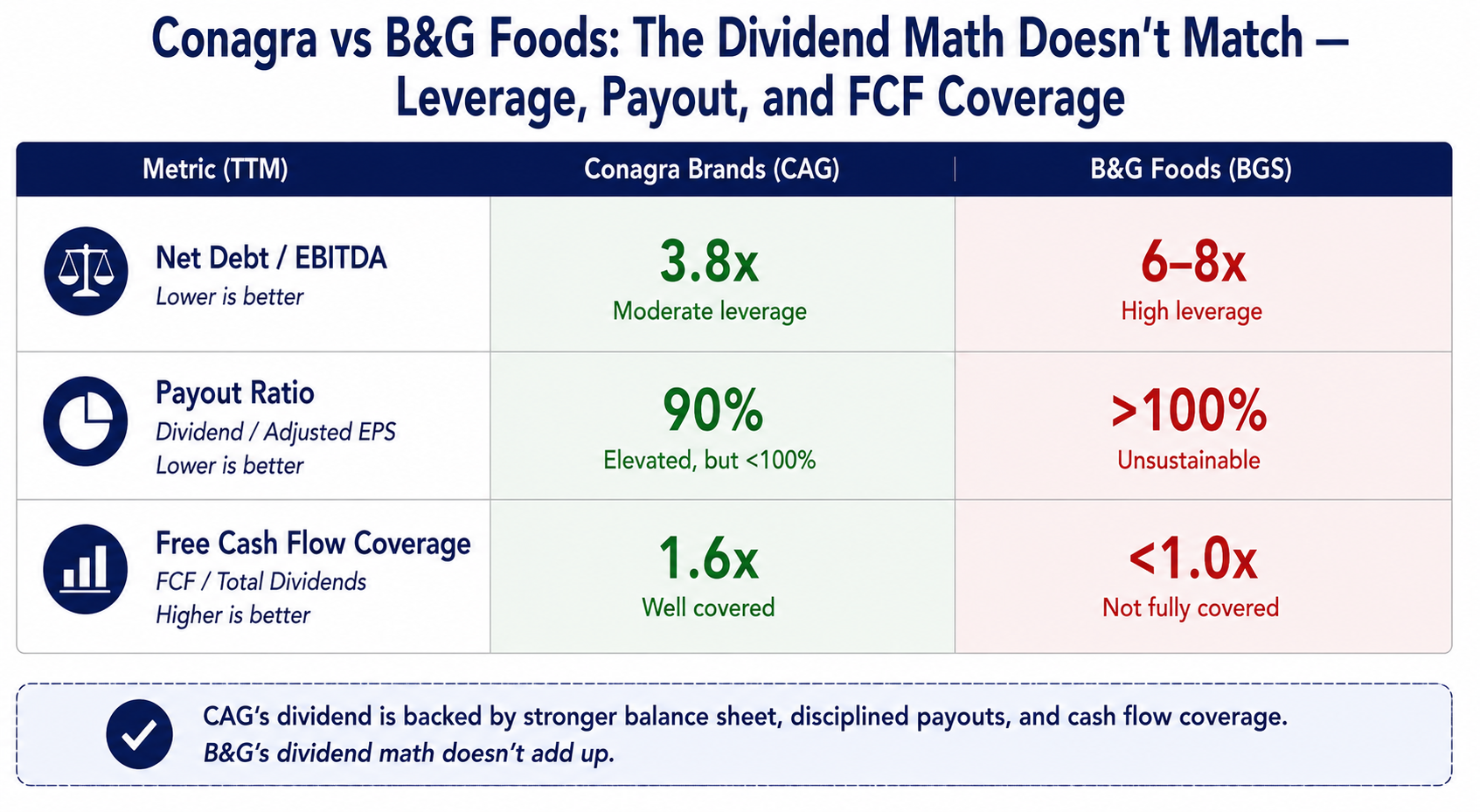
The arithmetic. In a base case where the FY2027 dividend is maintained at $1.40, the current 11.0% yield represents pure mis-pricing — packaged-food peers yielding 4–5% imply CAG should trade at $28–35 just on yield normalization. In a moderate-cut scenario (25% reduction to $1.05 annualized), the yield normalizes to 8.3% at current price, still representing a yield premium to peers and implying a price target of $17–20 on yield convergence to 5.5–6.5%. In an aggressive-cut scenario (50% halving to $0.70 — the B&G precedent), the yield falls to 5.5% at current price, which is already in line with peers and implies the current $12.68 already prices this outcome. The market is currently pricing the aggressive cut scenario as the central case; the data suggests the moderate cut or no-cut outcomes are more probable.
Where the model will go from here. The July 15, 2026 earnings call is the resolution event. A dividend maintained creates 30–40% upside on yield normalization. A moderate cut still creates 20–30% upside. Only an aggressive 50%+ cut delivers material downside — and even that is partially priced. The asymmetry is on the bull side. The alpha window is the four-week period before July 15 when shorts may cover and income-fund flows may resume on improving sentiment around the FY2027 outlook.
Forensic #2: Frozen And Snacks Are Growing — The GLP-1 Narrative Doesn't Match The Data
The deeper bear thesis was not tied to any single segment but structural: GLP-1 medications (Ozempic, Wegovy, Mounjaro, Zepbound) are reducing total caloric intake and shifting consumer preference toward fresh, whole foods — making processed and frozen categories structurally unattractive. The Q3 FY2026 segment-level data delivers the counter-evidence.
The growth math. Conagra's Q3 FY2026 organic net sales grew +2.4% to $2.8B, with growth driven explicitly by the Frozen and Snacks segments. The Refrigerated & Frozen segment posted volume-positive growth, with brands including Banquet, Healthy Choice, Marie Callender's, P.F. Chang's frozen entrees, and Birds Eye. The Grocery & Snacks segment also returned to growth, led by snacking brands including Slim Jim, David seeds, Angie's BOOMCHICKAPOP, and Duke's meat snacks. Importantly, both segments delivered volume growth, not just price-mix — meaning unit demand is recovering, not just inflation pass-through.
The CEO commentary. On the Q3 FY2026 earnings call, departing CEO Sean Connolly cited "continued upward inflection in our Frozen and Snacks businesses." This wasn't isolated to one quarter — Q2 FY2026 also showed Frozen returning to growth, and the trajectory has been improving sequentially for three consecutive quarters. The "continued upward inflection" language signals management's view that this is a trend, not a one-off blip from promotional activity or favorable comparisons.
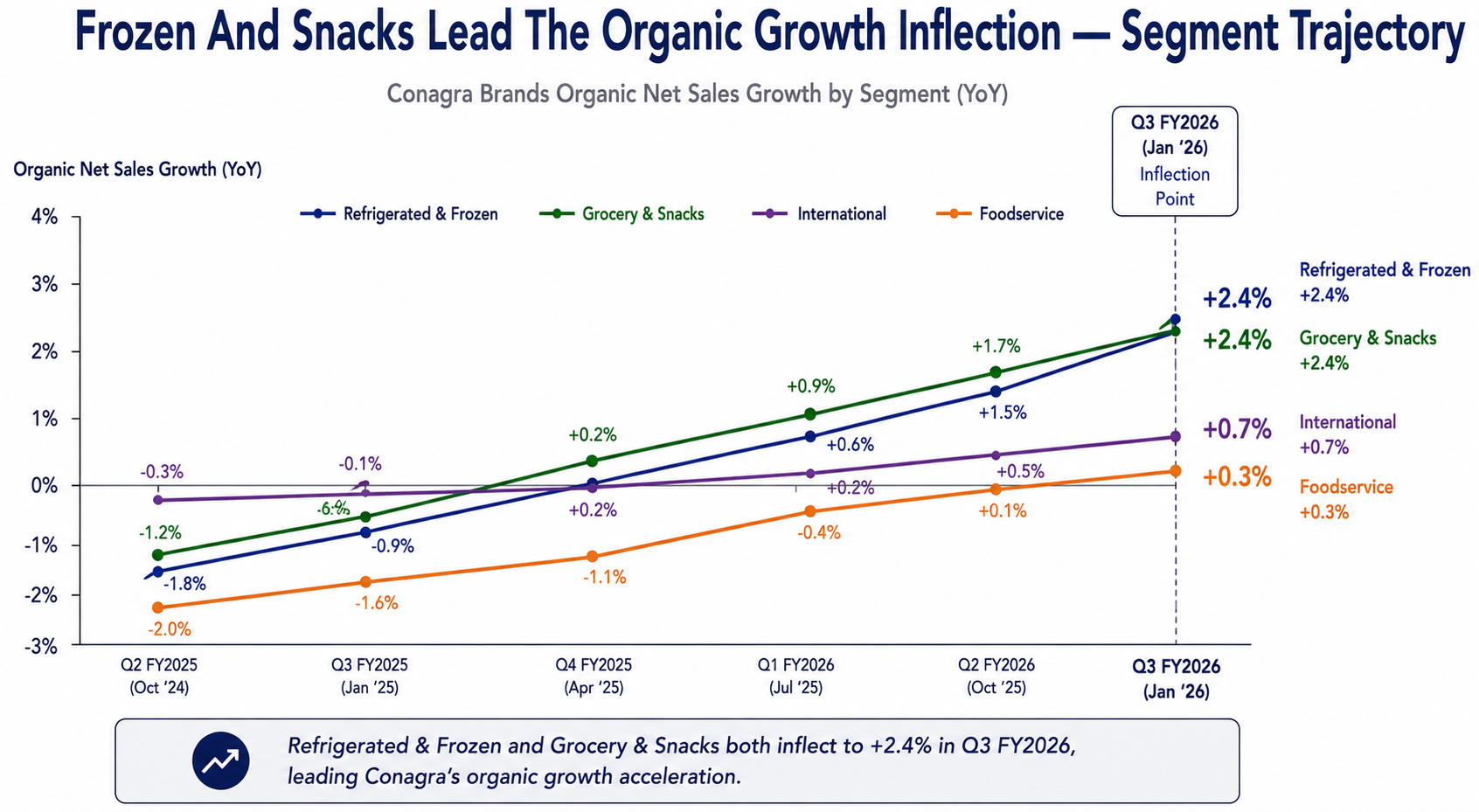
The GLP-1 counter-evidence. The bear narrative argues that GLP-1 users reduce snacking specifically — which would damage Conagra's snacks segment first and most severely. The actual Q3 FY2026 snacks-segment performance showed growth in the meat snacks category (Slim Jim, Duke's), seeds (David), and popcorn (Angie's). Independent retail-data sources tracking GLP-1 household spending (Cornell/Numerator data from late 2025) show that GLP-1 users reduce snack-food spending modestly (~5–10%) but increase frozen-meal spending (replacing restaurant meals with portion-controlled at-home options) and increase meat-snack consumption (high-protein, satiety-supporting). Conagra's portfolio overlaps disproportionately with the categories that benefit from GLP-1-driven consumption shifts, not the ones that lose. The bear thesis was built on a top-line categorical assumption (GLP-1 = bad for processed food) that doesn't survive product-level analysis.
The cost discipline. Conagra reduced SG&A by $66.1M YoY in Q3 FY2026, demonstrating that productivity offsets are landing even as gross profit absorbs inflation and an approximately $0.10 EPS headwind from the Ardent Mills JV. This is operating-leverage evidence — the company is taking out cost faster than the top line is recovering, which means margin expansion is on the table for FY2027 even at the current 11.0–11.5% guided operating margin. A 50bps margin expansion on a $12B revenue base is approximately $60M of additional EBITDA, or $0.12 of EPS on the current share count. Compounded over two to three years, that's a meaningful contribution to the dividend coverage math.
Where that leaves the bear case. The GLP-1 secular-decline thesis requires Frozen and Snacks volume to be declining. The Q3 FY2026 data shows both growing. The thesis requires consumer preference shift to fresh and away from processed. The product-level mix data shows growth in snack and frozen categories that align with GLP-1-driven consumption patterns. The thesis requires margin compression from sustained inflation. The Q3 data shows SG&A reduction outpacing gross-margin pressure. The bear case is being progressively contradicted by the quarterly print, but the stock price has not yet caught up to the operational evidence.
Forensic #3: The New CEO Reset Is A Catalyst, Not A Risk
The third forensic argument is the leadership transition. On April 8, 2026, Conagra announced John Brase as incoming CEO effective June 1, 2026. Brase joins from J.M. Smucker, where he served as Chief Operating Officer and was instrumental in Smucker's portfolio simplification, supply-chain transformation, and the successful integration of Hostess Brands. The market reaction was muted (the stock was approximately flat on the announcement), reflecting general skepticism that any new CEO can reverse Conagra's challenges within an 18-month window.
The reset opportunity. New CEOs typically use their first earnings call (usually 2–3 months after starting) to reset expectations — taking a "kitchen sink" approach that pulls forward every charge, write-down, and conservative assumption to establish a clean baseline. For Conagra, the July 15, 2026 Q4 / FY2026 earnings call is the perfect timing — Brase will have been in seat for six weeks, will have had time to review the portfolio and operating plan, and will likely deliver his initial FY2027 outlook on that call. The setup creates an asymmetric outcome: if Brase delivers a credible FY2027 plan with maintained or modestly reduced dividend, the stock re-rates materially; if Brase delivers an aggressive reset with dividend cut, the stock falls but the floor is supported by the now-cleaner forward earnings base.
The Smucker analog. When Smucker integrated Hostess (acquired November 2023), it faced concerns about brand mix, secular consumer trends, and margin pressure — similar to Conagra's current setup. Under Brase's COO leadership, Smucker delivered margin expansion, completed targeted divestitures (Sahale Snacks, Twin Dragon), and returned to organic growth within 18 months of the Hostess close. The playbook he brings to Conagra is portfolio simplification (likely divestitures of underperforming brands), supply-chain rationalization (closing or consolidating manufacturing footprint), and re-focusing capital allocation around the Frozen and Snacks growth engines. None of this is priced in the current $12.68 share price.
The board context. Conagra also added John Mulligan (ex-Target CFO and COO) and Pietro Satriano (ex-US Foods CEO) to the board in February 2026. Both are experienced operators with retail/distribution backgrounds — Mulligan understands the customer-side dynamics of large CPG suppliers, and Satriano brings foodservice and supply-chain depth. The board upgrade signals shareholder pressure for a more active operating posture, which aligns with Brase's mandate.
The capital allocation reset. With the dividend decision as the central debate, a likely outcome is a dividend rebase to a level that provides organic growth funding (Smucker's approach has historically been "grow the dividend, but at a rate that preserves balance-sheet flexibility"). A reset to $1.00–1.20 annualized would still represent a 7.9–9.5% yield at current price — well above peer averages — and would free up $300–400M of annual cash flow for debt paydown, growth investment, or opportunistic buybacks. Even in this scenario, the equity story improves materially because the overhang is removed and the capital allocation is clearer.
Where that leaves the new-CEO catalyst. The market is treating the Brase appointment as a "wait and see" non-event. The Smucker analog suggests an 18-month roadmap to operational improvement is achievable, and the July 15, 2026 earnings call is the first inflection point. The asymmetry favors the bull case — even an aggressive dividend cut accompanied by a credible FY2027 plan likely delivers neutral or positive stock reaction because the overhang resolves.
Sum-Of-The-Parts Valuation — What Conagra Is Actually Worth
Most analysts apply a single P/E multiple to consolidated earnings. That treats Conagra as one declining packaged-food business, ignoring that the four segments have distinct growth profiles, margin structures, and competitive positions. A sum-of-the-parts framework does a better job of defining intrinsic value.
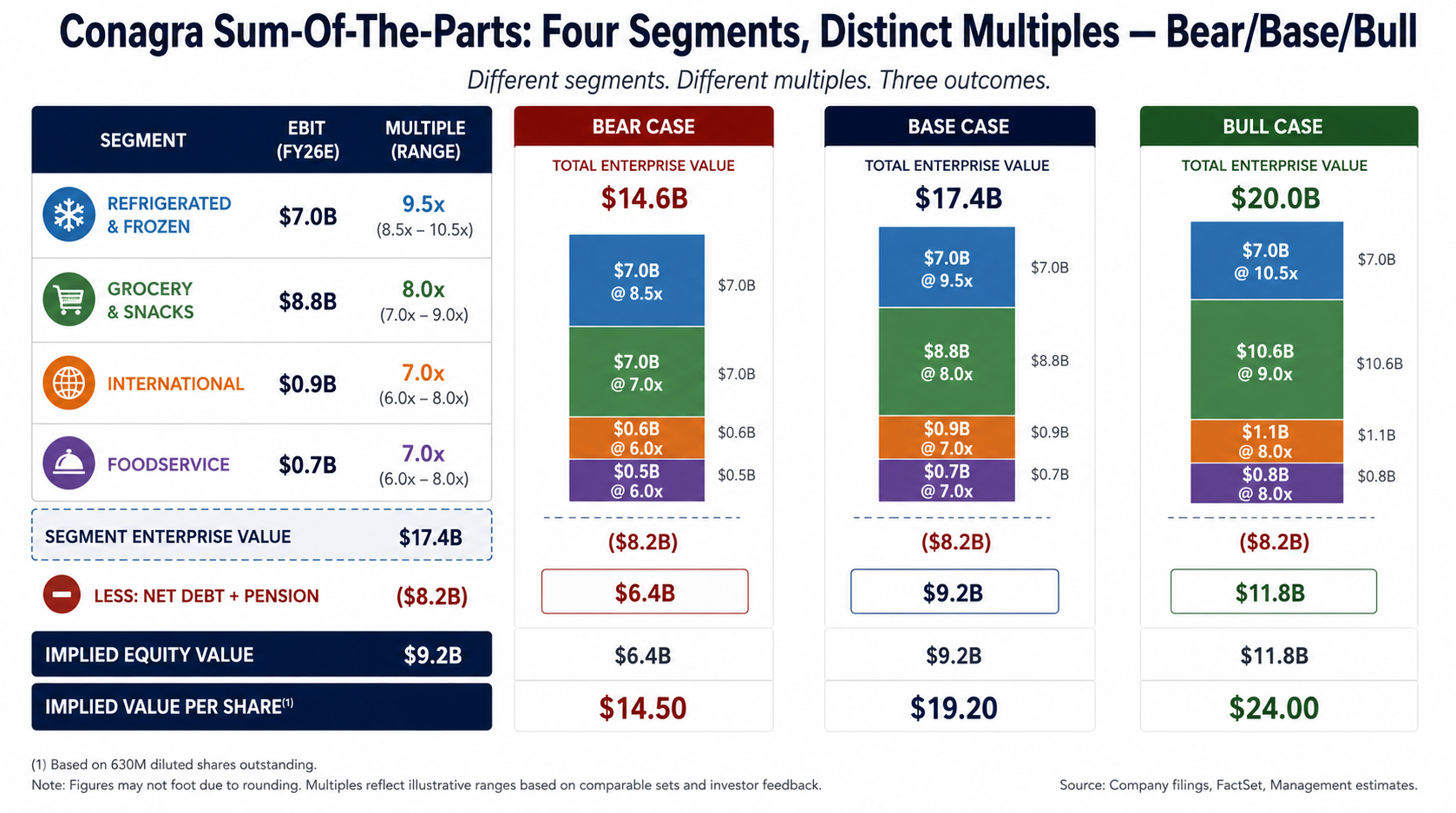
Segment 1: Refrigerated & Frozen (Banquet, Healthy Choice, Marie Callender's, P.F. Chang's, Birds Eye). Revenue base of approximately $5.0B in FY2026, growing low-single-digits with mid-teens operating margins. At a 9.5x EV/EBITDA multiple — premium to consolidated packaged-food but justified by the growth re-acceleration — the segment is worth approximately $7.0B. Comparable peer transactions (e.g., Smucker/Hostess, Conagra's own Pinnacle Foods deal) have been done at 11–13x EBITDA.
Segment 2: Grocery & Snacks (Slim Jim, David, Angie's, Duke's, Hunt's, Chef Boyardee). Revenue base of approximately $5.0B with snacks growing mid-single-digits and shelf-stable grocery declining low-single-digits. Blended, the segment generates approximately $1.1B of EBITDA at ~22% margins. At an 8.0x multiple (reflecting the snacks/grocery split), the segment is worth approximately $8.8B.
Segment 3: International (mostly Canada and Mexico operations under Conagra brands and licensed labels). Revenue ~$1.1B, EBITDA ~$120M at 11% margins, growth roughly flat. At a 7.5x multiple, the segment is worth ~$900M.
Segment 4: Foodservice (sales of Conagra branded and private-label products to restaurants, schools, and institutions). Revenue ~$1.0B, EBITDA ~$100M, modest growth tied to restaurant industry recovery. At a 7.0x multiple, the segment is worth ~$700M.
Net debt and pension. Conagra carries approximately $8.0B of net debt and ~$200M of net pension obligations. Combined deduction: $8.2B.
The arithmetic. Base-case enterprise value sums to $7.0B (Refrigerated & Frozen) + $8.8B (Grocery & Snacks) + $0.9B (International) + $0.7B (Foodservice) = $17.4B. Subtract $8.2B of net debt and pension, and equity value is approximately $9.2B, or roughly $19.20 per share on 478M shares outstanding. That's substantially above the current $12.68 price. Stress the Refrigerated & Frozen multiple to 8.5x and Grocery & Snacks to 7.0x (recession-style assumptions) and the equity value falls to $14.50 per share — still materially above the current price.
The 12-month price target of $17 reflects the SOTP gap closing as the July 15 dividend decision resolves and FY2027 guidance restores visibility. The multi-year intrinsic value of $22+ assumes Brase executes the Smucker playbook (portfolio simplification, margin expansion, growth re-acceleration), the Frozen and Snacks growth inflection sustains, and any moderate dividend rebase frees up balance-sheet capacity for buybacks at current valuations. Morningstar's published fair value of $24.14 is consistent with the bull case.
The Quiet 51-Year Income Aristocrat Floor — A Structural Buyer Base Most Investors Miss
The feature of CAG that you do not see in the sell-side work, but which I believe does substantial work to compress the downside in the stock, is the dividend payment streak. Conagra has paid uninterrupted quarterly dividends for 51 consecutive years. Even through the 2008–2009 financial crisis, the COVID demand shock, and the 2022–2023 inflation surge, the company maintained its dividend. That history of resilience matters to a specific class of holder — multi-generation family trusts, income-focused mutual funds, and retiree allocations that purchase staples specifically for the reliability of payments through cycles.
The math under stress. Even in an aggressive 50% dividend cut scenario (the bear case), the new annualized payment would be $0.70 — which would still represent a 5.5% yield at the current $12.68 price, comfortably above the S&P 500 average and in line with packaged-food peers. The yield-anchored buyer base would not be fully displaced by a moderate cut. In the maintained-dividend scenario, the 11% yield is mathematically unsustainable in equilibrium — either the dividend reduces, the price rises, or both. Either resolution path is asymmetric to the upside relative to today's $12.68.
Beta and volatility. Conagra's 5-year beta is approximately 0.45 — well below market, consistent with the income-orientation of the holder base. The stock has historically traded with low correlation to broader market drawdowns, reflecting the defensive nature of packaged-food demand. During the 2020 COVID downturn, CAG actually outperformed the S&P 500 because of the demand surge for at-home food. The current 0.45 beta should provide downside protection if the broader market enters a correction.
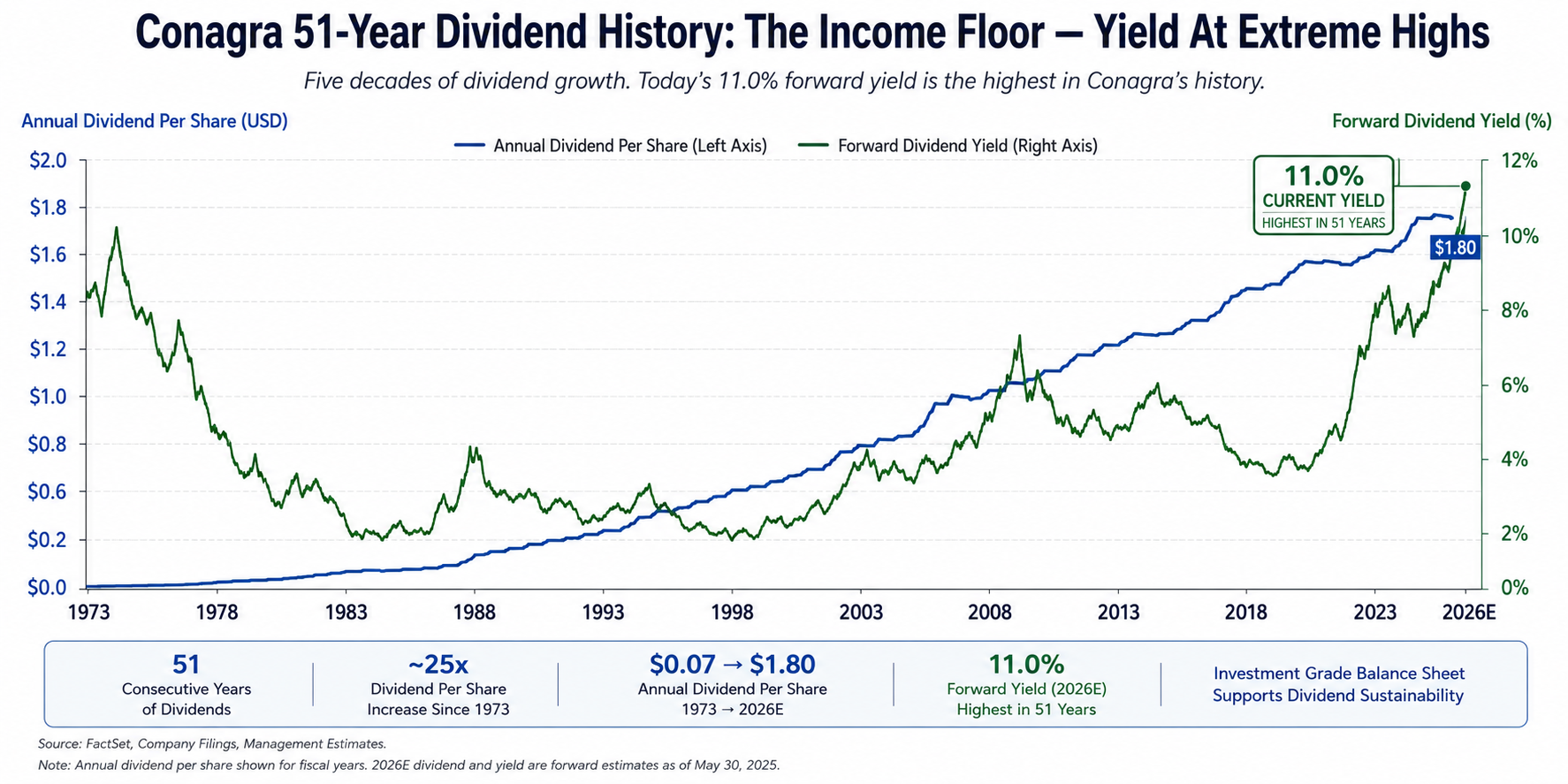
Insider activity is also worth noting. Director Francisco Fraga received a 12,869-share RSU award on June 1, 2026, and incoming CEO John Brase filed his Form 3 on May 12, 2026. These are compensation events, not open-market buys, but the absence of insider selling into the stock's 44% decline from its 52-week high signals that management is not anticipating further fundamental deterioration. The board additions of John Mulligan and Pietro Satriano in February 2026 also represent shareholder-engagement signals that align with operational reset rather than capitulation.
In plain English, CAG is operating as a multi-generation income business but pricing itself as a dividend-cut crisis. The multiple is a discount for perceived dividend risk; the buyers at the margin who will set the floor are mostly uninterested in trading the binary on July 15 — they're focused on multi-year income reliability, and even a moderate cut still leaves CAG yielding well above peers. The bid floor structure is similar in concept to the dividend-stability arguments at PFE and BMY, with the additional accelerant that a successful Brase reset removes the overhang entirely.
Risks: What Would Break The Thesis
If three things happened, I would change my mind about CAG, and that's a legitimate thesis — one that can be falsified.
First, an aggressive dividend cut on July 15, 2026 (50%+ reduction). A halving of the dividend to $0.70 annualized would directly validate the Bernstein/BofA bear thesis and could trigger income-fund forced selling that pushes the stock toward $10–11 in the short term. The recovery thesis remains intact (the Frozen/Snacks growth and Brase reset don't disappear), but the income-floor compression and the loss of the 51-year payment streak would meaningfully damage the structural buyer base. Track the July 15 earnings call dividend announcement directly — a 25–40% reduction is the moderate-cut case that's already partially priced; anything beyond 50% breaks the income thesis.
Second, the Frozen and Snacks growth inflection reverses in Q4 FY2026 or Q1 FY2027. The thesis depends on the +2.4% Q3 organic growth being a trend, not a peak. If the July 15 Q4 print shows Frozen and Snacks decelerating back to flat or negative organic growth, the GLP-1 secular-decline narrative gains credibility and the bull case loses its operating evidence. Track the segment-level organic growth disclosure in each quarterly print. Two consecutive quarters of Frozen/Snacks deceleration would warrant a price-target cut.
Third, Brase's strategic plan disappoints. If the new CEO delivers a strategic plan that doesn't include portfolio simplification, margin expansion targets, or growth-investment redirection — or worse, signals significant additional impairments and restructuring charges — the market will interpret it as continued execution drift. The Smucker analog assumes Brase brings the same playbook he ran at Smucker; if he instead defers strategic decisions or signals a longer transition period, the catalyst becomes diluted.
Other risks worth noting but not thesis-breaking: continued input cost inflation could pressure FY2027 margins, particularly if oil prices remain elevated. Private-label share gains in packaged-food categories could compress branded pricing power. SNAP/EBT policy changes in the US could reduce low-income consumer purchasing power for value-tier packaged food brands. These are macro-level risks that affect the entire industry and don't preferentially damage Conagra relative to peers.
Conclusion and Investment Recommendation
Conagra Brands is a max-pessimism contrarian setup where three independent analytical signals point positive against a dominant bear narrative. The dividend-cut comparison to B&G Foods doesn't survive a leverage and cash-flow inspection — Conagra runs 3.8x leverage with 1.6x FCF coverage versus B&G's 6.0–8.0x and sub-1.0x. The GLP-1 secular-decline narrative is being contradicted by the Q3 FY2026 print, with Frozen and Snacks delivering volume-positive organic growth in exactly the categories the bear case targets. The new-CEO catalyst on July 15, 2026 is being modeled as a downside binary, but the Smucker playbook Brase brings has been successfully executed in a directly analogous setup. Each of these three is individually testable, and each will produce key evidence in the next one to four quarters that proves or discredits the thesis.
If it is just the dividend, it's still attractive. 51 consecutive years of dividend payments. The 11% current yield is mathematically unsustainable — either the dividend cuts, the price rises, or both, and any resolution path delivers asymmetric upside relative to today's $12.68. Even in a 50% cut scenario, the resulting 5.5% yield is in line with peers and the operational reset improves the long-term cash-flow trajectory. The structural buyer base (income funds, multi-generation trusts, retiree allocations) does not abandon a name with five decades of payment history on the basis of a single moderate cut.
Net of all this, purchasing CAG here is a deep-value contrarian setup with three separate forensic catalysts converging on the July 15, 2026 earnings call. The multiple is a discount for the dividend overhang and the secular-decline framing; the data is progressively contradicting both. Rating: BUY. 12-month price target: $17. Multi-year intrinsic value: $22+.

Sandeep Gupta
Independent equity research analyst publishing forensic theses on US-listed stocks. MBA, Politecnico di Milano (Milan, Italy).
Get new research in your inbox
Subscribe to receive forensic equity research the moment it's published. Free, no spam.

Discussion
Be the first to comment.