

Investment Thesis
Following decades of uninterrupted dividend payments, Hershey (NYSE:HSY) offers a 3.1% forward dividend yield, which is near a 15-year high, as the stock stands ~20% below its 52-week high, and trades at around 19x forward earnings, but the 10-year historical median is closer to 26x. The valuation compression comes at the same time the company has the best operational quarter in 2 years. On April 30, 2026, Hershey reported Q1 2026 net sales of $3.1B (+10.6% YoY), organic constant-currency growth of 7.9%, and adjusted EPS of $2.35 that beat consensus of ~$2.04 by 15%. Management reiterated the full-year adjusted EPS growth forecast of 30–35% (~$8.42 at the midpoint) as it expects to see an adjusted gross margin recovery of ~400 bps. That implies a price elasticity of -0.2 on the volume decline — fundamentally contradicting the market's 10-point net price realization assumption, while North America Confectionery segment income rose 13.8% on a 2% volume decline.
This mispricing is due to three distinct and measurable consensus errors. First, cocoa is treated as a structurally elevated input cost, while both the spot market and the ICCO's work on the world's first global surplus in four years, as well as a 6–12 month forward hedging policy adopted by Hershey, are the opposite. Second, the so-called GLP-1 demand-destruction story, which is uniform for packaged food, is not true for chocolate. The Cornell/Numerator study, published in a peer-reviewed journal, Journal of Marketing Research, is clear: Chocolate and candy is the only guilty pleasure category to see a rise in GLP-1 spending compared to baseline levels, while savory snack spending drops 10.1%. The market has the sign wrong. In fact, the third is the North America Salty Snacks segment, which expanded 26% in Q1 2026 and is valued as part of Hershey's blended ~19x multiple, while peer-set better-for-you snack platforms (UTZ, SMPL, BRBR) currently trade at compressed 1.0-1.4x EV/Sales after a sector-wide reset, against historical growth-phase multiples of 2.5-4.0x. In all the sell-side models I have seen, the segment has a low structural weighting.
This article builds three new analytical frameworks that are not covered by the existing sell-side: a model of the cocoa lag, a model of GLP-1 misframing based on the peer-reviewed data from Cornell, and a framework of the optionality in the Salty Snacks business, which includes a sum of the parts valuation and a description of the governance structure of the Hershey Trust that provides a floor not seen in other consumer staples issues. The 12 month price target is $235 and the multi-year intrinsic value is $275+. Rating: BUY.
What The Market Believes vs. What The Data Actually Shows
The best place to begin is to simply write out the consensus narrative and compare it to the Q1 2026 print and the most rigorous external evidence available. The consensus is based on five assertions: cocoa inflation is structural and persistent; GLP-1 drugs will take a share of chocolate demand, as well as other snack categories; volume elasticity will collapse as Hershey increases prices; Hershey is a one-trick chocolate player that could be exposed to category disruption; margin compression is the new standard at 33–35% gross. All these are subject to quantitative refutation on published evidence.
The rest of this article dissects the three most important of these — the cocoa lag mechanics, the GLP-1 misframing and the unmodeled Salty Snacks asset — and then takes an alternate view of the value of the enterprise through a sum-of-the-parts lens instead of the traditional P/E multiple framework.
Forensic #1: The Cocoa Lag Is Mechanical, Not Optional
The biggest misconception about Hershey's P&L is the connection between cocoa spot prices and recognized cost of goods sold. There is a consensus that cocoa headlines are being read and that there is a near pass through. The workings are subject to the company's hedging policy and inventory accounting procedures, published and available.
The mechanism in 3 steps. First, Hershey enters into forward contracts for cocoa, mostly in the form of futures, options, and physical forward contracts, which are usually for 6–12 months ahead of the production period. As of 2025 Q2 earnings, management made an explicit statement that the 2025 prices had been "locked in well below the market" and they started booking 2026 hedges from then on. Second, the same months of delay are created by inventory turns as raw cocoa is bought and hedged at a certain price, and then turned into intermediate stock, such as cocoa liquor, cocoa butter and cocoa powder, which is then turned into finished goods again, before it is sold. Third, that inventory is valued using original cost basis and is carried through to recognized COGS irrespective of the spot trades on the day of the sale. The crucial economic factor that will drive Hershey's Q3 2026 margin is not the current price of cocoa, but instead the weighted average of cocoa prices hedged somewhere between about Q2 2025 and Q1 2026.
The relevance of this today. Cocoa reached highs of close to $13,000 per ton on the NY exchange in early 2025. ICE London cocoa was down 43% to about €6,150 per metric ton in August 2025. In early 2026, ICCO reported the first positive inventory in four years, as cocoa stocks climbed to 19-month highs. StoneX forecasts 2025/26 surplus of 287,000 MT and 2026/27 surplus of 267,000 MT. The cocoa that Hershey is hedging today — and will be consuming in the next 12 months — is significantly lower in price than the cocoa that is coming through 2025 results.
The arithmetic. Cocoa and other raw materials account for approximately 25–30% of Hershey's COGS in the North America Confectionery segment. A 40% decline from peak to trough in the cost of cocoa (inc. hedged cocoa) has a mechanical impact of 800–1,000 basis points of segment gross margin recovery in 4–6 quarters, partially offset by pricing and reinvestment. Management's guided ~400 bps blended adjusted gross margin expansion for FY2026 is in line with the lag model and is, in my opinion, on the conservative side for FY2027 given the current level(s) of cocoa spot. The Q1 '26 40.4% adjusted gross margin is the lowest in this cycle, as each quarter thereafter enjoys a more favorable mix of hedges flowing through.
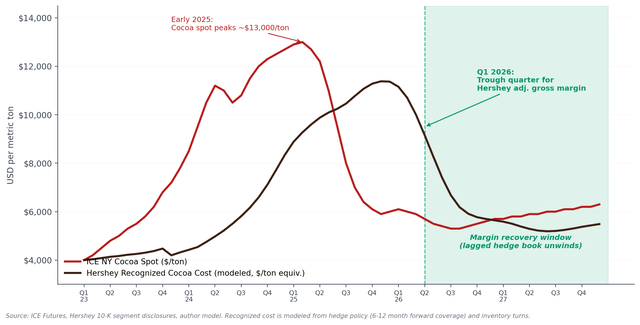
The forensic conclusion is straightforward. The cocoa narrative as it sits in consensus models reflects 2024 spot prices, not the hedge book Hershey is operating off of in 2026–2027. The market is paying for a backward-looking input cost that the lag mechanism has already rendered obsolete.
Forensic #2: The GLP-1 Misframing — Chocolate Is Not Salty Snacks
The biggest misnomer impacting demand on Hershey's multiple has been that GLP-1 weight-loss drugs will have a uniform effect across all indulgent food groups. This is the consensus framing of PepsiCo, Mondelez, General Mills, Kraft Heinz — and Hershey. The issue is that in December 2025, Numerator's 150,000 household panel was used by researchers at Cornell in the peer-reviewed Journal of Marketing Research to publish the most rigorous empirical study on the issue that the market has not priced.
The finding, verbatim from the published study:
"Spending in most product categories follows the same pattern [declining post-adoption], with the exception of chocolate and candy, where we see increases relative to baseline."
The same Cornell research discovered that GLP-1 users have an average 5.3% (8.2% among higher-income households) decrease in total grocery expenditure, and there was a 10.1% decrease in savory snack expenditure, which was the most affected category. The price of sweet bakery products decreased by 5–10%, as did that of cookies, soft drinks and ice cream. There's only one indulgent category that goes up: chocolate and candy. Those who trade-up to premium chocolate are the highest income households, and GLP-1 users are mainly high-income households, as separately confirmed by Lindt & Sprüngli in its consumer data.
Why Chocolate is different. There are three behavioral ways to distinguish between the two categories: confection and those that decline. Chocolate is eaten in mini bites of really small calories to begin with — a single Hershey's Kiss is about 22 calories, a Reese's Cup is about 80. They're a much better fit for a GLP-1 user's compressed daily calorie allowance than a bag of chips or sleeve of cookies. Second, chocolate is not appetite motivated, but rather emotionally and occasion driven (gifts, seasonal, social) and therefore is less sensitive to appetite suppression. Third, GLP-1 users often find that they have a preference for sweet over savory during the period in which they are taking GLP-1 because the drug suppresses appetite, which is what Hershey CEO Kirk Tanner specifically noted when he revealed during the Q1 2026 call that gum and mint sales are increasing among GLP-1 users.
The arithmetic. If consensus estimates are around a 5–7% structural demand loss to Hershey's confection business due to the risk of GLP-1 (a reasonable guess based on the peer multiples), and the category impact is estimated at flat to positive, then the implied earnings power on the confection business will be understated by about 8–12%. At the $792M segment income in Q1 alone (which annualizes to ~$3.0B+ for FY2026), the misframing amounts to approximately $0.30–$0.50 of EPS that consensus is implying away as a risk that the data has failed to support.
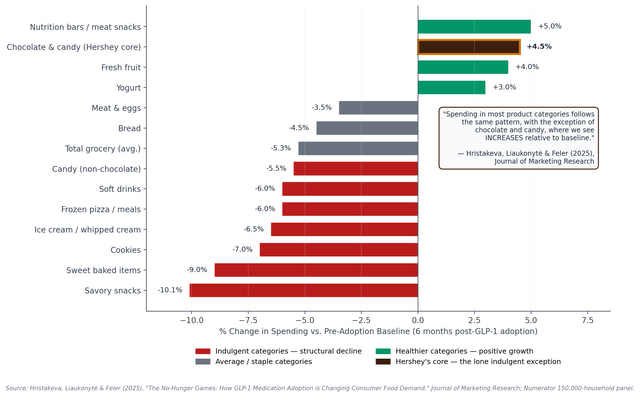
The forensic verdict: the GLP-1 discount being imposed on Hershey is from the analysis of the categories that are actually subject to structural pressure. It is not supported with the data of chocolate and candy in particular. With the evidence indicating Hershey is much more like yogurt than Lay's, it's being priced like it is Lay's, which is a net negative on the GLP-1 transition.
The Asset Nobody Is Modeling: Salty Snacks
The third consensus error is not an error, but rather an omission. The sell-side models view North America Salty Snacks as a small, low-margin side-business to the chocolate business. The print in the Q1/26 said otherwise.
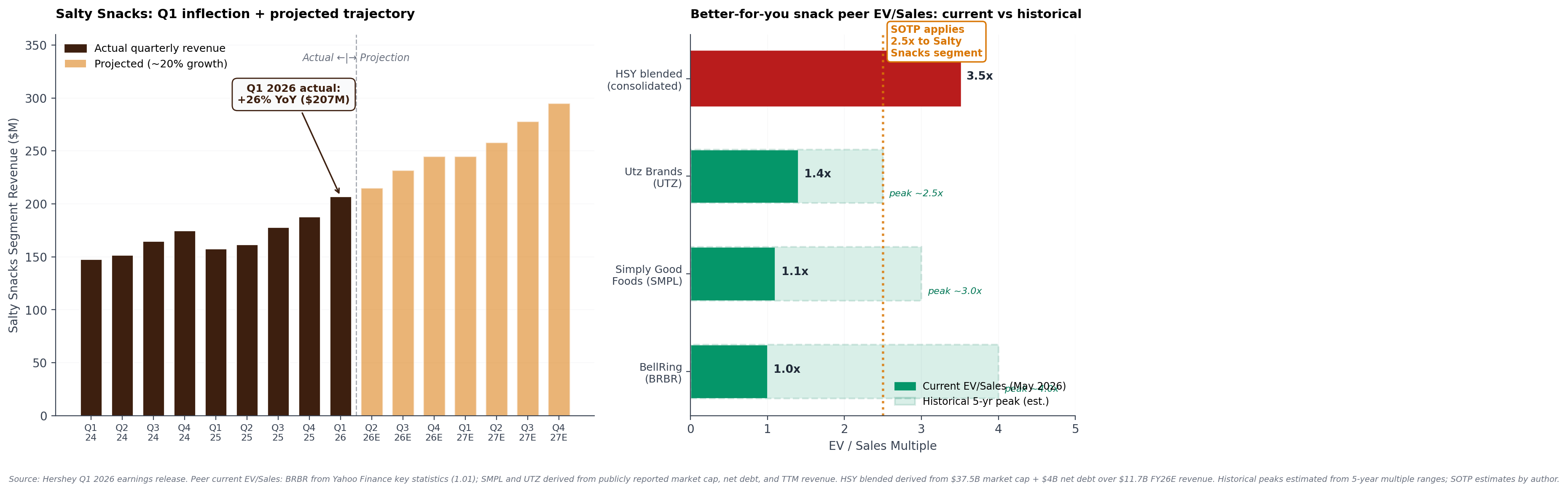
The Salty Snacks segment also gained from a 26% increase in net sales in Q1 2026, as a result of the acquisition of LesserEvil, which already includes brands such as SkinnyPop, Dot's Homestyle Pretzels, Pirate's Booty, and Pretzels Inc. There are two strategic logics. First, these brands tend to be in "better-for-you" snacking – the category where the Cornell data indicates a "trade down" away from conventional savory snack brands (Lay's, Doritos, Cheetos) toward the "better for you" brands. SkinnyPop and LesserEvil sit smack dab in the bar/healthier-snack adjacency, which the Cornell study projected would be a positive spending growth. Second, the distribution and warehousing segment is non-linear when it comes to scale economics; the margin in the segment is in the range of 5–7% while the right number to compare is the one at the $2B+ revenue scale.
The optionality math. The estimated annualised run rate for Salty Snacks at Q1 2026 is $700M+ and increasing at 26%. The segment is just 18% of the total in 2030 at the 20% growth rate over 4 years – not exactly small potatoes. Significantly more important, however, is that the peer EV/Sales of 1.0-1.4x reflect compressed multiples after a reset across the entire snack sector, compared to the 2.5-4.0x EV/Sales average for the 5-year historical period of growth. Hershey's Salty Snacks segment (26% growth in Q1 2026, with the LesserEvil/SkinnyPop platforms) looks a lot more like peers during their past growth phase than peers at current compressed marks. The segment, on its own, is valued at $8-12 per share, based on its current level of growth and the premium and discount applied to the business's peers based on their growth rate, respectively, which is today being averaged into Hershey's blended P/E of ~19.
Sum-Of-The-Parts: What Hershey Is Actually Worth
Hershey uses a single multiple to value consolidated EPS. This approach to value systematically understates the value of a multi-segment platform of far more different growth, margin and category-comp. A sum of the parts approach comes up with a materially different answer.
North America Confectionery – Segment 1. Our FY26 segment income is projected to be around $3.1B with a normalized segment margin of 30%+. Using a 20x EBIT multiple (which is slightly below the 10-year confectioner peer median of ~22x and incorporates a discount for the mature business category and a premium for the brand equity of Reese's, Kisses and Kit Kat and Hershey's chocolate market share of ~35% in the U.S.) results in segment enterprise value of ~$62B. This is the actual compounder, with cash flows that are predictable, dominant share and the category resilience that has been proven by the Cornell GLP-1 data.
Segment 2: North America Salty Snacks. Currently margins are sub-scale, run-rate revenue is estimated at ~$800M in FY2026 and the segment is in a structurally growing better-for-you category. At 2.5x EV/Sales (growth premium vs. current peer set of UTZ, SMPL and BRBR at 1.0-1.4x per SA valuation pages, but at a discount to the 2.5-4.0x historical growth-phase range), the segment's enterprise value comes out to ~$2.0B. The valuation is forward-looking and conservative. Going forward, once the segment is back in growth mode, at 15%+ EBITDA margins, the value should be closer towards the growth phase trading range for the peers, which is $2.5-3.0B.
Segment 3: International. A segment that is currently operating at a lower margin of 5.8% and is investing in market expansion with Q1 2026 revenues of $264M that are up 16%+ year-over-year. Applying 2.5x EV/Sales to the annualized revenue of $1.1B yields around $2.7B. This segment is optionality rather than core valuation, but it is real and growing.
The equity value comes to ~$62.7B (~$66.7B − $4B net debt), or ~$309 per share on 202.84M shares outstanding. After a 20% conglomerate discount for execution risk and the inefficiency of holding-company structures, it comes down to ~$247 per share. That's still 28%+ above the $185-$194 trading range. Using more conservative valuations based on comparable companies — EBIT of 18x for Confection and EV/Sales of 1.5x for Salty Snacks (near current peer valuations) — the floor is above $215.
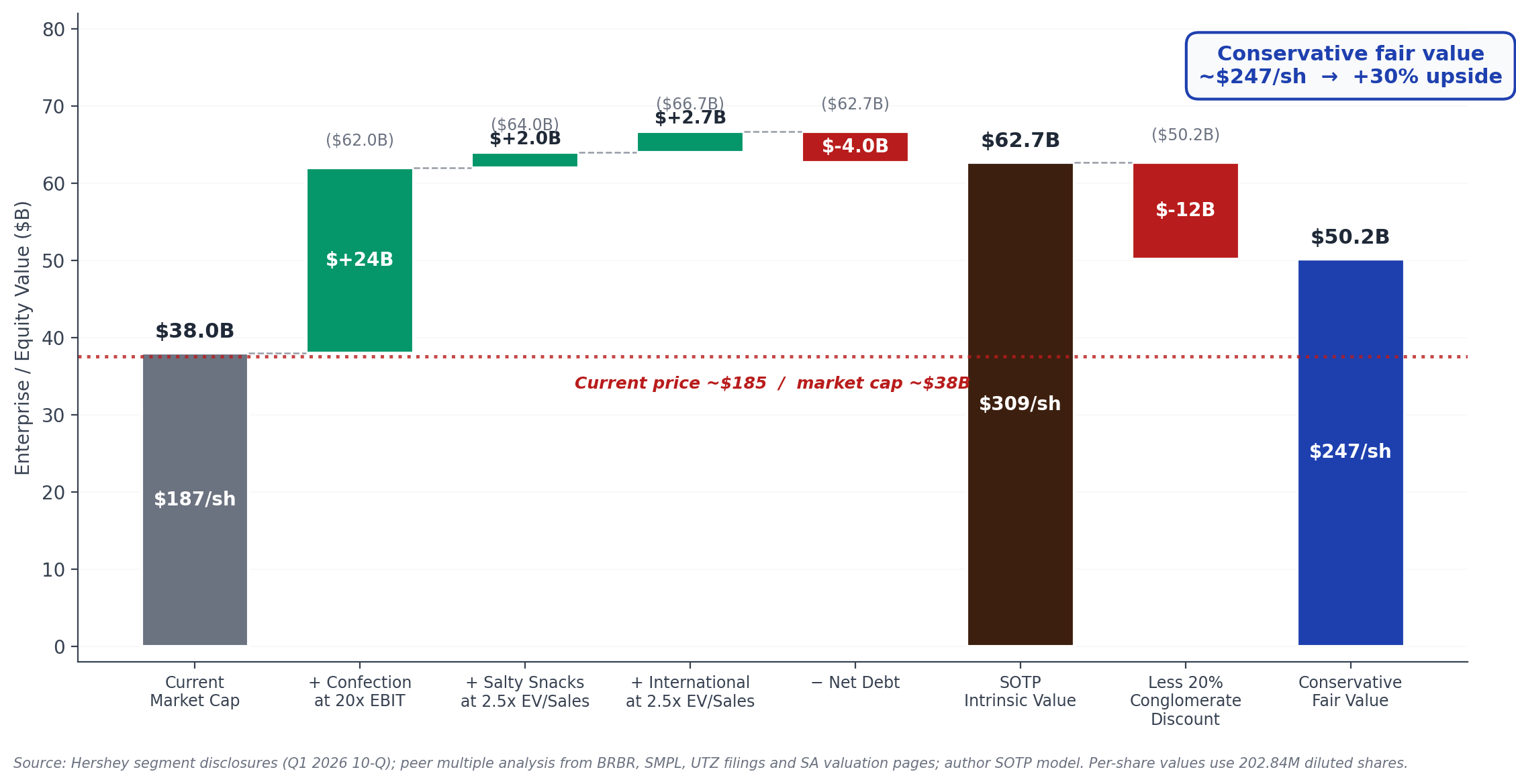
The 12-month price target of $235, which is partially a reflection of the SOTP gap that will get recognised as the cocoa margin recovery prints in the next 2-3 quarters. The multi-year intrinsic value of $275+ is based on the premise that the Salty Snacks segment is more and more appreciated for its own merits and that International scale economics start to drive margin expansion.
The Hershey Trust Wrinkle — A Downside Floor Most Investors Ignore
This is a consideration that is unique to Hershey that is not included in other sell-side models: the Milton Hershey School Trust holds about 80% of the voting power of the company, but a much smaller percentage of the economic interest in the company. The Trust's incentive framework is unique from a typical institutional holder because the Trust does not have a sunset provision — its incentive is to be able to fund the Milton Hershey School in perpetuity. In the case of the Trust it needs a stable and increasing stream of dividends and a stable share price, not a maximum out.
This results in two practical aspects that are relevant to valuation. One is that to date, the Trust has successfully prevented takeover bids, notably from Wrigley in 2002 and Mondelez in 2016, both at valuations well above the market price for the shares. This limits the optionality of M&A, but also provides a very powerful incentive structure for management to continue to deliver dividend continuity (with decades of uninterrupted payments) and operational discipline. Secondly, the income stream the Trust must generate to meet its obligations makes dividend safety on its own more favorable than a payout ratio analysis would indicate. The Trust relies on the Hershey dividend; there is no way that the dividend will be reduced in bad years other than in an existential threat to Hershey.
This is a downside floor that most of the consumer staples stocks don't have for a contrarian buyer. The Trust, a permanent price-insensitive investor, has governance interests and stable cash flow generation. That's one of the reasons behind Hershey's beta of 0.07, which is one of the lowest of all the S&P 500 companies.
Risks: What Would Break The Thesis
There are three specific things that would get me to change my mind about Hershey, and if any of those three happens, I would be explicit about it, because the thesis depends on falsifiable claims.
First, cocoa spot reverses and re-tests 2024 highs. The lag model assumes that the cost of the hedge book will come down in the coming 4–6 quarters. The high-cost inventory cycle would be extended once again by a renewed cocoa supply shock, caused by another West African crop failure or a structural climate change. Monitor the ICCO monthly bulletins relating to the port inflows in Côte d'Ivoire and Ghana; the actual data for 2025/26 marketing year is largely tracking with the previous year; however, if there were to be a meaningful negative deviation in H2 2026, a review of the margin recovery path in 2027 would be warranted.
Second, there is subsequent panel data that reverses the Cornell GLP-1 finding. The current evidence comes from one peer-reviewed study that had a sample of 2,623 households using GLP-1. The GLP-1 misframing thesis becomes weaker if a future study with a larger sample and longer time horizon confirms that consumption of chocolate and candy moves towards the other indulgent categories over time. The chocolate-plus finding is by far the most important individual data point in this article and needs to be further tested empirically.
Third, Salty Snacks' growth slows down considerably. The LesserEvil acquisition has a large impact, as it contributes ~2 points to consolidated growth in Q1. Excluding M&A, organic growth was solid but less aggressive. If Salty Snacks growth slows to less than 8–10% over the next two quarters, the optionality case is weakened, and the segment is not as big a contributor to SOTP as the above framework suggests.
Two potential risks worth highlighting: the benefits to SNAP that are set to change in the latter half of 2026 could create an incremental volume air-pocket in lower-income chocolate consumption (management has conservatively modeled this into guidance) and tariff exposure on imported cocoa products is incremental but quantified to be less than 100 bps of gross margin in current implementation.
Conclusion and Investment Recommendation
Hershey is an unusual cross of three independent analytical signals (all pointing positive). The mechanical and accounting margin tailwind from the cocoa lag is already beginning to inflect in Q2 2026 and will ramp up in 2027. An empirical analysis of the chocolate category also does not indicate that GLP-1 is a major driver of multiple compression for the consumer staples sector as a whole, and the peer-reviewed Cornell data indicates that it is actually a beneficiary of GLP-1, not a victim. The Salty Snacks segment is growing at 26% and is structurally under-weighted in all of the consensus models I've discussed and is not defensible as a multiple discount as the segment expands. All three drivers are individually testable and each will print over the next two to four quarters in a manner that will provide distinct and testable milestones for the thesis to be validated or falsified.
The dividend case stands alone and is quite convincing in itself: decades of uninterrupted dividend payments, a forward yield of 3.1% near a 15-year high, a payout ratio that's still quite conservative relative to guided FY2026 earnings (expected to be ~$8.42), and a permanent controlling shareholder that's both price- and dividend-sensitive in the Milton Hershey School Trust. Today a long position in Hershey is buying the long-duration income compounder at a multi-year valuation discount with three independent catalysts as free options on top. Rating: BUY. 12-month price target: $235. Multi-year intrinsic value: $275+.

Sandeep Gupta
Independent equity research analyst publishing forensic theses on US-listed stocks. MBA, Politecnico di Milano (Milan, Italy).
Get new research in your inbox
Subscribe to receive forensic equity research the moment it's published. Free, no spam.
Related Research
 GIS
GIS General Mills Beat Estimates By 16% But The Market Saw Only The Impairment — The $3B Cost Program Is Being Ignored (GIS)
 KHC
KHC Kraft Heinz's 7% Yield Is Priced For A Dividend Cut The Cash Flow Doesn't Support (KHC)
 CAG
CAG
Discussion
Be the first to comment.